Advanced Concrete Crushing and Sorting for On-Site Reuse
Advanced Concrete Crushing and Sorting for On-Site Reuse
In 2024, the EPA updated its construction and demolition debris material data to reflect that 95% recovery rates for concrete are now achievable in well-managed demolition projects — a benchmark that was considered aspirational as recently as a decade ago (EPA C&D Debris Data). For stadium demolition projects, where a single structure may generate 50,000 to 150,000 tons of concrete rubble, the difference between a 60% and 95% concrete recovery rate is not just an environmental metric — it is a material value difference of millions of dollars, and a landfill cost avoidance that can determine whether a project meets its waste diversion targets.
Advanced concrete crushing sorting on-site reuse demolition is the discipline that bridges the gap between demolition-generated rubble and market-ready recycled concrete aggregate arena teardown demands. Getting it right requires mobile crusher selection, contamination control, grade separation, and sequencing that integrates the on-site concrete processing stadium deconstruction workflow with the structural demolition plan — not as an afterthought, but as a parallel operational stream with its own schedule, equipment, and space requirements.
Why On-Site Crushing Outperforms Off-Site Processing for Stadiums
Concrete recycling can be performed off-site — the material is hauled to a fixed processing plant, crushed and sorted, and the aggregate is returned to market from the plant location (Wikipedia Concrete Recycling). For stadium demolition, off-site processing has two significant disadvantages.
First, haul cost. A 70,000-seat stadium may generate 100,000+ tons of concrete rubble. At $20-35 per ton for haul-and-dump, the transport cost alone exceeds $2 million before any processing fee is added. On-site crushing eliminates most of this cost — the processed aggregate is either reused on-site as sub-base material for the new development or loaded directly from the crushing plant to final destination without an intermediate haul.
Second, contamination control. Stadium concrete rubble contains embedded rebar, post-tensioning strands, formwork hardware, and occasional non-structural contamination from asbestos-containing joint fillers or lead-containing paints. When contaminated rubble is hauled to an off-site plant, any contamination that was not separated on-site contaminates the off-site facility's product stream. On-site crushing allows contamination to be managed at source — separating the problematic material before it enters the crusher, rather than after.
The EPA's sustainable management of construction and demolition materials guidance identifies on-site concrete processing as the preferred strategy for projects generating more than 5,000 tons of concrete rubble, precisely because of the contamination control and haul cost advantages (EPA Sustainable Management C&D).
Mobile Crusher Stadium Demolition Workflow
The mobile crusher stadium demolition workflow has four sequential stages, each with its own quality control requirement:
Primary separation. Before concrete enters the crusher, all embedded steel — rebar, post-tensioning strands, embedded anchors — must be removed by hand or by magnet-equipped sorting equipment. This is the single most important quality control step in the entire on-site process. Steel contamination in the crusher reduces throughput, damages crusher wear parts, and degrades the aggregate product. Hand separation of steel from the demolition face — where hydraulic shears cut reinforcement at the point of structural removal — is more effective than attempting to remove embedded steel from a pile of mixed rubble. Coordinating this step with the steel recycling logistics plan ensures that separated steel goes directly to the right-grade stockpile rather than accumulating as unsorted scrap around the crusher circuit.
Primary crushing. The demolition-scale rubble — sections up to 500 mm — is reduced to 150-200 mm primary aggregate in a jaw crusher. Primary aggregate is suitable for unbound sub-base fill but has not yet been graded for structural applications.
Secondary crushing and grading. Primary aggregate passes through a cone or impact crusher, reducing it to specified aggregate sizes — typically 0-40 mm for sub-base, 10-20 mm for road base, and 4-10 mm for drainage fill. Vibrating screens separate the aggregate into grade fractions immediately after the secondary crusher. The grade separation step is what converts undifferentiated rubble into market-ready recycled concrete aggregate (ScienceDirect Recycled Concrete Aggregate Topics).
Contaminant removal. Final aggregate passes through a water wash or air classifier to remove fines, dust, and any residual light contamination. The Metso C&D waste recycling framework identifies this final cleaning step as the difference between recycled aggregate that qualifies for structural concrete applications and aggregate that is limited to sub-base use — with corresponding differences in market price (Metso C&D Waste Recycling).
Concrete Rubble Grading Demolition Site: Specifications for Structural Reuse
Not all recycled concrete aggregate is equal, and the grading specifications that govern structural reuse are more demanding than those for sub-base fill. Research on recycled aggregate structural concrete has established that concrete made with properly processed recycled aggregate can achieve 85-95% of the compressive strength of equivalent virgin aggregate concrete — but only when the recycled aggregate meets specific requirements for maximum attached mortar content, absorption rate, and particle size distribution (PMC Recycled Aggregates Structural Concrete).
For on-site concrete processing in stadium deconstruction, meeting structural-grade aggregate specifications requires:
Selective crushing by source zone. Concrete from different parts of a stadium structure has different original design strength, aggregate type, and contamination profile. High-strength post-tensioned concrete from grandstand rakers has different crushing characteristics than lightly reinforced concourse slabs. Processing these sources separately — and testing the aggregate from each separately — allows teams to designate the highest-quality sources for structural aggregate production and direct lower-quality sources to sub-base fill.
Steel removal rate monitoring. The steel content of recycled concrete aggregate is measured by weight as an indicator of primary separation effectiveness. Most structural aggregate specifications set a maximum steel content of 0.5-1.0% by weight. Exceeding this threshold requires the batch to be reprocessed through a magnetic separator before it can be released for structural use.
Absorption testing. Recycled aggregate absorbs water at a higher rate than virgin aggregate due to attached mortar. Concrete mix designs using recycled aggregate must account for this higher absorption rate to achieve the target water-cement ratio — a step that requires laboratory testing of the recycled aggregate before the mix design is finalized.
Integrating the Concrete Processing Stream with the Demolition Score
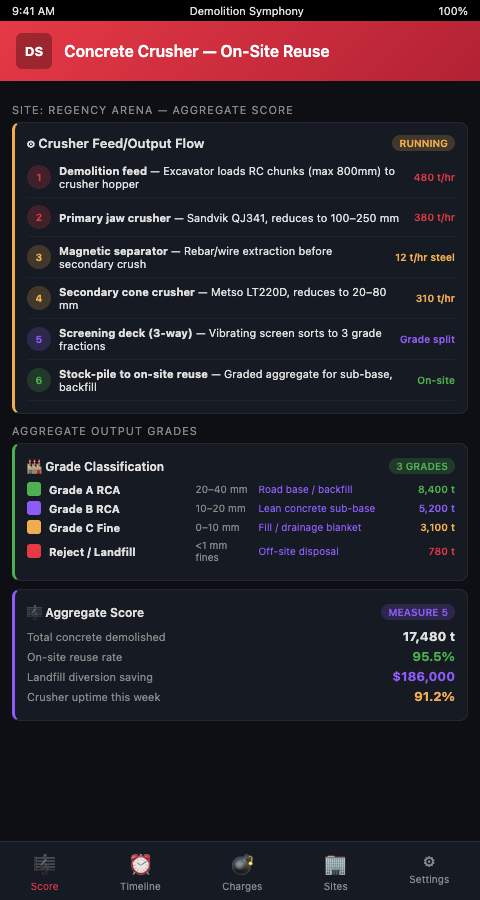
In the Demolition Symphony Planner, the concrete crushing and sorting workflow is notated as a Material Stream Sorting Cadence track in the demolition score, running in parallel with the structural removal track. Each structural removal measure generates a concrete rubble volume — specified in the score — that the crushing workflow must process before the next structural removal can begin. If the crusher is behind schedule, the score flags the delay at the next structural phase gate, preventing the demolition from outpacing the on-site processing capacity.
This integration prevents the most common on-site concrete processing failure: a rubble stockpile that grows faster than it can be processed, eventually blocking access for demolition equipment and forcing a site shutdown that costs more to resolve than the crusher backlog would have cost to prevent.
The seating removal care parallel is equally relevant here: just as seating must be removed before bulk grandstand demolition to preserve its salvage value, concrete rubble must be sorted before crushing to preserve the recycled aggregate's grade quality. Both operations share the same sequencing logic — the preparatory step must be scored as a predecessor to the bulk operation, not a concurrent activity.
For teams managing heavy machinery extraction in parallel with concrete processing, the space allocation challenge is identical: mobile crushers, screening plants, and aggregate stockpile areas require significant site area that must be planned alongside equipment extraction corridors, not allocated from whatever space remains after everything else is placed.
Stadium demolition teams building on-site concrete processing workflows for large venue projects can Score Your Stadium Teardown with Demolition Symphony Planner — the platform that treats concrete crushing and sorting as a first-class operation in the demolition score, with its own timeline, capacity tracking, and phase gates integrated directly into the structural sequencing that drives the entire project. Get started with an on-site crushing workflow that prevents rubble backlog from stalling your demolition front before the first structural bay is broken.