Managing Seating Removal at Scale Without Damaging Substructure
When Controlled Demolition, Inc. tackled the West Stands at Kyle Field (Texas A&M University), the sequencing challenge wasn't the grandstand structure itself — it was the 27,000 attached seats whose anchor bolts penetrated into the concrete risers that supported the upper-tier load path. Remove the seats incorrectly and the riser sustains cracking damage that must be repaired before the next demolition phase can proceed safely. Remove them correctly and the risers remain structural assets that can be demolished on schedule without remediation delays.
Stadium seating removal at scale is a substructure management problem as much as a logistics one. With venues holding 40,000 to over 100,000 seats, the extraction workflow must be fast enough to clear the bowl in days, not weeks — yet precise enough to avoid the riser damage that turns a straightforward demolition phase into a concrete repair project.
Why Bulk Seat Extraction Damages Substructure
Concrete riser seating deconstruction fails predictably when crews apply impact extraction tools — rotary hammers, jackhammers, or pneumatic chisels — to anchor bolts that are torqued into riser nosings. The torque transfers vibration through the riser section, initiating micro-fractures at the nosing edge that propagate inward under repeated impact. A stadium bowl that sustains nosing fractures across 20% of its risers requires structural assessment before heavy demolition equipment can operate on the upper tiers — adding days and engineering fees to a phase that should have been straightforward.
Arena seat extraction substructure protection is complicated by three factors unique to large venues. First, seat anchors vary across the bowl because renovation cycles over a stadium's 40–60-year life introduced multiple anchor systems — original cast-in-place bolts, retrofit post-installed anchors, and replacement hardware that may not match the original torque specification. Second, concrete risers deteriorate differently at different elevations: lower bowl risers accumulate moisture from field operations, while upper bowl risers sustain more UV degradation and freeze-thaw cycling.
Third, Leadcom Seating research noting that refurbishment is 30–60% more economical than replacement means some seats in a mixed-condition bowl may be re-sellable — which creates an extraction workflow that must preserve a subset of seats in extractable condition while bulk-removing the rest. Preferred Seating's seating renovation documentation confirms that seat frames can be unbolted without jackhammers or concrete damage when proper methods are followed — the extraction protocol must specify these methods by anchor type.
The Demolition Symphony Score for Seat Removal
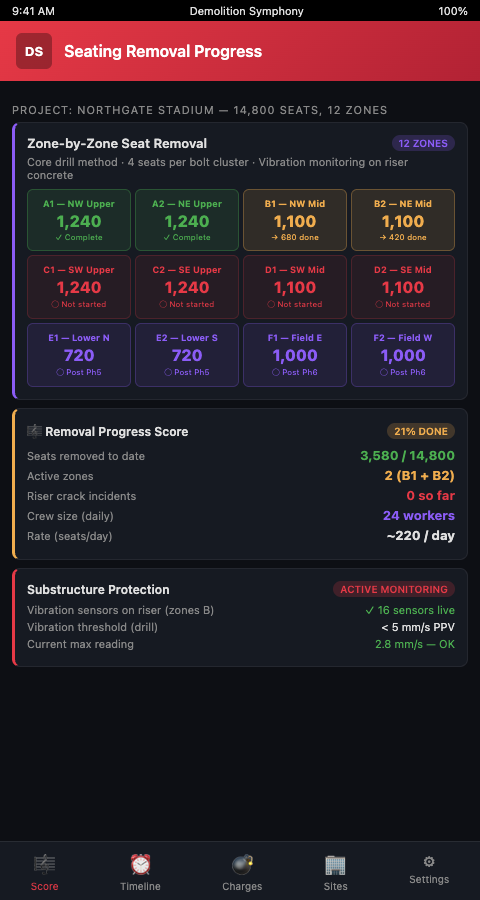
Demolition Symphony Planner maps stadium bowl seat removal workflow as a scored sequence: every salvage window, recycling stream, and structural cut becomes musical notation on a visual demolition score, and the seating removal phase is notated as a series of overlapping measures with clearly defined rests where substructure inspection occurs. The visual score makes the extraction workflow visible across the project team — from the seat removal contractor to the structural engineer monitoring riser condition.
The framework stages extraction across four movements.
Movement 1 — Condition Survey and Anchor Mapping. Before any seat is removed, the bowl is surveyed by quadrant for anchor type, concrete condition, and seat salvageability. Demolition Symphony Planner logs the survey results as a zone-by-zone annotation on the bowl plan, flagging high-risk nosing locations where impact extraction is prohibited and identifying salvageable seat sections that require gentler extraction protocols.
Movement 2 — Zone Sequencing. Extraction proceeds from upper tiers downward — not because upper seats are less valuable, but because upper-tier access requires scaffolding or man-lifts that must be positioned before lower-tier extraction generates debris that blocks access routes. ScienceDirect research on recovering building elements documents that top-down extraction sequencing reduces riser damage rates by limiting the vibration transmission that accumulates when crews work above previously impacted sections. OSHA demolition standards additionally require top-down removal and structural member retention until above floors are cleared — reinforcing the downward sequencing logic from a regulatory standpoint.
Movement 3 — Anchor Extraction Protocol by Type. Cast-in-place bolts are cut flush with an oscillating multi-tool rather than extracted — the cut is faster and eliminates impact vibration entirely. Post-installed expansion anchors are extracted with a hydraulic puller that applies controlled tension rather than impact force. Salvageable seat sections are extracted with a battery-powered torque multiplier set to the manufacturer's removal specification. Each protocol is logged in the demolition score with the zone and anchor type to which it applies.
Movement 4 — Riser Inspection Gates. After each quadrant is cleared, a brief structural inspection gate verifies riser nosing integrity before the next extraction team moves in. The bowl stability analysis framework informs where inspection gates must occur relative to active load paths — ensuring that a partially cleared bowl maintains structural integrity as the extraction front moves around the circumference.
Advanced Tactics for Large-Scale Bowl Seat Removal
Three tactics separate stadium seat removal projects that finish on schedule from those that halt for remediation.
Run extraction crews in non-adjacent quadrants simultaneously. Running two extraction crews in adjacent quadrants doubles the vibration input to shared risers. Running crews in opposite quadrants — northeast and southwest simultaneously, then northwest and southeast — keeps vibration sources separated by the full bowl diameter, eliminating cumulative nosing stress. Demolition Symphony Planner's parallel-track scoring visualizes which quadrants are active simultaneously and flags adjacency conflicts before they reach the field.
Stage debris removal to protect substructure access. Seat hardware — bolts, washers, plastic caps — generates significant ground-level debris that blocks inspection access to lower nosings. Scheduling a debris sweep after every 500 seats extracted keeps inspection lanes clear and prevents crews from stepping on hardware that could roll and cause falls on riser surfaces. OSHA demolition standards require maintained safe access throughout all phases; building that requirement into the score as a mandatory rest prevents the safety shortcuts that generate citations on large-scale extraction projects.
Coordinate with the cantilever removal order plan before upper-tier extraction begins. Cantilevered upper-tier sections carry live load differently once lower-tier structural members begin their own removal sequence. The seat extraction score must be cross-referenced against the structural demolition sequence to ensure that upper-tier seat removal doesn't occur during a phase when the cantilever's load path is already being modified below. Temporary shoring logic — as applied in bridge deconstruction temporary shoring — sometimes applies to upper-tier grandstand sections during concurrent bowl and structural demolition.
Delivering the Bowl Clearance on Schedule
The Rigo Demolition stadium guide identifies seat removal sequencing as one of the three most commonly underestimated phases in large-venue teardown planning. Teams that treat stadium seating removal at scale as a brute-force labor problem — more crews, more impact tools, faster — reliably damage substructure and absorb the schedule hit of remediation. Teams that score the extraction as a structured sequence with anchor-specific protocols, quadrant coordination, and inspection gates deliver bowl clearance on time without riser repair delays.
Demolition Symphony Planner exports zone-specific extraction work orders that include anchor type, protocol assignment, and inspection gate requirements in field-readable format. Every crew member operating in the bowl works from the same score — same protocols, same gate requirements, same debris management cadence. Score Your Stadium Teardown with Demolition Symphony Planner and sequence the bowl clearance before the first extraction crew mobilizes. Get started with a seat extraction score that assigns anchor-specific protocols, quadrant sequencing, and inspection gates across every tier of the venue bowl.