Building Your First Implosion Score: A Beginner's Guide
What New Coordinators Get Wrong Before They Start
OSHA's preparatory operations standard 29 CFR 1926.850 mandates an engineering survey before any demolition begins — and it is the most cited standard in the demolition industry. But the survey is only the first step. What the regulation doesn't prescribe is how to translate a structural engineering survey into a blast plan that every team member can read, review, and execute without misinterpretation.
Most coordinators building their first implosion score start with what they have: structural drawings from the original construction permit, a column schedule, and a floor plan. That's a reasonable starting point. The problem begins when the charge placement notes live in one document, the delay network lives in another, and the safety zone calculations live in a third. No one reviewer can verify the full sequence without reconciling three separate documents that were never designed to talk to each other.
This fragmented approach produces a specific class of error: the plan is internally consistent within each document, but inconsistent across documents. A charge placement map that lists all columns correctly becomes dangerous when the delay network assigns intervals based on an outdated column numbering convention that doesn't match the structural drawings. This type of error is invisible until the detonation network is physically installed — which is exactly when you cannot correct it.
Building the Score: From Survey to Composition
The IJIRSET implosion technology study describes the correct planning pipeline: structural analysis, charge mapping, delay sequencing, and safety coordination. These aren't sequential phases that you complete and hand off — they're interdependent layers of a single score that must be developed in parallel.
Think of the implosion score like a musical composition. The structural analysis defines the time signature — how many beats (columns) per measure (floor), how many measures (floors) in the piece, and which measures contain unusual structural notes (post-tensioned slabs, mechanical floors, transfer beams). The charge mapping defines the melody — which structural members get explosive notes, at what weight, and in what configuration. The delay sequencing defines the rhythm — the intervals between notes that turn a collection of individual detonations into a coherent progression.
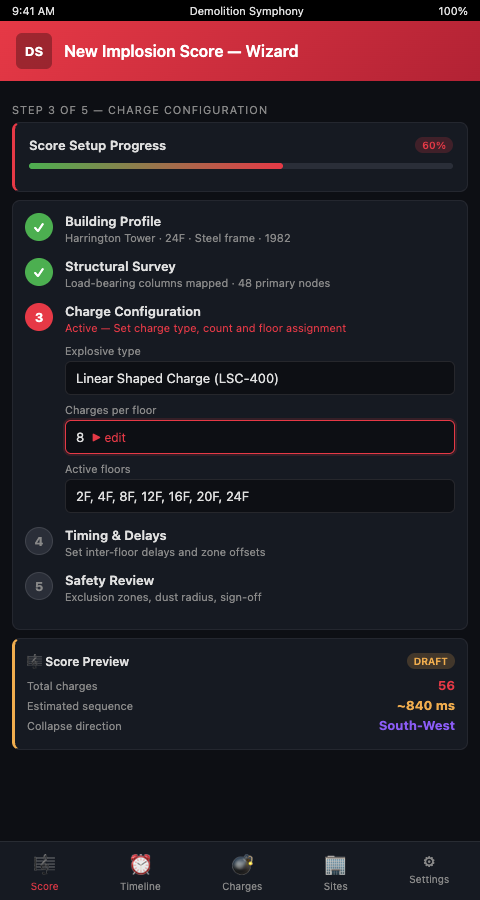
The Demolition Symphony Planner supports this composition workflow by letting coordinators build all three layers in the same visual interface. The structural analysis layer shows the column grid and element index values. The charge placement layer overlays the charge type and weight on each column. The delay sequencing layer adds timing intervals as spacing between notes. All three layers are always visible simultaneously, which means any change to one layer immediately shows its effect on the others.
Start with the HowStuffWorks overview of building implosion for the foundational physics — particularly the explanation of how progressive collapse works and why the sequence of column removal determines collapse direction. With that physics understanding in place, the structural drawings become interpretable: you're not just reading column schedules, you're identifying which columns are the load-path keystones that the sequence must address first.
For the delay sequencing layer, millisecond timing covers the calculation methods in detail — including how to derive optimal delay windows from floor height, column spacing, and neighboring structure resonance frequencies.
The CDI buildings service workflow shows what the planning pipeline looks like from a contractor perspective: assessment, charge design, sequencing, and safety coordination are all interlinked. No phase is final until all phases are consistent.
A practical step-by-step order for building a first implosion score: (1) Collect the structural drawings and the structural engineer's column schedule. Identify every load-bearing column at every floor level. (2) Mark the key element index value for each column if the structural engineer has provided one; otherwise, flag columns at structural discontinuities (setbacks, transfer floors, moment frame zones) for priority review. (3) Open the Demolition Symphony Planner and create a floor track for each floor, from lowest to highest. (4) Place a note at each column position on each floor track. The note carries the column identifier and, eventually, the charge specification.
From that foundation, the sequence work begins: (5) Assign a preliminary delay interval between each floor, using the floor height and the free-fall physics formula as the starting point. (6) Review the assembled score for transition zones — floor height changes, column grid changes, moment frame zones — and adjust the delay intervals and charge specifications for each. (7) Validate the full sequence in blast simulation software. (8) Submit to the structural engineer for review, with the score as the primary reference document.
This eight-step workflow is the core of every first building implosion plan. Steps 1-4 require a day per 10 floors for a well-documented building; steps 5-7 require specialist time that varies by building complexity. The scoring format keeps all eight steps in a single traceable document rather than distributed across disconnected files.
Advanced Score Construction
Handling as-built discrepancies. Original construction drawings rarely match what was actually built. Fire-stopping modifications, post-construction reinforcements, and tenant-driven structural changes all alter the column schedule. Before the charge placement layer can be finalized, the as-built condition must be verified against the drawings. On a first implosion score, this verification step is consistently underestimated. Budget one site-inspection day per 10 floors of building height specifically for as-built column verification.
Pre-visualization tools. ResearchGate's simulation study documents an early computational system that pre-visualized demolition plans by examining blast location, size, sequence, and delay time together. Modern equivalents — including JKSimBlast, documented in E&MJ's software survey — allow coordinators to replay detonation sequences before any charge is placed. This replay step should be mandatory for first-time scores and standard practice for experienced coordinators on unfamiliar building types.
The safety coordination layer. The exclusion zone boundary must be derived from the charge placement map and delay sequence, not set as a fixed radius based on building height alone. When building your first implosion score, calculate the debris projection energy for the lowest floor detonation — which typically generates the highest lateral fragment velocity — and use that calculation to set the inner exclusion zone. Add a buffer between the predicted debris boundary and the formal exclusion perimeter as the UK guidance recommends.
When to add a decommissioning scoring layer. For buildings with active mechanical, electrical, or hazardous material systems that require phased disconnection before the explosive work begins, the implosion score needs a pre-demolition phase track. The decommissioning scoring post covers how to structure these multi-phase scores for complex building types — the methodology applies directly to high-rise implosion projects where utility disconnection and hazmat removal precede the blast sequence.
Regulatory submission format. Several US and UK jurisdictions now require a formatted blast plan document — not just a signed engineer's letter — as part of the demolition permit application. For first-time implosion coordinators navigating this requirement, the visual score format produced by the Demolition Symphony Planner is specifically designed to be legible to building department engineers and municipal safety reviewers who are not blast specialists. Tabs for structural analysis, charge placement, delay sequencing, and safety zones make the document auditable without requiring the reviewer to interpret blast engineering notation from scratch. This reduces permit review cycle time on first-submission applications.
Learning from the score review. On a first implosion score, the structural engineer's review of the charge placement and delay sequencing layers will almost always return comments. These comments are the most valuable learning opportunity available. A comment identifying an incorrect charge weight on a post-tensioned column reveals a gap in the coordinator's structural assessment workflow. A comment flagging an anomalous delay interval at floor 14 reveals a misapplication of the floor height formula. Treating the score as a review document — rather than a final deliverable — and iterating through structural engineer comments builds the competency that makes second and third implosion scores faster and more accurate.
For the visual sequencing framework that connects charge placement to delay timing in a single readable format, blast choreography covers how the visual planning layer works for tower demolition and how coordinators use it to communicate the sequence to structural engineers and safety officers simultaneously.
Build Your First Score With the Right Tools
Every first implosion score has a moment where the planner realizes they've been building the wrong document — the charge placement map that was developed over two weeks doesn't align with the structural engineer's delay sequence review because the two documents used different column numbering conventions. The visual demolition planning tool approach in the Demolition Symphony Planner eliminates this class of error by keeping all layers — structural analysis, charge placement, delay sequencing, and safety coordination — in the same numbering system from the start. There is no translation step between the charge placement document and the delay sequence document because they are the same document.
For first-time coordinators approaching the implosion planning software tutorial aspect of the workflow, the most important early decision is the floor numbering and column labeling convention. Whatever convention you adopt in the Demolition Symphony Planner's initial score setup becomes the reference system for every downstream document: the charge specification list, the delay network diagram, the field installation sheet, and the permit submission report. Establishing this convention before any charges are specified prevents the numbering mismatch that causes late-stage reconciliation work.
If you're coordinating your first high-rise implosion and building the blast plan from scratch, the visual score format in the Demolition Symphony Planner reduces the risk of inter-document inconsistency that causes most first-implosion planning errors. Urban high-rise implosion coordinators on the waitlist get priority access to the beginner's score template — a pre-configured visual score layout that starts from the structural survey and walks through every layer from charge mapping to safety coordination. Join the waitlist and have your first complete implosion score ready for structural engineer review before the demolition permit is issued.