Understanding Millisecond Timing in High-Rise Implosion
When 50 Milliseconds Costs Millions
The Kochi high-rise implosion monitoring study is one of the most precise real-world records of millisecond delay sequencing under urban conditions. Vibration sensors at multiple radial distances confirmed that the delay timing — not charge weight — was the primary variable keeping peak particle velocity within safe limits for neighboring structures. Push the intervals too tight and waveforms constructively interfere, amplifying ground vibration. Space them too wide and the progressive collapse loses directionality before lower floors have fully dropped.
These are not theoretical margins. An urban implosion where neighboring structure damage is documented triggers regulatory review, potential litigation, and—in some jurisdictions—criminal liability for the licensed blaster of record. Millisecond timing accuracy is what separates a documented success from a documented failure.
Yet the standard planning workflow in most implosion contracts still involves timing networks reviewed in tabular form — a spreadsheet column of delay values with no visual representation of how those intervals interact across the building geometry. Coordinators check for arithmetic errors. They rarely catch interaction errors: two delay groups on adjacent floor lines whose combined timing creates a destructive vibration node at a neighboring structure's foundation frequency. Achieving detonation sequence millisecond precision across 200-plus initiators requires not just precise detonation delay intervals, but a review format that exposes inter-chain timing conflicts before the network is wired.
The Timing Score: Composing Delays as a Visual Sequence
Millisecond timing in high-rise implosion is fundamentally a composition problem. Each floor is a measure. Each column group within that floor is a beat. The interval between beats determines whether the collapse progression sounds like a controlled descending phrase or a discordant chord that throws debris laterally.
Electronic detonator research from Frontiers in Earth Science establishes that modern electronic detonators achieve ±0.1 ms accuracy, and that properly sequenced delay intervals can reduce peak particle velocity by up to 50% through destructive waveform interference. This is a precision instrument — but only when the timing sequence itself is designed to exploit it. A poorly spaced sequence with electronic detonators is still a poorly spaced sequence.
The PLOS One study on millisecond-delay controlled blasting derives the optimal delay time calculation: the interval must be long enough for the previous column group to fully collapse before the adjacent group fires, but short enough that the building's upper floors don't begin free-fall before the lower sequence completes. In practice, this means delay windows between 17 ms and 42 ms for standard RC floor heights, with adjustments for steel frame members and variable floor heights.
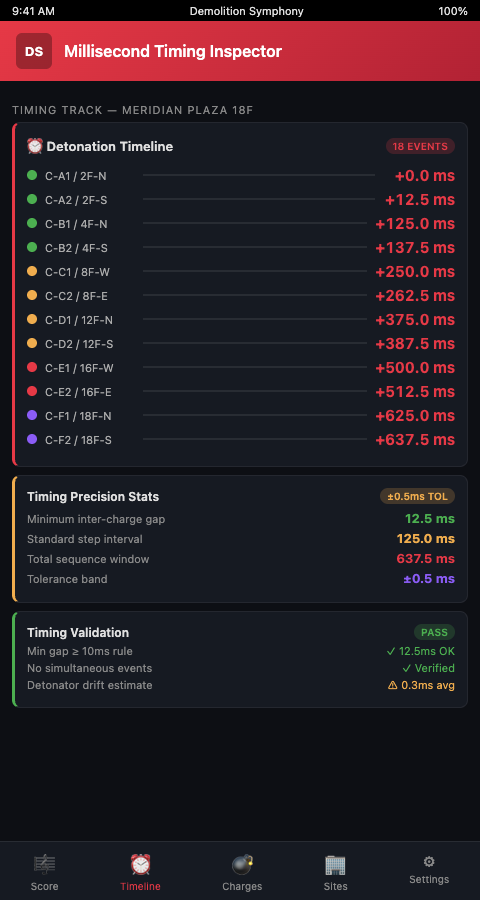
The Demolition Symphony Planner renders this timing logic as a visual score rather than a table. Each column group appears as a note on a floor-level track. Delay intervals appear as the horizontal spacing between notes — wider spacing for longer delays, tighter spacing for rapid sequential groups. A coordinator reviewing the full score for a 35-floor implosion can see at a glance whether the timing ramps evenly from floor 1 to floor 35, or whether there's a timing compression artifact at floors 18-22 that requires attention.
This visual representation also catches a class of error that tabular timing sheets miss entirely: relative timing between parallel delay chains. When a building has two independent detonation networks running simultaneously — east wing and west wing, for instance — the interaction between those networks at their junction point only becomes visible when both timing chains are rendered on the same score. The Demolition Symphony Planner overlays parallel chains in separate color tracks so their intersection points are immediately identifiable.
The delay calculation workflow begins with floor height. For a standard 4-meter office floor and a target of allowing 1 floor height of drop before the adjacent column line fires, the required delay interval is derived from free-fall physics: d = ½gt², so for d = 4 m, t ≈ 0.9 seconds. That 900 ms baseline then gets adjusted for the structural type — steel frame typically requires a shorter interval than RC because column failure via buckling happens faster than RC shatter — and for each floor's specific structural condition. Any floor with a documented structural anomaly (corrosion, pre-existing deformation) gets a conservative interval adjustment.
This per-floor interval calculation is where the musical score metaphor reaches its most practical application. Each measure of the score carries its own time signature — the delay interval for that specific floor — rather than forcing a uniform tempo across a 40-measure composition. A building with uniform 4-meter office floors can use a consistent interval throughout. A building with mechanical floors at floors 10, 20, and 30 has three measures with different time signatures, and the score makes those transitions immediately legible to every reviewer, including the municipal safety authority reviewing the permit submission.
For the practical calculation steps behind deriving per-floor delay intervals for real projects, the Taylor & Francis Delhi case study provides the closest published record of how field engineers converted structural parameters to specific timing windows on a live urban high-rise implosion project.
For coordinators new to implosion scoring, the implosion score basics post covers how to build a complete score from structural drawings, including how to translate delay network diagrams into visual notation.
Advanced Timing Tactics for Urban High-Rise Conditions
Vibration frequency matching. Every adjacent structure has a natural resonant frequency — typically 1-10 Hz for multi-story buildings. If the implosion's sequential detonation interval accidentally matches that frequency, ground vibration amplifies dramatically. The Serene Towers Kochi implosion case documents how detonation interval precision prevented premature ground impact, which would have caused ground-borne vibrations at a frequency dangerous to neighboring towers. Pre-blast vibration surveys should determine neighboring structure resonance frequencies, and the timing sequence should be designed to avoid those frequencies in its firing rhythm.
Mixed detonator networks. Some projects use a hybrid of electric and non-electric detonators due to cost or procurement constraints. Mixed networks have different accuracy tolerances — non-electric detonators have ±2-4 ms accuracy compared to ±0.1 ms for electronic. When a visual timing score includes both network types, coordinators must represent the accuracy tolerance as a shaded window around each note position, not a fixed point. This makes the timing margin of error explicit rather than assumed.
Wind and temperature corrections. Detonator timing is calibrated at standard temperature and pressure. Urban implosions scheduled in winter conditions — below 5°C — require timing adjustments for both the detonator chemistry and the explosive performance. High-wind conditions affect when the dust cloud reaches neighboring structures, which affects how the post-blast exclusion period is calculated. These environmental variables belong in the timing score as conditional annotations.
Software validation. Orica's SHOTPlus platform allows blast designers to simulate full timing sequences and flag problematic delay windows — a validation step that should precede any field implementation. The Demolition Symphony Planner's score format is designed to interface with this validation workflow, so coordinators can move from visual composition to simulation to field execution without reformatting the sequence plan.
Real-time monitoring integration. Millisecond timing accuracy in planning is only valuable if the field execution matches the plan. For urban high-rise implosions, real-time vibration monitoring at radial sensor stations provides immediate confirmation that the detonation sequence fired within designed tolerances. Any sensor reading that exceeds the pre-set threshold triggers a post-blast investigation of the delay network. Building this monitoring protocol into the timing score — specifying sensor positions, threshold values, and response procedures for each radial zone — closes the loop between the planned sequence and the executed sequence. The Kochi monitoring study set the standard for this protocol: six monitoring stations at different radial distances, each assigned a peak particle velocity threshold derived from the neighboring structure's foundation type.
Approval documentation for dense urban sites. Some cities now require the blast timing sequence to be submitted as a formatted document to the building department alongside the demolition permit application. A visual timing score — showing the full delay network for every floor, including the timing of any parallel chains and their junction interactions — satisfies this requirement in a format that a building department engineer can audit without specialized blast software. Producing this document as a byproduct of the scoring workflow, rather than as a separate documentation task, saves 15-20 hours of formatting time on a complex 40-floor project.
For a breakdown of the specific timing errors that have caused documented urban implosion failures — including the Dallas 2020 partial collapse — the timing mistakes post provides a categorized failure analysis with lessons for each error type.
For stadium demolition teams applying millisecond timing to cantilevered grandstand sequences, deconstruction scoring covers how the timing principles adapt when the structural geometry is curved rather than rectilinear.
Calibrate Every Delay Before the First Charge Fires
Urban high-rise implosion coordinators operating in dense city environments — where neighboring structures sit within 50 meters of the blast perimeter — cannot afford to discover timing interaction errors during detonation. The visual score approach in the Demolition Symphony Planner makes the full timing sequence auditable before the licensed blaster signs off on the network design.
Blast timing control tower demolition projects demand that implosion timing accuracy be treated as a design output, not a field variable. Every delay that is set in the office using the visual score is a delay that the field crew does not have to verify under time pressure with the exclusion zone already established. When each millisecond timing high-rise implosion interval is derived, documented, and reviewed in the visual score format, the licensed blaster can confirm the network's accuracy before the arm command — and the regulator has a document they can audit after the shot.
If you're managing implosions in constrained urban sites and your current timing review process relies on tabular delay sheets, join the waitlist for early access to the millisecond delay calibration module built specifically for urban high-rise implosion teams.