Common Mistakes in Urban Implosion Timing
The Seven Mistakes That Keep Appearing in Failure Reports
Controlled Demolition Inc.'s failure case archive is the most comprehensive public record of implosion failure root causes in the industry. Across documented cases, improper sequencing accounts for the majority of incomplete collapse events — not explosive performance failures, not structural assessment errors, but sequencing mistakes that cause the detonation to proceed in the wrong order or at the wrong intervals.
The WHYY report on the Dallas 2020 implosion is the highest-profile recent example: a partial collapse that left substantial portions of the structure standing, requiring a second demolition attempt days later. The cost of secondary demolition, extended exclusion zone maintenance, additional permits, and public relations damage far exceeded the original contract value.
These failures share a pattern: the timing mistake wasn't new or obscure. It was one of seven recurring error types — common urban implosion timing mistakes that experienced engineers encounter repeatedly but don't always have a systematic process for catching during plan review. Implosion failure causes timing errors to cascade: one detonation sequencing error at a lower floor can make the entire sequence above it unfixable once the shot is in progress.
Most urban high-rise implosion plans are reviewed by at least three parties before the permit is issued: the licensed blaster who designed the sequence, the structural engineer who verifies the charge placement, and the safety officer who checks the exclusion zone calculations. Despite this multi-party review, timing mistakes survive to the field in a predictable pattern. The structural engineer focuses on collapse mechanics and may not scrutinize the delay intervals closely. The safety officer focuses on zone boundaries derived from the original sequence and may not re-check them after late sequence changes. The licensed blaster is familiar with their own design and may miss the systematic errors that come from applying familiar patterns to an unfamiliar building type.
The seven mistake categories below are organized not by how serious they are — all seven have produced documented failures — but by when in the planning process they're most catchable. Mistakes 1-4 are catchable during score review before the network design is finalized. Mistakes 5-7 are catchable during the permit review phase. None are catchable during network installation without aborting the planned blast window and incurring substantial cost. Understanding demolition planning mistakes to avoid — and at which review stage each is catchable — is the difference between a seven-minute controlled implosion and a week-long incident investigation. Recognizing implosion timing errors high-rise coordinators most commonly make requires reviewing the sequence not just for arithmetic correctness but for structural logic at every transition zone.
The Seven Timing Mistakes
Mistake 1: Firing the lower floors too early. When lower-floor charges fire before the structural pre-weakening sequence is complete, the upper-floor load redistributes to remaining columns before the progressive collapse develops directional momentum. The result is outward collapse rather than inward collapse, with debris scatter beyond the exclusion zone. This is the most common single mistake in documented partial implosion failures. The fix: the floor-by-floor score must include the pre-weakening completion event for each floor as a mandatory precursor to that floor's detonation timing.
Mistake 2: Uniform delay intervals across variable floor heights. Applying the same millisecond interval between every floor regardless of floor height creates timing gaps at mezzanine and double-height floors. The physics is straightforward: a 7-meter mechanical floor requires a longer delay before the next floor fires than a 3.5-meter office floor. The Kochi vibration monitoring study exposed vibration anomalies during implosion that would otherwise have been attributed to detonator variance — when the actual cause was floor-height-dependent timing gaps in the delay network.
Mistake 3: Ignoring pre-existing structural design errors. Wiley's analysis of RC structures with design mistakes under explosive demolition found that pre-existing structural design mistakes compound timing errors during implosion. A column that was under-designed during original construction will fail under a lower applied charge than the sequence plan assumes. If the sequence was designed assuming a standard failure threshold and the column fails early, the timing relationship to adjacent columns breaks down. The fix: pre-blast structural assessment must include a check for original design deficiencies, not just current deterioration.
Mistake 4: Partial detonation of a column group. When one or more detonators in a column group fail to fire, that group fires as a partial detonation. The structural member is damaged but not severed, creating a residual connection that transmits load on an unintended path. OHSE.ca's demolition implosion analysis documents that a single placement or timing error can cause debris to scatter outward — and that early fuse methods caused partial failures specifically because they lacked the detonator reliability to ensure all charges in a group fired simultaneously. The fix: electronic detonators with verified continuity testing before the blast window.
The millisecond timing post covers the detonator accuracy specifications and continuity testing protocols that reduce partial detonation risk to near-zero on modern projects.
Mistake 5: No inter-chain timing verification. When a building has two independent detonation chains — east wing and west wing, core and perimeter — the interaction between those chains at their junction point creates a timing relationship that exists in neither chain individually. If chain A fires floor 15 at T+2500 ms and chain B fires floor 15 at T+2400 ms, the 100 ms offset between chains at that floor creates an asymmetric collapse front. This mistake is invisible when reviewing each chain independently and only visible when both chains are rendered on the same timing score.
Mistake 6: Vibration-induced neighboring structure damage. ResearchGate's vibration impact study documents structural impact on a neighboring building caused by blast-induced ground vibration exceeding predictions. The timing sequence was designed to minimize vibration, but the delay intervals accidentally produced constructive waveform interference at the neighboring structure's foundation frequency. The fix: vibration wave propagation preview must be part of the timing score review, not a post-blast analysis.
Mistake 7: Late sequence changes without zone recalculation. When the charge configuration changes after the safety zones have been calculated — additional charges on floor 18, for example, due to a discovered post-tensioned slab — the inner exclusion zone boundary changes. If the zone isn't recalculated, the exclusion zone is undersized for the new configuration. This administrative mistake is the most preventable: it requires a linked planning system where charge changes automatically trigger zone recalculation.
Catching Mistakes Before They Reach the Field
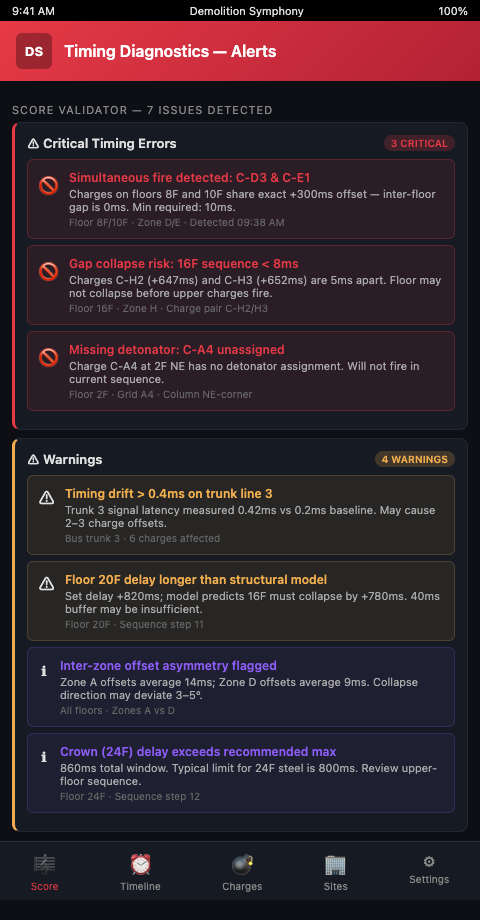
The Demolition Symphony Planner addresses each of these seven mistake types through the visual score format and its integrated validation checks. Pre-weakening completion events are mandatory precursors in the score. Non-standard floor heights are flagged for manual delay interval input. Inter-chain timing interactions are visible when both chains are rendered on the same score. Zone boundaries are linked to charge placement data.
Each of these validation checks works because the visual score format makes the timing relationship explicit rather than implicit. In a tabular delay sheet, Mistake 5 (no inter-chain timing verification) requires the reviewer to mentally construct the timing relationship between two columns of numbers and identify where they interact. In a visual score with both chains rendered on the same layout, the interaction point is a visible crossing of two tracks — immediately identifiable without mental construction. This difference between explicit and implicit representation is why the visual score format catches mistakes that experienced engineers miss in tabular reviews.
The seven-mistake framework also provides a structured briefing tool for implosion project kick-off meetings. Walking the full project team through each mistake category — with the visual score on screen and each mistake type mapped to the score section it affects — ensures that every team member understands the failure modes relevant to their role. The structural engineer understands which structural conditions create Mistake 3 risk. The safety officer understands what triggers a Mistake 7 zone recalculation. The field crew understands why Mistake 4 requires electronic detonator continuity testing before any charge is declared ready to fire.
Orica's SHOTPlus blast design platform provides an additional validation layer: timing sequence replay and problematic delay window flagging. The Demolition Symphony Planner's score format is designed to integrate with this simulation workflow, so coordinators can move from visual composition to simulation validation to field execution without reformatting the sequence plan.
The network redundancy post covers how to design detonation networks that tolerate partial detonation failures — the hardware-level response to Mistake 4 above.
For multi-disciplinary teams where implosion work occurs alongside active hazardous material remediation, the contamination risks post covers the planning overlap between demolition sequencing and hazmat operations that creates an additional category of timing conflict not covered in standard implosion planning guidance.
Audit Your Sequence Against All Seven Mistakes Before Filing the Permit
Urban high-rise implosion coordinators who systematically review their timing sequences against these seven mistake categories before the blast plan is submitted for permit catch the errors that cause partial collapses, neighboring structure damage, and extended exclusion zone costs. The Demolition Symphony Planner's validation checklist maps each mistake type to the relevant layer of the visual score, so the review is structured and auditable rather than dependent on individual reviewer judgment.
Each of the seven mistake categories has a specific review artifact that catches it. Mistake 1 (early lower-floor detonation) is caught by reviewing the pre-weakening completion events in the score before any floor's detonation note is scheduled. Mistake 2 (uniform delays across variable floor heights) is caught by reviewing the floor-height input for each measure and confirming the delay interval is proportional. Mistake 3 (pre-existing structural errors) requires the pre-blast structural assessment to be cross-referenced against the charge specification at each column position — not assumed from the drawings. Mistakes 4 through 7 each have a corresponding score layer that either flags the issue automatically or requires a structured manual review step.
Building this audit into the pre-submission workflow — rather than relying on a final reviewer to catch what the original designer missed — reduces the probability that any single mistake category survives to the permit application. Join the waitlist for urban high-rise implosion coordinators and get access to the seven-mistake timing audit tool when it launches.