5 Contamination Risks When Demolition Overlaps Hazmat Abatement
A 2024 PMC study on mesothelioma incidence from 2006 to 2022 found that construction workers accounted for 13.5% of all mesothelioma cases—the second-highest occupational category after manufacturing. The construction worker cases were disproportionately associated with renovation and demolition activities, not new construction. The exposure vector in nearly every case was asbestos-containing material disturbed during demolition before abatement was complete. These are not historic exposures from the pre-OSHA era. They are ongoing.
The Chemical Safety Board's startup/shutdown digest documents that the majority of hazardous material incidents on industrial sites occur during shutdown, decommissioning, or non-routine activities—precisely the conditions of facility demolition. The hazmat abatement demolition overlap dangers are highest during the transition between abatement and demolition phases, when containment barriers are being removed and demolition equipment is moving in.
Industrial demolition contamination prevention is fundamentally a sequencing problem. The contamination events are not caused by abatement technique failures or demolition equipment operator errors. They are caused by the abatement and demolition voices playing in the same physical space at the same time without adequate separation.
Risk 1: Negative Pressure Failure at Zone Boundaries
Asbestos abatement requires negative pressure containment within the work zone to prevent fiber migration. Brick Industries' negative pressure containment guide specifies that containment must maintain -0.02 to -0.04 inches of water column relative to adjacent spaces. When demolition work creates new openings in walls or ceilings adjacent to an active abatement zone, those openings compromise the negative pressure differential and allow fibers to migrate into adjacent spaces.
The contamination risk is highest when structural demolition is occurring in the building immediately adjacent to an active abatement containment. Vibration from demolition equipment also degrades containment integrity—particularly in older facilities where the abatement containment is attached to deteriorated wall framing.
Demolition Symphony Planner prevents this by enforcing a physical separation constraint: no structural demolition can be scheduled within a configurable radius of an active abatement zone. That radius is set by material type and building construction, based on the negative pressure maintenance requirements.
Risk 2: Shared Decontamination Corridor Contamination
Workers exiting an active abatement zone pass through a decontamination unit before entering clean areas. When demolition workers share exit corridors with abatement workers—even if they are not entering the abatement zone itself—they can pick up surface contamination from abatement workers' equipment, clothing, or footwear.
OSHA's HAZWOPER decontamination standards require that decontamination units be physically separated from normal personnel pathways. On active demolition sites with multiple crews operating simultaneously, that separation is frequently compromised by schedule pressure.
Demolition Symphony Planner maps decontamination unit locations and assigns exclusive access corridors to abatement zones. Those corridors appear on the concurrent abatement demolition risks view as locked pathways—no demolition crew routing can use them during active abatement operations.
Risk 3: Debris Classification Errors
When demolition begins in a zone adjacent to a recently completed abatement area, debris from the demolition zone may be misclassified as clean demolition debris rather than potentially contaminated abatement waste. The CCOHS guide to abatement of hazardous materials notes that debris classification errors are among the most common—and most costly—compliance failures in demolition projects.
Misclassified debris creates two problems: hazardous waste disposed as non-hazardous waste (a regulatory violation with significant penalties) and non-hazardous waste disposed as hazardous waste (a cost overrun). The debris classification boundary must be explicit and mapped at the zone level.
Demolition Symphony Planner assigns debris classification rules at the zone level based on material survey results and abatement completion status. Zones that have not received full clearance continue to require hazardous waste handling for all debris until clearance is confirmed.
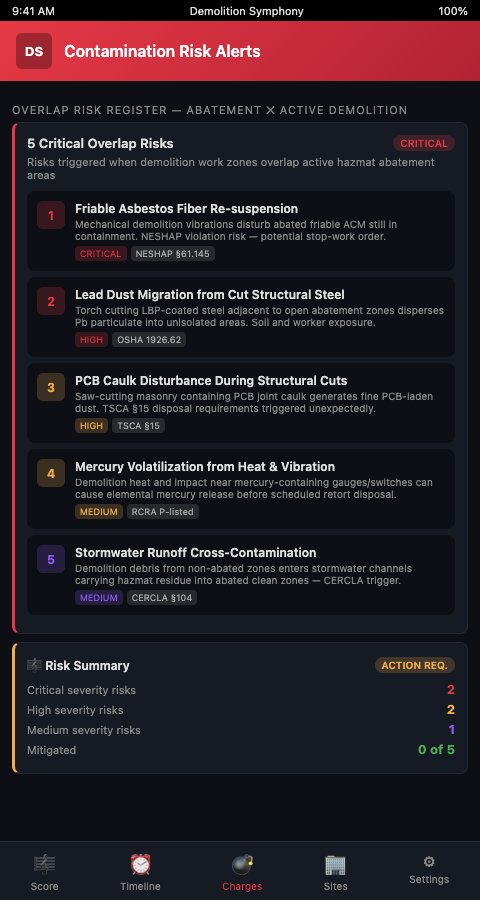
Risk 4: Air Monitoring Gap During Transition
Air monitoring during abatement is performed inside the containment. Once abatement is complete and containment is removed, the first structural demolition activities in that zone must be preceded by ambient air monitoring outside the former containment area to confirm clearance. This monitoring step is frequently omitted when project teams treat clearance as a containment event rather than a zone event.
OSHA's HAZWOPER work zones guidance requires that exclusion zones—the highest-contamination areas—have defined entry and exit protocols and that zone boundary changes (such as the removal of abatement containment) be accompanied by air monitoring updates. Removing containment expands the clean zone boundary, but that expanded boundary must be verified by monitoring, not assumed.
For the broader cross-contamination framework, hazmat sequencing facility demolition covers how to structure the abatement sequence itself—this post focuses on the transition from abatement to demolition as the highest-risk moment in that sequence.
Demolition Symphony Planner places the ambient air monitoring task as a mandatory dependency between abatement clearance and the first demolition activity in every zone. The dependency cannot be bypassed without a documented exception that requires project manager authorization.
Risk 5: Hazmat Overlap in Multi-Contractor Environments
The final contamination risk is coordination failure between contractors. An abatement contractor and a demolition contractor operating on the same site under separate contracts may have no shared schedule visibility. The abatement contractor completes Building A containment removal on a Thursday afternoon. The demolition contractor, working from a separate schedule, begins structural work in Building A on Friday morning—24 hours before the ambient air monitoring results are available.
This is the hazmat abatement demolition overlap danger that cannot be managed by better technique from either contractor individually. It can only be prevented by a shared sequencing tool that both contractors access and that enforces the transition dependency regardless of which contractor is performing the next scheduled activity.
Sequential strip-out prevent cross-contamination addresses how to design the strip-out phase sequence to minimize these transition-period risks—the answer lies in making each phase boundary a formal gate rather than an informal handoff.
Negative-pressure containment best practices from Spycor's industrial air machine guide reinforce that containment equipment itself must be sequenced—negative air machines are demobilized only after clearance testing, not when abatement work stops.
The cross-niche parallel applies to environmental containment in bridge demolition over waterways: in both contexts, the containment system is a physical constraint that must remain active past the point of perceived work completion until monitoring confirms the environment is clear.
When to Accept Calculated Risk and When to Add Buffer
Not every proximity between abatement and demolition is a contamination event waiting to happen. On large campuses, the practical reality is that some concurrent activity is unavoidable if the project is to maintain any reasonable schedule. The question is not whether to allow concurrent activity but how to quantify the risk of each overlap configuration and set the schedule buffers accordingly.
Demolition Symphony Planner's contamination risk scoring model assigns each potential overlap configuration a risk score based on: the separation distance between activities, the building construction type (which affects vibration transmission), the material category of the active abatement (asbestos Class I work is scored higher than lead paint removal), and the ventilation conditions in the overlap zone. Low-risk overlap configurations—separated by solid masonry walls, with abatement using lower-disturbance-risk materials—may be permitted with enhanced monitoring rather than full prohibition.
High-risk configurations—abatement of Class I asbestos materials with structural demolition in an adjacent open-plan bay—require the full separation buffer with no exceptions. The scoring model makes this distinction explicit, so project managers are not forced to choose between blanket prohibition (which extends schedules unnecessarily) and uniform risk tolerance (which creates genuine exposure events).
The risk scoring approach aligns with the concurrent abatement demolition risks framework recommended in industrial decommissioning best practice: contamination prevention is a risk management discipline, not a binary rule. The mandatory rests in the score are calibrated to the actual contamination risk of each voice transition, not applied uniformly regardless of conditions.
This calibrated approach also produces better regulatory documentation. When an inspector asks why a specific abatement-to-demolition overlap was permitted, the answer is not "we thought it was fine"—it is a documented risk score with specific inputs, a specific score value, and a specific set of enhanced monitoring controls that were applied as a result. Demolition Symphony Planner stores the risk score for every overlap configuration alongside the monitoring results from the active period, creating an auditable record that demonstrates the industrial demolition contamination prevention framework was applied systematically rather than ad hoc.
Industrial Demolition Contamination Prevention: The Scheduling Controls
Demolition Symphony Planner enforces five scheduling controls that directly address these five risks:
- Physical separation radius between active abatement zones and structural demolition, enforced at zone level
- Decontamination corridor exclusion from demolition crew routing during active abatement
- Debris classification zone boundaries locked until abatement clearance is confirmed
- Ambient air monitoring as mandatory dependency before first demolition activity per zone
- Shared schedule access for all contractors on the decommissioning score, with transition dependencies visible to every party
Secure your decommissioning sequence. Import your abatement zone layout and contractor schedules into Demolition Symphony Planner and activate contamination barrier enforcement before your first concurrent-activity week. Start your contamination risk review now and enforce every separation buffer before the first overlap week begins.