Why Sequential Strip-Out Phases Prevent Cross-Contamination
A CDC/ATSDR summary of asbestos exposure risk identifies demolition and renovation workers as among the highest-risk groups for occupational asbestos exposure—not because asbestos is present in higher concentrations at demolition sites than elsewhere, but because the physical disturbance of materials during demolition releases fibers that would otherwise remain bound. The exposure risk is highest during the transition between strip-out phases, when containment from one phase has been removed and the physical work of the next phase has not yet established its own controls.
Cross-contamination on industrial decommissioning sites follows a predictable pattern: Phase 1 work (hazmat abatement) finishes in a zone, the containment is removed, Phase 2 work (equipment extraction or structural demolition) begins, and the disturbance from Phase 2 work releases residual contaminants that were not captured by Phase 1 abatement. The MDPI research on fast-track construction risks documents that overlapping phase boundaries are the primary source of quality and safety defects on fast-tracked projects—a finding that applies directly to industrial strip-out sequencing.
Cross-contamination control on a demolition site is not primarily a technical problem. It is a sequencing problem. The technical controls—negative pressure containment, HEPA filtration, decontamination units, PPE requirements—are effective only when they are applied in the correct phase order with adequate barriers between phases.
The Three-Phase Strip-Out Architecture
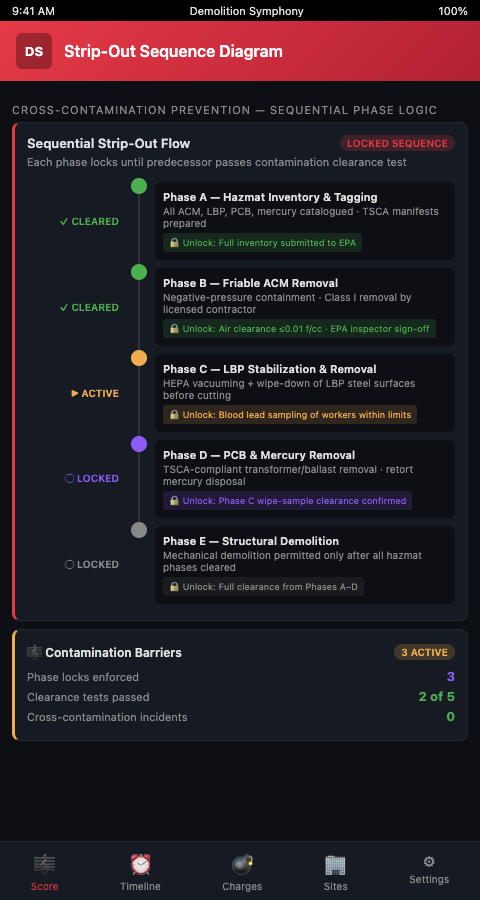
Facility decommissioning contamination barriers work when the strip-out is organized around three sequential phases with formal gate conditions between them:
Phase 1: Hazardous material abatement. All regulated materials—asbestos, lead, PCBs, mercury, refrigerants—are removed from the zone under full containment. Negative pressure is maintained throughout. Workers exit through decontamination units. No Phase 2 or Phase 3 activities occur anywhere that could disturb Phase 1 containment.
Phase 2: Secondary strip-out. Non-hazardous materials that are physically intermingled with formerly contaminated surfaces—piping, electrical conduit, mechanical equipment components—are removed. Phase 2 begins only after Phase 1 clearance is confirmed by air monitoring and written sign-off from a licensed industrial hygienist. Demolition Symphony Planner enforces this gate: Phase 2 cannot be scheduled in a zone until the Phase 1 clearance dependency is satisfied.
Phase 3: Structural demolition. The building shell, structural members, and foundation are demolished. Phase 3 begins only after Phase 2 is complete and a final zone survey confirms no unaccounted regulated materials remain. Structural demolition that begins before Phase 2 is complete will disturb secondary materials that may have surface contamination from Phase 1 activities.
This three-phase architecture is supported by OSHA HAZWOPER 1910.120, which requires formal decontamination procedures at every work zone boundary, and by OSHA's hazardous waste decontamination standards, which specify three-stage decontamination for workers exiting exclusion zones. The three-phase strip-out mirrors the three-zone HAZWOPER model: each phase has defined entry and exit protocols, and no phase begins until the prior phase's zone has been formally closed.
What Causes Phase Boundary Failures
Causeway Cleaning's decontamination stages guide identifies the most common failure mode at phase boundaries: treating decontamination as a worker hygiene step rather than a zone transfer protocol. Workers carry surface contamination from completed abatement zones into adjacent active zones on their clothing, equipment, and footwear—not through air pathways, but through physical contact.
The hazmat strip-out phase order must address this surface transfer pathway explicitly. The strip-out schedule must include:
Decontamination unit placement at every phase boundary. Not just at the site perimeter but at every internal phase boundary where workers transition from a Phase 1 zone to a Phase 2 or Phase 3 zone. Demolition Symphony Planner maps decontamination unit locations as logistics infrastructure on the facility plan and flags any phase boundary without an assigned unit.
Equipment decontamination between phases. Power tools, hand tools, and small equipment used in Phase 1 work must be decontaminated or disposaled before use in Phase 2 zones. This equipment tracking requirement is enforced in Demolition Symphony Planner's equipment disposition system—tools assigned to Phase 1 work are not available for Phase 2 scheduling without a decontamination event record.
Debris container separation. Phase 1 debris (hazardous waste) and Phase 2 debris (potentially contaminated non-hazardous materials) require separate containers with separate manifests. Mixing these streams is the most common debris classification error in industrial strip-out. Demolition Symphony Planner assigns debris container types at the zone and phase level, so field supervisors know at a glance which container receives each type of debris from each zone.
For the upstream connection, waste stream segregation in multi-material demolition covers the full debris classification and disposal logistics that the sequential strip-out phase system must feed into.
Negative Pressure as a Phase Boundary Control
Brick Industries' negative pressure containment guide specifies that negative pressure containment is most vulnerable at phase boundaries—specifically during the transition from active abatement to containment removal. The moment negative pressure is removed from a zone, the air pressure differential reverses and any residual fibers or contaminants in the containment space are drawn outward rather than inward.
The industrial strip-out phase sequencing protocol must address this transition moment explicitly: air monitoring inside the former containment zone must confirm that fiber counts remain below clearance thresholds immediately after negative pressure is removed, before any Phase 2 activities begin. This monitoring step is a mandatory gate in the Demolition Symphony Planner phase transition workflow.
Total Wrecking's hazardous site management guide recommends that the phase transition monitoring window be treated as a paid standby period for Phase 2 crews rather than unscheduled downtime—crews are mobilized and staged at the zone boundary, waiting for clearance confirmation, rather than being sent off-site and recalled. This practice reduces the incentive to skip or compress the monitoring step.
The hazmat sequencing facility demolition guide covers the regulatory notification requirements that must be satisfied before Phase 1 can begin—the sequential strip-out architecture described here assumes those requirements have been addressed in the upstream planning.
For the cross-niche comparison, seating removal at scale in stadium demolition faces a structurally analogous phase sequencing challenge: the removal of non-structural elements (seating) must be complete before structural demolition begins, and the boundary between those phases must be a formal gate rather than a concurrent operation.
Training Workers to Treat Phase Boundaries as Physical Gates
The most carefully designed sequential strip-out schedule fails if field workers do not understand why phase boundaries exist and what crossing them without clearance means. A Phase 2 secondary strip-out worker who walks through a Phase 1 abatement decontamination unit because the unit is on the most direct path to the break room is not being reckless—they are operating in an environment where phase boundaries have not been made physically obvious.
Demolition Symphony Planner's field interface generates daily zone status displays that can be printed or displayed on site as visual phase maps. Each zone's current phase is shown with color coding and access restriction language. Workers can see at a glance which zones require PPE and decontamination, which zones are open for access, and which zones are off-limits entirely. These visual maps reduce the cognitive load on field personnel who are not trained in the regulatory details of HAZWOPER zone protocols.
Phase boundary signage on the site must match the phase map. When Demolition Symphony Planner advances a zone from Phase 1 to Phase 2, the site superintendent is notified to update physical signage at the zone boundary. The signage update is a scheduled task in the transition checklist, not an informal communication.
The visual management system also serves as documentation. When a regulator or litigant later asks whether workers were adequately informed of the phase status of each zone, the project record shows not just that the phase transitions occurred, but that signage was updated, daily zone status maps were generated and posted, and workers were present for site safety briefings that covered the current zone status. That documentation record is built automatically through Demolition Symphony Planner's transition workflow, without requiring additional administrative effort from the site team.
Industrial strip-out phase sequencing has a physical and a procedural dimension. The physical dimension—containment, negative pressure, decontamination units—gets most of the attention. The procedural dimension—worker training, visual management, boundary communication—determines whether the physical controls are actually used correctly. Demolition Symphony Planner addresses both.
Cross-Contamination Control: The Scheduling Checklist
Before any zone begins Phase 2 strip-out, confirm in Demolition Symphony Planner:
- Phase 1 abatement clearance confirmed by licensed industrial hygienist, written sign-off recorded
- Negative pressure removal monitoring complete, results below clearance thresholds
- Decontamination unit installed and operational at zone Phase 2 entry point
- All tools and equipment used in Phase 1 decontaminated or replaced before Phase 2 use
- Debris containers assigned—separate containers with separate manifests for Phase 1 waste, Phase 2 debris, and Phase 3 structural debris
- No shared ventilation pathways active between Phase 2 zones and any remaining Phase 1 containments
- Phase boundary signage updated at zone perimeter to reflect Phase 2 status
- Zone status display updated on site and in Demolition Symphony Planner field interface
Lock your phase boundaries before strip-out begins. Configure the three-phase gate conditions in Demolition Symphony Planner and generate the sequential strip-out schedule with decontamination unit placement before your first abatement crew mobilizes.