Introduction to Visual Blast Choreography for Tower Demolition
The Communication Gap That Causes Blast Failures
Stott Demolition's contractor failure case analysis documents real projects where poor blast choreography produced debris scatter beyond the exclusion zone, structural lean during progressive collapse, and partial failures requiring secondary demolition at substantial additional cost. The root cause in each documented case was not a calculation error or a structural assessment failure — it was a choreography communication failure. The person who designed the sequence understood it; the crew executing the sequence didn't.
Visual blast choreography solves a communication problem first and a technical problem second. Every implosion project already has a sequence plan. What most projects lack is a format that communicates that sequence clearly to the structural engineer reviewing the charge placement, the safety officer calculating exclusion zones, the crew installing the detonation network, and the project owner approving the methodology — all from the same document. A demolition sequence choreography tool that every stakeholder can read removes the translation overhead that typically costs two to three review cycles on complex urban high-rise projects.
Tower demolition involves more simultaneous stakeholder reviews than any other demolition type. A 40-story building implosion in a dense urban environment will involve a structural engineering firm, a licensed blaster, a project owner, a municipal safety authority, and potentially a third-party peer reviewer. Each of those parties needs to verify a different aspect of the sequence plan. When the sequence plan exists as visual blast choreography — a readable score showing every charge, every delay, every floor progression — each party can review their concern directly, in context, without requiring the blaster to translate from blast notation to whatever format the reviewer prefers. Tower demolition visual planning in score format reduces the review cycle for complex urban projects from weeks to days because every reviewer reads from the same document rather than waiting for document-specific translations.
Choreography as Visual Score
The GEOMATE Journal criteria for controlled demolition design states it clearly: the position, initiation sequence, and delay timing of notch blasts must be planned as a kinematic chain. Kinematic chains have a visual structure. Each link affects the next. The sequence of links determines the motion path of the structure as it collapses.
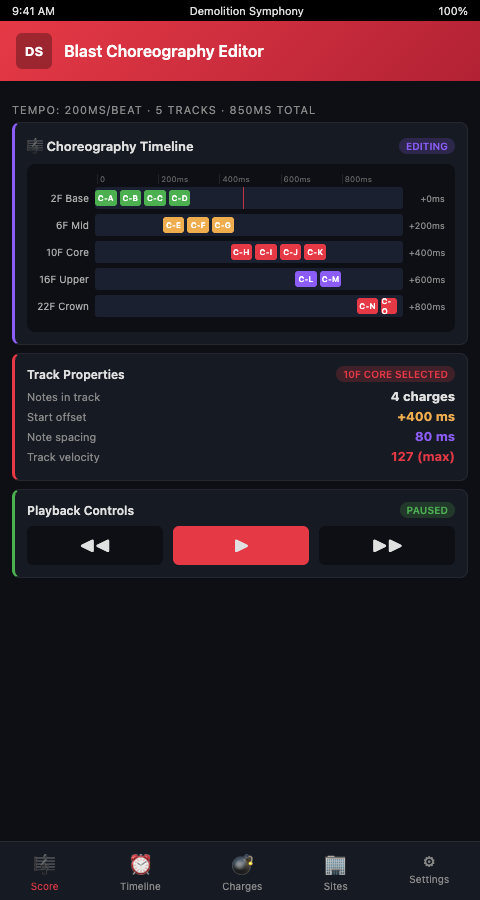
Visual blast choreography is the discipline of representing that kinematic chain as a notation system every qualified reviewer can interpret. In the Demolition Symphony Planner, the choreography interface renders the full tower demolition as a musical score: each floor is a horizontal track, each column group is a note on that track, and the delay intervals are the spacing between notes. The full composition — from the first lower-floor detonation to the final upper-floor sequence — reads left to right like a piece of music, with the structural progression visible as a rising phrase from the bass (ground floor) to the treble (roof level).
This format has a specific advantage over 3D blast simulation software for stakeholder communication. ARA's 3D Blast platform and similar tools estimate pressure and impulse distribution on facades and map results to 3D models — technically comprehensive, but requiring specialized software to read. The visual score in the Demolition Symphony Planner is interpretable by any engineer who can read a structural drawing and follow a timeline. No software license required for the reviewer.
For the technical depth behind 3D blast pressure mapping — useful for pre-choreography structural assessment — ARA's blast design platform provides 3D visualization of blast loads mapped to building geometry, and that output feeds directly into the charge placement layer of the choreography score.
The explosives.org blast planning overview describes how blast timing sequences are created and verified before execution — the choreography workflow that experienced blasters follow, which the visual score format structures and documents.
The choreography framework creates a specific type of value in the review process: it makes every assumption visible. When a sequence plan exists only as a table of delay times and column identifiers, the reviewer must mentally construct the three-dimensional collapse sequence from that table and check whether the design intent is being served. When the same sequence is presented as a visual choreography score, the collapse progression is visible directly — a reviewer can identify that floors 22-24 show an anomalous delay compression at a glance without having to reconstruct it from the numbers.
This matters most on large urban high-rise projects where multiple reviewers must sign off before the permit is issued. A structural engineer reviewing the sequence for collapse mechanics, a safety officer reviewing for zone compliance, and a municipal building department engineer reviewing for regulatory compliance are all drawing on different expertise. A visual choreography score allows each reviewer to read the aspects they're qualified to assess without requiring the blaster to present the sequence three different ways for three different audiences. This consolidation reduces the review cycle — and catches errors that might survive a siloed review.
For new coordinators building a choreography framework for the first time, the implosion score notation post covers the full composition workflow from structural survey to notation, including how to set up the initial score structure for a multi-floor tower.
Advanced Choreography for Complex Tower Geometries
Dual-direction collapse choreography. Some urban sites require the collapse to fall in a specific direction — away from an adjacent structure on one side, away from an underground transit line on another. Dual-direction choreography splits the score into two simultaneous collapse fronts: the primary direction (larger debris field, controlled by the main detonation sequence) and the secondary direction (smaller fragment scatter, controlled by a secondary delay chain). Orica's SHOTPlus allows replay of timing sequences in 3D and auto-highlights problematic firing patterns in multi-directional sequences — a validation step that should precede any dual-direction choreography plan.
Progressive collapse visualization. The choreography score shows when each charge fires. What it doesn't automatically show is the structural state of the building at each moment between firings — how much of the lower structure has already collapsed, how much live load has redistributed to the remaining columns, and what the failure mode of the next column group will be under that redistributed load. Advanced choreography integrates a structural state track that shows these inter-firing conditions as annotations between the notes, so the reviewer can verify that each floor fires at the correct structural state, not just at the correct time.
Multi-contractor coordination. When the detonation network installation is split between two crews working from different floor levels, the choreography score serves as the coordination document. The floor detonation sequence post covers how per-floor timing control works in practice — the choreography score shows the crew working floors 1-15 exactly which notes they're installing and how those notes connect to the crew working floors 16-30.
Version control and change tracking. On a 40-story tower demolition project with a 12-month planning timeline, the choreography score will be revised multiple times — as the structural assessment reveals new conditions, as permit comments require sequence adjustments, and as field conditions during network installation differ from assumptions. Maintaining version control on the choreography score ensures that the version the licensed blaster executes from is the same version the structural engineer last reviewed. The Demolition Symphony Planner tracks revisions to the score with timestamps and change notes, so any late modification has a documented review trail rather than an undocumented verbal instruction.
Post-blast score comparison. After the implosion, the as-built execution — reconstructed from detonator continuity logs and timing trace data — can be compared against the choreography score to identify any timing deviations between planned and actual. This comparison is the primary learning tool for improving future sequences. Deviations of more than 10 ms on any delay group should trigger a root cause investigation: was the deviation in the detonator, in the network design, or in the charge installation? The visual score format makes this comparison straightforward because the as-built timing trace maps directly onto the planned score.
For industrial plant decommissioning teams applying choreography methods to equipment removal sequences, interleaved scheduling covers how visual sequence planning adapts when the work involves both structural demolition and equipment removal in overlapping phases.
Score Your Tower Demolition Before the Crew Arrives on Site
The implosion choreography visualization produced by the Demolition Symphony Planner is not a static deliverable that describes the plan once. It's a living document that tracks the plan from the first structural analysis through permit submission, network installation, and post-blast comparison. At each phase of the project, the same score document serves a different function: during design, it's the sequencing workspace; during review, it's the audit document; during installation, it's the field reference; after the blast, it's the as-planned baseline for deviation analysis. This continuity — one document across the full project lifecycle — is what visual blast choreography offers that no disconnected set of tabular documents can match.
Urban high-rise implosion coordinators who build the choreography score before the detonation network design is finalized catch multi-contractor coordination conflicts, structural state gaps, and delay interaction errors while changes are still cheap. The Demolition Symphony Planner gives tower demolition teams a visual choreography interface designed specifically for the multi-stakeholder review process that governs urban high-rise implosion permits. Join the waitlist to get early access to the blast choreography visualization module and score your next tower demolition before the first drill hits the structural frame.