Understanding Structural Load Paths in Curved Roof Systems
When engineers analyzed the London Olympic Stadium's cable-net roof for post-Games reconfiguration, LUSAS structural modeling revealed load redistribution patterns that weren't apparent from visual inspection alone — a finding that has direct implications for every arena roof deconstruction safety plan. Curved roof systems in stadiums concentrate load through geometries that behave nothing like flat-slab or simple-span structures, and removing one member without understanding the load path it serves can trigger progressive collapse across an entire bay.
The US demolition industry counts roughly 4,772 firms (IBISWorld), and the subset that regularly handles large-venue roof systems is far smaller — precisely because curved roof load path analysis requires structural engineering competence that most conventional demolition contractors don't carry in-house. For stadium and arena demolition specialists, understanding how load travels through a curved roof before the first torch cut is not optional; it is the prerequisite for every subsequent phase decision.
How Curved Geometry Creates Hidden Load Dependencies
A flat concrete slab carries gravity load in a predictable two-way pattern. A cable-net, space-frame, or long-span truss roof over a stadium bowl carries load through tension, compression, and bending in three dimensions simultaneously — and that geometry means that removing a single chord member or cable can redirect force into elements that were not designed to carry it.
MIT research on structural roof systems for stadia documents how the transition from closed-ring to open-cantilever configurations — the most common form in modern arenas — creates significant asymmetric load states during partial removal. Reliability analysis of curved roofs under combined wind and snow loading (published in Disaster Prevention and Research, 2022) further demonstrates that curved geometry amplifies dynamic load effects that a static demolition plan may not account for.
The practical implication for stadium roof structural system demolition planning is that temporary shoring calculations must reflect the as-built geometry, not a simplified equivalent flat-span model. LUSAS grandstand dynamic analysis case studies reinforce this: the natural frequencies of cantilevered and curved structures differ enough from flat equivalents that vibration from adjacent demolition operations can induce resonance in sections that appear stable.
Scoring the Load Redistribution During Roof Removal
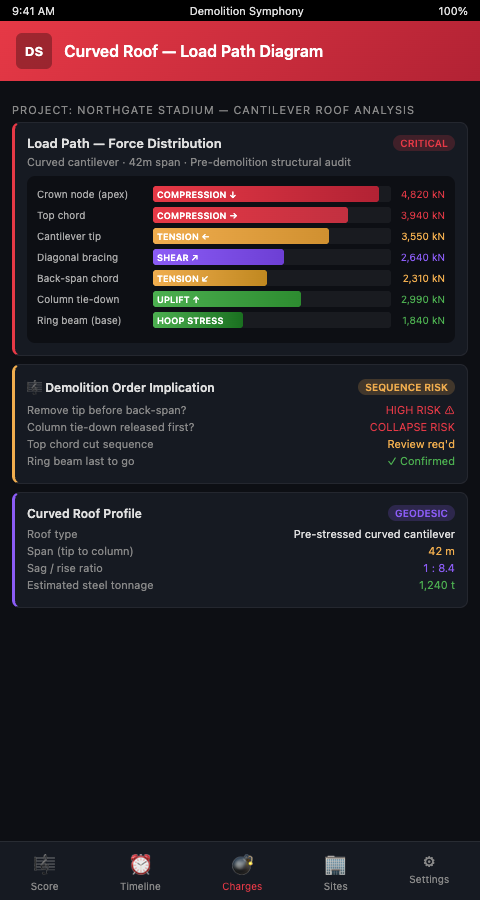
Demolition Symphony Planner treats every structural cut in a curved roof system as a note in a demolition score — and the score notation for roof removal sequences is built around load redistribution checkpoints. Before each chord or cable section is cut, the system prompts the structural engineer to verify that the remaining structure can carry the redistributed load in its new configuration.
This is not a bureaucratic checkbox. Research on progressive collapse in double-layer trusses (ScienceDirect, 2023) shows that progressive failure in space-frame roofs typically initiates at nodes where load redistribution after a first member failure exceeds the capacity of adjacent members. The demolition score for curved roof removal explicitly maps these cascade-risk nodes and flags them as tied notes — cuts that must be sequenced with temporary support in place before the preceding member is removed.
The cantilever removal order interface in Demolition Symphony Planner extends this logic from individual members to entire cantilever bays, providing a visual sequence map that keeps the load state within safe bounds at every stage of removal. The roof truss choreography module then coordinates equipment positioning and ground crew exclusion zones in real time as the sequence progresses.
Advanced Tactics for Cantilever Roof Demolition Engineering
Experienced structural demolition engineers apply three tactics that go beyond basic load path modeling when planning cantilever roof demolition for large venues.
Staged temporary support sequencing. Rather than installing all temporary shoring before demolition begins — a costly and time-consuming approach — advanced teams stage temporary support to follow the demolition front. Darda's structural analysis methodology for demolition formalizes this as a dynamic shoring plan: each demolition phase installs the minimum temporary support required for the next cut, then removes shoring from completed sections as the front advances. Demolition Symphony Planner's score notation system tracks active shoring locations against the demolition sequence, preventing any cut from being scheduled before its required support is in place.
Wind-load re-evaluation at each phase. Open-ring and partial-ring roof configurations that emerge during phased removal expose structural members to wind loading that the enclosed configuration never experienced. MDPI research on lightweight stadium roofing structures documents how wind uplift on partially deconstructed roofs can exceed design loads for the remaining structure — particularly during the intermediate phases when some bays have been removed but others remain. The demolition score incorporates phase-specific wind load checks as rest points: the sequence pauses for re-evaluation if weather conditions exceed the threshold for the current structural configuration.
Cross-reference bridge demolition load transfer methods. The load transfer analysis methodology developed for partial bridge demolition — specifically the sequencing of temporary load-transfer systems — translates directly to curved roof removal on long-span stadium structures. Both problem types involve removing a continuous structural system in segments while maintaining integrity in the remaining sections, and the engineering principles governing safe sequencing are the same.
Document as-built deviations before modeling. Stadium roof structures are routinely modified after original construction — additional mechanical equipment mounted to roof purlins, HVAC duct systems added to interior chord members, lighting rigs permanently attached to primary structural elements. These additions change the load distribution the structural model must account for. A pre-demolition scan-to-model survey comparing the BIM model against as-built conditions has become standard practice for complex curved roof systems, because a model that reflects the original design rather than the current as-built condition will produce load redistribution predictions that diverge from field reality.
The divergence is typically small in the early phases and grows as the demolition front advances — which means errors in the as-built model compound rather than correct themselves over the course of the sequence. For arena roof deconstruction safety planning, this compounding error risk is the strongest argument for completing the scan-to-model survey before committing to the removal sequence: a single unmodeled attachment point can shift the cascade-risk node analysis for an entire roof bay, requiring a mid-sequence engineering review that halts demolition while the structural team re-evaluates the remaining cut order.
From Load Model to Field Sequence
Understanding curved roof load paths is the analytical foundation. Converting that analysis into a field-executable sequence is where demolition scores earn their value. Demolition Symphony Planner exports phase-specific cut orders keyed to the structural model, so equipment operators receive instructions that are directly derived from the load redistribution analysis — not interpreted through multiple layers of verbal communication.
Stadium roof structural system demolition is one of the highest-risk operations in the venue teardown sequence. A score that makes the structural logic visible to every member of the project team — from the structural engineer to the crane operator — is the difference between a controlled sequence and an uncontrolled one.
Load redistribution during roof removal produces intermediate structural configurations that exist for hours or days while equipment is repositioned — configurations that the score must track continuously, not just document at phase gates. Cantilever roof demolition engineering that treats each intermediate state as a distinct structural problem, rather than a transition between two planned configurations, is what separates teams that complete curved roof removals without incident from those that discover mid-sequence that a planned cut is no longer structurally safe in the current load state. Score Your Stadium Teardown with Demolition Symphony Planner and bring load redistribution analysis into every phase decision before the first curved member is cut. Get started with a curved roof demolition score that maps every cascade-risk node and sequences each cut with the temporary support verification the structural analysis requires.