Introduction to Phased Pier Column Removal Sequencing
Why Pier Sequencing Fails More Often Than Expected
The NCHRP Synthesis 536 found that 60% of state DOTs prohibit certain demolition methods outright, and a large share of those prohibitions apply specifically to pier and substructure removal. The restrictions exist because pier column extraction phases carry risks that superstructure removal does not: the pier must remain stable throughout its own removal, meaning partial cuts at the base can destabilize a column before the crane or controlled blast is ready to manage the fall.
The $26.5 billion allocated over five years under the FHWA Bridge Formula Program will fund removal and replacement of thousands of aging bridges across the U.S. A significant proportion of those projects involve multi-column pier bents and long piers extending over waterways or active roadways — configurations where pier column removal sequencing errors have direct consequences for traffic, adjacent utilities, and the stability of the remaining structure.
Standard practice for pier demolition often addresses columns as individual line items in a work schedule: "demolish pier 3 columns" appears as a single task. But each pier bent is a multi-member system where the order of column removal, the timing of pier cap cutting, and the placement of temporary support after the first column comes down all affect the stability of the bent as a whole. A design of bridge blasting demolition study from MATEC confirms that blast design for pier column demolition requires specific charge placement that accounts for the column's structural relationship to the pier cap above — not just the column's own geometry.
Composing the Substructure Score
The Demolition Symphony Planner treats pier column removal sequencing as a scored movement within the full bridge demolition composition. Where the superstructure score addresses spans and deck sections, the substructure score addresses columns, pier caps, pile caps, and footing demolition — each with its own phase measure, stability annotation, and method notation. Substructure demolition planning as a scored discipline — rather than a verbal field sequence — is what separates controlled pier removal from improvised work that triggers unplanned structural movement.
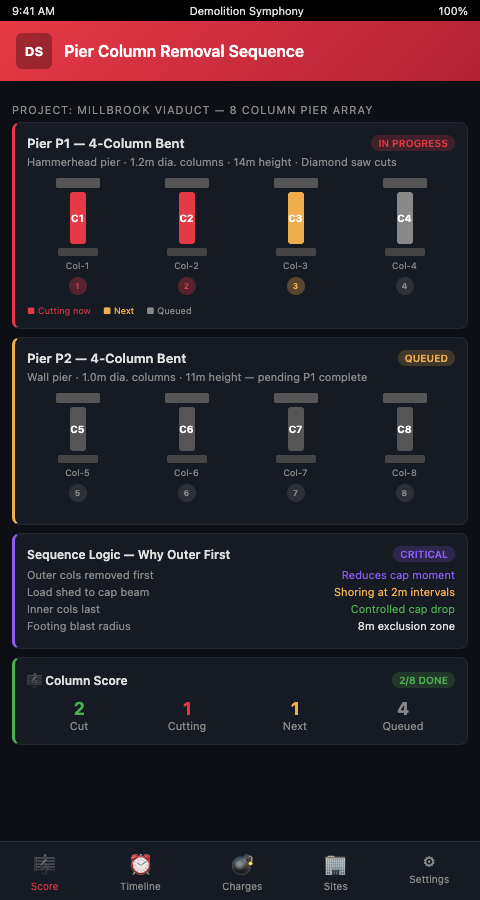
Column Extraction Order Within a Multi-Column Bent. A pier bent with three columns is not demolished as a unit. The columns are removed in a specific order that maintains moment balance in the pier cap above until the cap itself is cut. The Demolition Symphony Planner writes column extraction order as a numbered sequence within the bent's measure: column A first, then column C, then column B — with the structural rationale encoded as an annotation. This prevents field crews from reversing the order based on equipment convenience. Bridge column extraction phases are distinct structural events, each requiring its own stability check — the score enforces this by treating each column extraction as a separate measure with its own gate condition, not as substeps within a single undifferentiated "pier demolition" task.
Pier Cap Removal as a Gate Condition. The pier cap cannot be removed until all column connections to it are severed and the cap's dead load is transferred to temporary support. The pier cap removal sequence for a bridge must be written as a gate-condition note that only opens after the column extraction sub-sequence is complete and the cap load transfer is verified. This gate is not a time delay — it is a structural confirmation that the cap is ready to be lifted or cut.
Footing and Pile Cap Demolition as the Final Measure. Below-grade demolition of footings and pile caps follows pier cap removal and is written as the final measure of the substructure movement. For overwater piers, this measure includes dewatering operations, cofferdam management, and environmental containment — notations that connect the substructure score to the broader project score. Understanding load transfer analysis at each stage ensures that below-grade work does not inadvertently alter the load distribution in any remaining above-grade structure.
FEA Validation as Measure Gate. The MDPI Safety and Stability Analysis of Bridge Pier Demolition demonstrates that FEA validates structural stability at each phased demolition stage of pier work. The Demolition Symphony Planner encodes FEA gate results as measure-opening conditions: the next phase measure is locked until the FEA validation for the current state is cleared. This applies at each column extraction step, at pier cap transfer, and at footing removal.
State DOT Method Compliance. The NYDOT Section 582 specification for staged concrete demolition requires specific methods and documentation for each removal stage. The Demolition Symphony Planner generates method notation that can be cross-referenced against state DOT specifications, ensuring that the phased pier demolition order written in the score meets the regulatory requirements governing the project.
The connection to span removal order is direct: the span sequence determines which piers are load-free at any given point, and pier column removal only begins on a pier after the spans it supports have been fully removed or shored. The substructure score is written after the superstructure score is finalized, with pier release conditions flowing from the span removal sequence.
Advanced Tactics for Pier Demolition
Hydraulic breaking versus blasting for column extraction. The choice between hydraulic hammer, diamond-wire cutting, and explosive demolition for pier column extraction phases depends on the pier's location, the adjacent constraints, and the required fall footprint. The Demolition Symphony Planner encodes the method as a score annotation and applies the corresponding debris exclusion zone, vibration threshold, and timing constraint for that method. Switching methods mid-project requires an annotation update, not a full plan revision.
Overwater pier demolition timing. Piers that extend into navigable waterways require tidal window coordination — specific high or low tide conditions at which barge-mounted crane operations are safest. The Demolition Symphony Planner writes tidal windows as timing constraints in the overwater pier measures, preventing barge operations from beginning outside the safe tidal band. This connects the substructure score to environmental and maritime permit conditions.
Real project benchmarks. The FirstEnergy Lowellville Bridge Pier Removal by Independence Demolition demonstrates phased pier demolition in a constrained industrial corridor — a useful reference for teams building their first pier-specific score. The project documentation shows how column extraction phases are organized when equipment access is limited and adjacent structures are within the influence zone.
Connecting to industrial zone-based planning. Teams familiar with zone-based decommissioning workflow planning from plant decommissioning work will recognize the spatial discipline in pier sequencing — each pier bent is a zone, and the demolition proceeds zone by zone in a defined order, not opportunistically wherever equipment happens to be positioned.
Contractor coordination at pier transitions. Multi-span bridge projects often involve subcontractor transitions between superstructure removal (done by a crane and rigging specialist) and substructure demolition (often done by a concrete demolition contractor). The Demolition Symphony Planner's substructure score creates a handoff document that the substructure contractor receives with the current structural state annotated — specifically, which spans have been removed, which shoring is in place, and which piers are cleared for column extraction. No verbal briefing required.
The Score That Prevents Improvised Pier Work
Pier column demolition improvised in the field — order adjusted by the foreman to match crane positioning, methods changed without engineering review, pier cap removal sequence changed before column extraction is complete — is the origin of most pier demolition incidents. The Demolition Symphony Planner prevents these improvisations not by adding bureaucratic checkpoints but by making the correct sequence visible and legible at the measure level, so the field crew understands the structural rationale for the order they are following.
The difference between a scored pier sequence and a verbal one is not administrative formality. When the phased pier demolition order is written in a shared score that every team member reads — crane operator, structural engineer, field supervisor — no team member is dependent on hearing the correct sequence from the right person at the right moment. The score communicates the structural logic continuously, not just at shift briefings.
Bridge column extraction phases that are documented in the score also provide the record that post-project regulatory and structural reviews require. When an OSHA investigation or an owner's quality review examines a pier demolition project, the question is not just whether the correct sequence was intended but whether it was executed and documented. A scored substructure sequence generates that documentation automatically: every gate confirmation, every method authorization, and every structural check is logged in the score's audit trail as the work proceeds.
Write the Substructure Score Before the Crane Arrives
Bridge and overpass demolition teams planning pier column removal on upcoming projects should build their substructure demolition plan with the Demolition Symphony Planner. Score your bridge column extraction phases with the Demolition Symphony Planner and eliminate the field improvisation that turns pier demolition into an incident — giving your structural engineer's sequencing logic the same visibility as your crane schedule and traffic plan. The pier measures, gate conditions, method annotations, and FEA validation requirements are all part of the same scoring system — so every team member from structural engineer to crane operator is reading from the same sheet.
Substructure demolition planning managed through the Demolition Symphony Planner also creates the documentation that owner-managed quality assurance programs require for bridge demolition substructure work. When pier cap removal sequences and structural verification gates are logged in the score as the work proceeds, the project team has a phase-by-phase compliance record that is available for owner review at any point in the project — not assembled retroactively after project closeout. Start your substructure demolition score with the Demolition Symphony Planner and give your bridge and overpass demolition team the pier column extraction sequencing tool that makes structural logic visible from first cut to final pier removal.