Integrating Real-Time Traffic Data into Bridge Demolition Schedules
When Schedule Meets Reality on the Road
In a single year, FHWA work zone statistics document fatalities that have increased 50% over recent decades, with work zone crashes costing an estimated $42 billion annually across the U.S. A significant portion of that exposure occurs during bridge and overpass demolition, where lane closures are longer, equipment is larger, and debris hazards are real. Yet many demolition schedules are written once — often months before the work begins — and carried to the field as fixed lane-closure windows that don't account for what traffic is actually doing on the day of the operation.
The gap between planned and actual traffic conditions is not a minor inconvenience. A closure that opens during morning rush rather than the off-peak window it was scheduled for will queue vehicles for miles. That queue creates rear-end collision risk, emergency vehicle access failures, and community pressure that can force work to stop mid-phase — leaving a bridge in a partially demolished, structurally compromised state. The real-time traffic data bridge demolition scheduling problem is structural: fixed schedules cannot respond to dynamic road conditions without a mechanism that connects monitoring feeds to work authorization.
The ASCE 2025 Infrastructure Report Card notes that 42% of U.S. bridges are over 50 years old, creating an accelerating replacement and removal pipeline. As demolition volume increases, the need for live, data-integrated scheduling becomes a baseline requirement rather than an advanced option.
Writing Live Data into the Demolition Score
The Demolition Symphony Planner treats each phase of a bridge demolition as a note in a sequence — and real-time traffic feeds are the time signature that governs when each note may be played. Without that time signature, musicians play whenever they feel ready. With it, every entry is precisely cued.
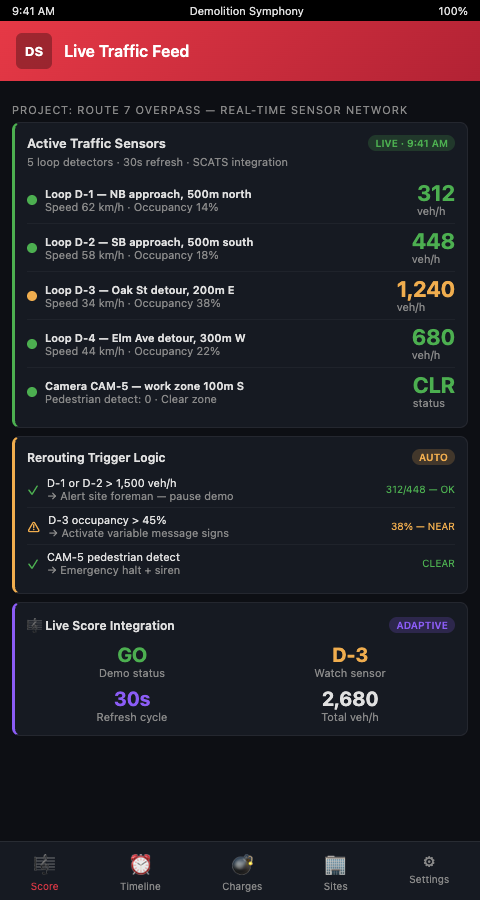
Traffic monitoring as a score annotation layer. The Demolition Symphony Planner overlays live traffic monitoring demolition schedule data as an annotation layer on top of the structural phase score. Each phase-measure carries two kinds of notations: structural conditions that must be met before the phase begins, and traffic conditions that must be met before the lane closure is authorized. A dynamic schedule adjustment for bridge removal might look like: saw-cut of Span 2 is authorized only when inbound volume on Route 9 falls below 400 vehicles per hour and no incident flags are active within a five-mile upstream radius.
Smart Work Zone sensor integration. The Transportation Research Board Smart Work Zone Deployment study documents that queue warning systems reduce work zone collisions by up to 70%. The underlying mechanism — dynamic message signs fed by upstream speed sensors — is the same mechanism that should gate demolition phase entry. When traffic sensor integration for demolition planning feeds ITS data into the phase score, a closure request is not submitted until sensor thresholds clear. The Demolition Symphony Planner logs each sensor trigger as a timestamped gate event on the score, creating an auditable record of why each phase started when it did.
Phase-specific traffic windows as measures. In the musical score analogy, each traffic window is a measure — a defined duration with a fixed beat structure. A night-window overpass removal might run from 11 PM to 5 AM with a hard close before 4 AM to allow detour clearing. The planner writes these windows as measure boundaries with countdown notation: 90 minutes remaining in the window triggers a review gate; 60 minutes triggers a mandatory phase-hold evaluation; 30 minutes triggers a hard stop regardless of structural completion status. Teams practicing adaptive bridge demo scheduling know that an incomplete phase is far safer than a re-opened lane with equipment still in the zone.
Incident detection and schedule branching. Real-time traffic data bridge demolition schedules should include branch notation for incident scenarios. The FHWA Work Zone Traffic Management guidance recommends using live data to minimize delays and maintain emergency access. In the Demolition Symphony Planner, incident branch notation specifies the alternative score path: if an upstream incident is detected within the closure window, the demolition hold cue activates, lanes reopen on a defined timeline, and work resumes only when the incident clears and traffic flow returns to pre-closure baseline. This is distinct from a simple work-stop — it is a pre-written alternative passage the team rehearses before taking the field.
The framework connects directly to how teams score overpass removal traffic management at the project level. Real-time feeds don't replace that planning layer — they execute against it.
Advanced Tactics for Live-Data-Gated Demolition
Upstream queue prediction, not just current volume. Current vehicle count is a lagging indicator. By the time queue length reaches the closure taper, it is already too late to delay the closure. Advanced live traffic monitoring demolition schedules use speed-flow regression to predict queue buildup 20 minutes ahead. The Demolition Symphony Planner can accept predicted-queue data as a gate input, not just current-speed data, shifting the decision from reactive to anticipatory.
Emergency vehicle corridor logging. Every phase score entry that involves a full lane closure must carry a logged emergency access corridor. Smart Work Zones, as documented by the Work Zone Safety Clearinghouse, deploy ITS to manage emergency access alongside queue management. The Demolition Symphony Planner writes emergency corridor status as a persistent annotation — visible to the site superintendent and the traffic control coordinator simultaneously — so no closure decision is made without confirming emergency access is maintained.
Cross-phase data persistence. On multi-night demolition operations, traffic behavior on night one affects the schedule for night two. Volume patterns, incident frequency, and detour compliance rates from prior nights are logged in the score as reference data. Teams calibrating their traffic-window assumptions mid-project have a documented basis for adjusting closure start times, rather than repeating a fixed schedule that proved incorrect on the first night.
Digital twin integration for predictive gating. A Digital Twin-Driven Strategic Demolition Plan study (PMC) demonstrated that live sensor data synchronized with a digital twin model allows scheduling adjustments based on real structural and environmental readings rather than static assumptions. Pairing a live traffic sensor feed with a structural digital twin creates a dual-gated phase system: neither the structural gate nor the traffic gate permits phase entry alone — both must clear simultaneously. The Demolition Symphony Planner supports this dual-gate architecture in its notation system.
Connecting traffic gates to sensor-driven sequencing. The traffic integration layer in the Demolition Symphony Planner is designed to work alongside the sensor-driven adaptive decommissioning scheduling approach developed for large industrial sites. The underlying data architecture — real-time feeds, threshold gates, branch notation — transfers directly to bridge work, giving teams a unified framework for adaptive scheduling regardless of structure type.
The Cost of Static Schedules on Dynamic Roads
A bridge demolition team operating from a static traffic window plan is playing a composition written for a different venue. The traffic patterns that existed when the plan was written may have shifted due to a new development, a parallel road closure, or a seasonal event. When those conditions don't match, field supervisors are left making improvised calls about whether to proceed or hold — calls that happen without data, under time pressure, with equipment staged and workers deployed.
The traffic-aware demolition timeline approach gives teams the structural vocabulary to define windows correctly at the planning stage. Real-time data integration gives them the ability to execute against those windows accurately in the field. Together, they close the gap between what was planned and what the road actually allows.
The cost of that gap is not just operational disruption. When a demolition phase advances during an unplanned traffic peak and a rear-end collision occurs in the work zone queue, the project team faces regulatory scrutiny, potential litigation, and the moral weight of a preventable incident. The $42 billion annual work zone crash cost documented by FHWA reflects a systemic failure to connect available monitoring data to field authorization decisions. For bridge demolition specifically — where the lane closure is longer, the equipment is more disruptive, and the structural operation cannot be paused mid-cut the way routine maintenance can — the connection between traffic data and field authorization is a planning requirement, not an optimization option.
Plan Your Next Span Removal Against Live Conditions
Bridge and overpass demolition teams managing lane closures in high-volume corridors need more than a fixed closure window in the contract documents. They need a live instrument that reads road conditions, gates phase entry, and logs the data that explains every decision made during the operation. The Demolition Symphony Planner gives your team that instrument — written into the same score that drives your structural sequence, so traffic gating and structural gating are managed together, not in parallel documents that nobody compares until something goes wrong.
Start your traffic-integrated bridge demolition planning with the Demolition Symphony Planner and build a score where live sensor feeds gate every closure authorization, every phase entry, and every branch decision — so your bridge and overpass demolition team executes against actual road conditions, not assumptions from months ago.
The adaptive bridge demo scheduling capability of the Demolition Symphony Planner closes the loop between dynamic schedule adjustment for bridge removal and the structural gate logic that governs phase sequencing. When a traffic sensor triggers a hold on phase entry, the structural plan does not need to be rebuilt — the score's branch notation picks up from the pre-written contingency path, and the team resumes from a documented structural hold state rather than an improvised mid-sequence stop. The live data feed and the structural plan are the same document, executing together.