Future of Sensor-Driven Adaptive Decommissioning Scheduling
The Future of Sensor-Driven Adaptive Decommissioning Scheduling
A decommissioning crew on a 60-acre chemical plant site in the Midwest discovered elevated particulate readings at the site perimeter during Week 3 of structural demolition — not because any sensor flagged it automatically, but because the safety officer happened to check a portable monitor during a routine walk. By the time the elevated reading was correlated to the active demolition in Zone C and the schedule was adjusted to pause that zone, the readings had been elevated for at least two days. Two days of schedule that could have run differently if the sensor data had been connected to the sequencing system rather than to a display panel that nobody was continuously watching.
Sensor-driven adaptive decommissioning scheduling is the architectural response to that gap. The industrial facility decommissioning and remediation market is expected to grow significantly through 2030, and IoT sensors industrial demolition planning is identified as a primary enabler of schedule compression and safety performance improvement in large-scale teardowns (Research and Markets). But the technology gap is not sensor hardware — high-quality air quality monitors, vibration sensors, and equipment load sensors are readily available at reasonable cost. The gap is the integration layer that connects real-time sensor data demolition schedule adjustment rather than simply feeding monitoring dashboards. Smart sensor decommissioning project management closes that gap by treating IoT readings as operational schedule inputs, not safety compliance records.
IoT predictive maintenance frameworks demonstrate that the value of sensor data is realized at the decision layer, not the data layer: sensors that feed a dashboard have marginal impact on operations; sensors that feed a decision algorithm that adjusts work orders have transformative impact (IoT Business News). Decommissioning scheduling needs the same integration architecture.
What Sensors Are Relevant in Industrial Decommissioning
Air quality sensors are the most directly relevant to decommissioning scheduling. Particulate matter (PM10 and PM2.5), volatile organic compounds, asbestos fiber proxies, and heavy metal dust all vary with demolition activity type and intensity. The Aeroqual AQS platform is specifically designed for construction and demolition air quality monitoring, providing continuous readings at the perimeter and at zone boundaries with data accessible via API (Aeroqual). When a sensor at a zone boundary detects an exceedance, the integration layer should flag the demolition activity in the adjacent zone for review — not just alert the safety officer.
Structural vibration sensors measure the ground-borne vibration generated by demolition activities and their transmission to adjacent structures, equipment, and active abatement zones. Vibration thresholds for abatement integrity — the level above which enclosure systems begin to fail — are well-established for most abatement material types. A vibration sensor network can continuously compare actual vibration at each abatement enclosure against the threshold for that enclosure's construction type, triggering an automatic schedule hold on the vibration-generating activity before the enclosure is compromised.
Equipment load and operational sensors on cranes, excavators, and demolition robots provide real-time data on equipment capacity utilization, cycle time, and operational status. When an equipment item is running at 95% of rated capacity for more than two consecutive shifts, predictive maintenance modeling indicates a maintenance event within the following 48-72 hours (Engineering Science IoT). An adaptive scheduling system that sees this data can preemptively schedule the maintenance window during a period when that equipment's absence has minimal schedule impact — rather than reacting to an unplanned breakdown during a critical path task.
Smart construction site research confirms that IoT sensor networks integrated with site management platforms reduce unplanned work stoppages by 30-40% compared to traditional inspection-based monitoring (ResearchGate). The mechanism is straightforward: sensors surface conditions that would generate stoppages if undetected, at a point where schedule adjustment is still possible.
The relationship between sensor-driven scheduling and predictive analytics for contamination spread is direct: the sensor data provides the real-time calibration input that keeps the contamination spread model accurate as demolition progresses, and the model's forward-looking forecasts inform which sensor readings should trigger schedule adjustments versus which fall within the expected envelope.
The Demolition Score as an Adaptive Scheduling Interface
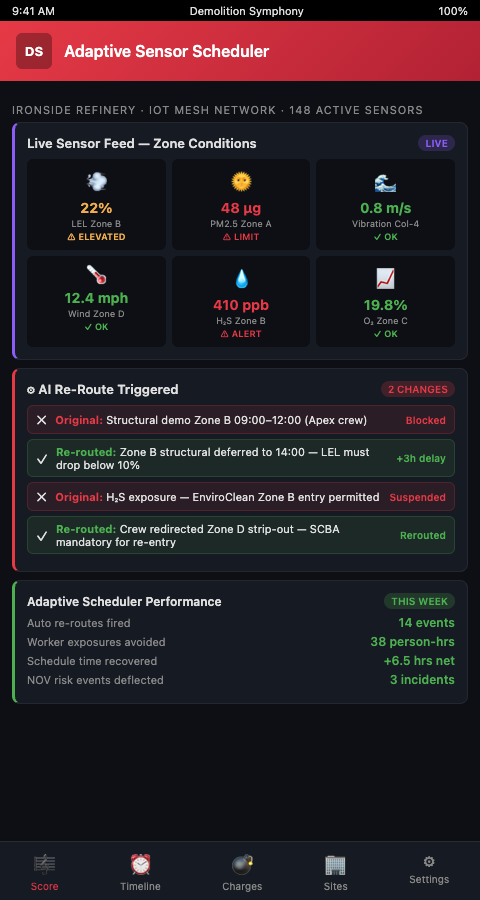
The Demolition Symphony Planner's score notation provides the natural interface for sensor-driven adaptive scheduling. Each measure of the score corresponds to a time interval; each zone has sensor thresholds annotated as performance conditions on the relevant voice lines. When a sensor reading crosses a threshold, the score interface flags the affected measures in that zone — not as a standalone alert but as a notation on the score that shows which upcoming tasks are affected and what adjustment options are available.
This is the difference between a monitoring system and an adaptive scheduling system. A monitoring system tells you that PM10 at Zone C's perimeter is elevated. An adaptive scheduling system tells you that PM10 is elevated, that the source is the mechanical demolition activity in Zone C-2, that Zone C-2 can be held for 4 hours without affecting the critical path, and that delaying Zone C-2 by one shift will allow wind conditions to improve based on the meteorological forecast — presenting the adjustment as a scored option within the sequence rather than as an open-ended operational problem.
Digital twin research for construction management demonstrates that real-time sensor integration into a schedule model enables adaptive sequencing decisions that would otherwise require manual analysis of heterogeneous data streams — reducing the decision lag between condition detection and schedule adjustment from hours to minutes (ScienceDirect Digital Twin; Taylor & Francis).
The Demolition Symphony Planner's Contamination Buffer Tempo Control feature is the scheduling mechanism through which sensor-triggered holds are implemented: when a sensor threshold is crossed, the tempo in the affected zone is held — the notation does not advance — until the sensor reading returns to within the acceptable envelope or a supervisor authorizes an override with documented rationale.
As the analysis of real-time contamination mapping for demolition plan revision details, the contamination mapping layer provides the spatial context that transforms a point sensor reading into a zone-level schedule decision — the two capabilities must work together to close the loop between detection and response.
Implementing Sensor-Driven Adaptive Scheduling
Define sensor placement from the schedule, not from the site plan. The common approach to sensor network design is to distribute sensors evenly across the site — one per zone, one at each perimeter corner. The adaptive scheduling approach designs sensor placement from the schedule: where are the critical handoff points in the demolition sequence, what are the conditions that must be met at each handoff, and what sensors are needed to verify those conditions in real time? This produces a sensor network that is optimized for schedule management rather than for site-wide monitoring coverage.
Set threshold values to schedule-relevant conditions, not regulatory limits. Regulatory air quality limits exist for worker exposure and public health protection — they are appropriate boundaries for enforcement purposes. Schedule-relevant thresholds are lower: the condition at which the current demolition activity is on track to generate a regulatory exceedance within the next operational period. An adaptive scheduling system that triggers at the schedule-relevant threshold prevents exceedances rather than responding to them.
Build the override protocol into the score notation. Sensor-triggered tempo holds must have a documented override path for situations where the hold would create a greater risk than the condition that triggered it. The override protocol — who can authorize, what documentation is required, what additional controls must be in place — should be notated directly on the score at the threshold condition, so field supervisors have the authorization path without needing to reference a separate document.
Treat sensor data as a schedule input, not a safety report. The cultural shift required for adaptive scheduling is treating sensor readings as operational data that changes the schedule, not as safety compliance data that gets filed in the project record. When the safety officer and the project scheduler receive the same sensor data simultaneously and the scheduling system automatically generates adjustment options based on that data, the decision loop closes in the operational timeframe rather than the reporting timeframe.
For cross-sector comparison, sensor-driven adaptive scheduling for industrial decommissioning shares architectural principles with BIM model integration for stadium deconstruction planning: both integrate real-time condition data into a structural model to generate updated sequence recommendations — the difference is that the industrial decommissioning context adds chemical exposure as a primary sensor category alongside structural condition.
Conclusion
Sensor-driven adaptive decommissioning scheduling closes the gap between what sensors can measure and how that data changes the operational sequence. By integrating IoT data streams directly into the Demolition Symphony Planner score, decommissioning crews move from monitoring dashboards that describe conditions to scheduling systems that adjust to them — automatically holding the tempo in affected zones, presenting scored adjustment options, and building the documentation trail that regulatory compliance requires.
Industrial plant decommissioning crews running large teardowns need sensor data that talks to the schedule, not just to the safety record. The Demolition Symphony Planner's sensor integration layer connects your IoT network to the decommissioning score, so every threshold exceedance produces an immediate scoring adjustment rather than a delayed manual response. Start your sensor-driven scheduling setup today and get every IoT threshold connected to a scored schedule adjustment before your next teardown begins.