Integrating Environmental Compliance Checkpoints into Phase Gates
AEI Consultants documents that environmental compliance failures during industrial facility decommissioning cause delays of months or years—not days. The mechanism is predictable: a structural demolition phase begins before an environmental clearance for the preceding abatement phase has been formally issued, the regulatory agency discovers the sequence violation during a site inspection, and a stop-work order locks the entire project pending a compliance review. The review is not just of the immediate violation; regulators audit backward through the project's compliance history, looking for additional violations that preceded the discovered one. Environmental compliance checkpoints demolition phase gates exist specifically to prevent this audit scenario by making regulatory clearance a structural dependency—not a hoped-for outcome.
The industrial facility decommissioning compliance problem is organizational before it is technical. O6 Environmental's comprehensive decommissioning guide identifies the failure pattern: the project manager and the environmental consultant operate on separate timelines, with the consultant issuing clearances and approvals into a document management system that the project manager checks periodically. The project schedule does not require environmental clearance as a gate condition; it assumes that clearance will be issued in time. That assumption fails whenever regulatory review takes longer than the schedule buffer allows—which is more often than most project schedules acknowledge.
RCRA and CERCLA regulatory frameworks impose mandatory compliance requirements at multiple points in the decommissioning process: hazardous waste generator registration, manifest chain-of-custody for each waste shipment, remediation milestone approvals under state oversight agreements, and final site closure documentation. CERCLA Section 103 notification requirements impose release notification timelines that are measured in hours, not days—a compliance obligation that must be pre-programmed into the project response plan, not identified after the fact.
The Phase Gate Compliance Architecture
Think of environmental compliance checkpoints as rest marks on the decommissioning score—mandatory pauses between movements where the conductor verifies that the previous movement resolved completely before the next one begins. A piece of music without rests is not more efficient; it is incomprehensible. A decommissioning project without compliance phase gates is not faster; it is a regulatory liability accumulating in real time.
The phase gate compliance architecture for industrial decommissioning has four tiers. Tier 1, pre-mobilization gates: before any decommissioning work begins, regulatory notifications must be filed and accepted, permits must be in hand, and the environmental consultant's project-specific compliance plan must be approved. No crew mobilizes until all Tier 1 gates are closed. Tier 2, pre-phase gates: before each major phase begins—abatement, equipment extraction, structural demolition, or remediation—environmental clearance from the preceding phase must be issued and documented in the project system. That clearance is not a courtesy copy from the environmental consultant; it is a required input to the phase gate that unlocks the next phase on the schedule.
Tier 3, intra-phase checkpoints: within each active phase, specific activities trigger compliance checkpoints—waste manifest completion before container departure, air quality monitoring before crew entry after a containment event, soil characterization before excavation in a hold zone. Tier 4, phase closure audits: before a phase is marked complete and the zone is released for the next voice on the score, a structured environmental audit confirms that all compliance requirements for that phase have been satisfied and documented.
The Beck & Pollitzer step-by-step decommissioning guide provides a process-stage framework that maps naturally to this four-tier architecture. The OECD-NEA guide on preparing for decommissioning adds the licensing and regulatory interface dimension, particularly relevant for nuclear and chemical facility decommissioning where regulators are co-signatories on phase advance decisions.
The AEI Consultants specification-to-bid guidance notes that decommissioning projects with well-defined compliance gate structures attract better contractor bids—because contractors can price the compliance requirements accurately rather than embedding contingency for regulatory uncertainty.
Implementing Compliance Gates in Demolition Symphony Planner
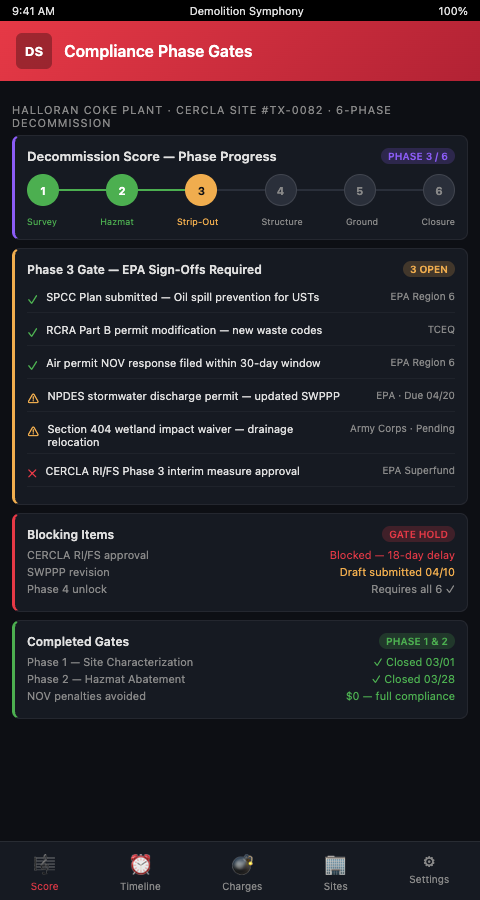
Demolition Symphony Planner embeds environmental compliance checkpoints as mandatory voice gates on the decommissioning score. Each phase transition requires a compliance clearance input before the subsequent phase can be scheduled or executed. The clearance input is not a task checkbox—it is a document reference: the clearance letter number, issuing agency, date, and scope. That document reference is attached to the phase gate record in the project file, creating an audit trail that demonstrates sequential compliance rather than post-hoc documentation.
The compliance gate structure works across regulatory frameworks. For RCRA-regulated waste streams, the gate inputs are manifest chain-of-custody confirmations—the receiving facility's confirmation that each shipment was received and accepted. For CERCLA-governed remediation, the gate inputs are the regulatory agency's milestone approval letters. For OSHA-governed abatement, the gate inputs are the industrial hygienist's clearance reports and air monitoring results. For permit-required activities—controlled burns, large-scale demolition permits, stormwater permits—the gate inputs are the permit documents themselves.
Controlled burn permit requirements exemplify the phase gate structure: the burn event cannot be scheduled until the permit approval gate is closed, the burn cannot proceed until the meteorological condition gate is confirmed, and subsequent demolition in the burn zone cannot begin until the post-burn air quality clearance gate is closed. Three compliance gates for a single demolition event. Demolition Symphony Planner requires all three before the structural phase following the burn is unlocked.
For soil remediation oversight, the state environmental agency's remediation milestone approvals are the critical path items in the compliance gate structure. Those approvals may require 30-90 days of regulatory review after the remediation contractor submits evidence of milestone achievement. That review period must appear on the project score as a fixed-duration mandatory rest, not as a float period that the project manager assumes will be shorter than its maximum duration.
Advanced Tactics for Regulatory Relationship Management
Environmental compliance phase gates are not just a scheduling mechanism—they are a relationship mechanism. The regulatory agency that receives compliance documentation consistently, in advance, and in complete form is the agency that processes approvals promptly. The agency that receives incomplete submittals, late notifications, and defensive explanations is the agency that adds review cycles, requests additional documentation, and sends inspectors. The compliance gate structure in Demolition Symphony Planner supports proactive regulatory relationship management by tracking submission dates, response times, and pending approvals—giving the environmental consultant and project manager visibility into which gates are approaching, which submittals are overdue for response, and where follow-up is required.
AEI Consultants' decommissioning liability guidance identifies early regulatory engagement—before the project is in the field—as the highest-leverage compliance risk reduction strategy. Pre-project meetings with state environmental agencies, early permit applications, and preliminary hazardous material surveys submitted for agency review before demolition begins reduce both approval timelines and stop-work risk during execution.
Multi-agency coordination for projects spanning multiple jurisdictions requires the same gate architecture applied across multiple approval chains simultaneously. Each agency's clearance requirements, review timelines, and submittal formats are different; the project score must accommodate the longest lead time across all agencies for each phase transition gate.
Phase gate environmental audit industrial practice should include an internal pre-submittal review before each compliance document is sent to a regulatory agency. A submittal that returns with a request for additional information adds the agency's review period to the project critical path twice—once for the initial submittal and once for the resubmittal. Internal quality review before submission is cheaper than external review after an incomplete submittal.
Compliance verification before demolition phase transition is the structural mechanism that prevents the audit scenario AEI describes: the stop-work order that audits backward through everything done before it was issued. Demolition Symphony Planner prevents that scenario by ensuring that every phase begins with documented proof that the previous phase met its environmental obligations—proof that is attached to the project record, not filed separately in an environmental consultant's system the project manager cannot access.
Ready to integrate environmental compliance into your phase gate structure? Load your regulatory framework requirements, permit applications, and compliance milestones into Demolition Symphony Planner and let the scheduling engine enforce sequential compliance before any crew advances to the next phase. Start your compliance gate setup today and get every regulatory clearance requirement embedded as a hard dependency before the first phase transition reaches the field.