How to Schedule Controlled Burns Within a Demolition Plan
An EPA permit document from the SEMSPUB repository describes a controlled burn authorization at a contaminated industrial site that required pre-notification to state and local agencies, air quality modeling for downwind receptor impact, and a post-burn air quality verification period before adjacent demolition activities could resume. The permit conditions span six pages. Most decommissioning project schedules allocate "burn day" as a single Gantt bar. That gap—between the multi-dimensional regulatory reality of a controlled combustion event and the single-bar schedule entry—is where controlled burn scheduling failures originate.
Industrial demolition controlled burn permits are not a formality. EPA's open burning requirements for large-scale demolition establish federal baseline conditions: notification requirements, prohibited material lists (asbestos-containing materials may never be open-burned), air quality conditions, and documentation requirements. 40 CFR Part 257 governs solid waste open burning at demolition sites. State-level requirements layer on top: Iowa DNR's open burning procedures and Illinois EPA's open burning permit process each establish state-specific approval windows, notification timing, and material restrictions that apply in addition to federal requirements. The project team must identify the applicable state framework and build its lead times into the schedule before any burn date is proposed.
The WorldMetrics demolition industry statistics report places the U.S. demolition industry at $11.1 billion in annual revenue—a market where schedule compression creates significant commercial pressure to compress regulatory lead times. Fire-assisted demolition industrial site applications face that pressure directly: a burn that could accelerate structure removal by two weeks is tempting to schedule before permits are fully in hand. That sequence—burn first, permit problems second—is the fastest path to stop-work orders and project liability.
The Controlled Burn Scheduling Framework
Think of a controlled burn event as a percussion fortissimo in the middle of a quiet orchestral passage. The event itself is brief and powerful. But the score demands measures of preparation before the downbeat—wind condition readings, receptor distance checks, material verification—and measures of resolution afterward—air quality clearance, residue characterization, perimeter inspection. The conductor who marks only the fortissimo downbeat and ignores the preparation and resolution measures will find the orchestra unable to resume after the percussive event.
Planned burn sequencing facility teardown has five sequential requirements that must all appear on the project schedule as distinct activities, not as implicit preparation steps embedded in the burn event itself.
First, material verification: any structure proposed for controlled burning must be fully characterized for prohibited materials before the burn permit application is submitted. Asbestos-containing materials, PCBs, and lead paint are prohibited from open burning under federal and most state regulations. Characterization must be documented and attached to the permit application. This step alone typically requires 2-4 weeks for sampling and laboratory analysis.
Second, permit application and approval: permit applications must be submitted to the state environmental agency with sufficient lead time for review. The EPA's state demolition information resource identifies state contacts and specific application requirements. Review timelines vary by state from 10 business days to 60 days. The permit approval date—not the application submission date—is the constraint that governs burn scheduling.
Third, meteorological window confirmation: controlled burns require specific wind speed and direction conditions to ensure that smoke plumes do not impact identified downwind receptors—residences, schools, healthcare facilities. NOAA's atmospheric dispersion guidance for open burning operations and the American Meteorological Society's open burning meteorology standards provide the technical basis for receptor identification and meteorological condition requirements. Burn day scheduling must allow for weather-related postponement without cascading the entire structural demolition sequence.
Fourth, fire suppression pre-positioning: fire suppression resources must be pre-positioned before ignition, with a confirmed agreement with the local fire authority. That agreement is not a phone call; it is a documented coordination event with specific resource commitments, access routes, and command structure.
Fifth, post-burn air quality clearance: residue from controlled burns—ash, char, and combustion byproducts—must be characterized and cleared before adjacent demolition activities resume. The clearance period is a mandatory rest on the score, not a contingency day.
Integrating Controlled Burns into the Decommissioning Score
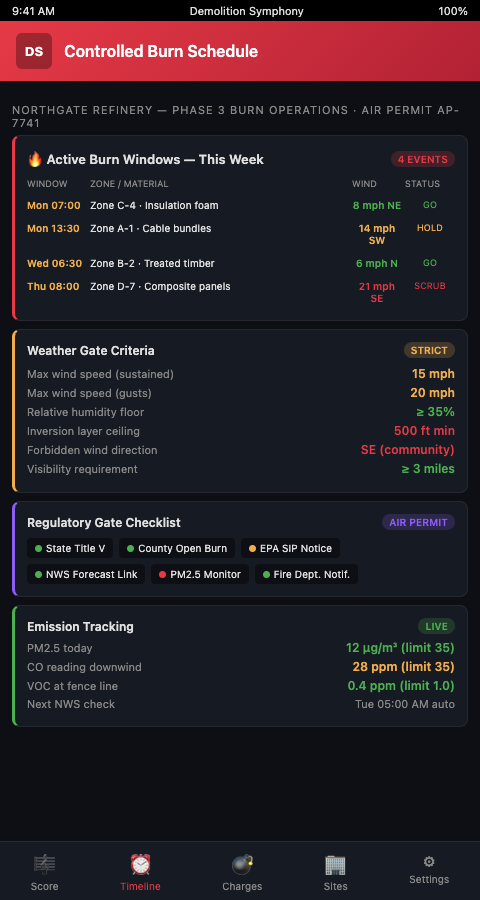
Demolition Symphony Planner treats controlled burn events as composite activities with mandatory pre-burn and post-burn voices. When a project manager adds a controlled burn event for a zone, the system expands it into five sequential requirement voices: material characterization, permit application, permit approval (held open until the project manager enters the approval date), meteorological window, and post-burn clearance. No subsequent demolition activity in that zone can be scheduled until all five voices have resolved.
The meteorological window voice is handled differently from the other four: it is a condition requirement rather than a task completion. The project manager sets the required wind condition parameters, and the burn day is tagged as weather-dependent on the score. When the burn day arrives, if conditions are not met, the burn is automatically rescheduled to the next available window, and the post-burn clearance voice shifts accordingly—pulling the structural demolition start for that zone without requiring manual schedule rework.
Soil remediation considerations interact directly with controlled burn events: if the burn zone overlaps with an active soil remediation area, ash and combustion residue deposition will affect the remediation substrate. The post-burn residue characterization must include soil impact assessment, and the remediation voice for that zone must be re-evaluated after the burn. Demolition Symphony Planner flags this overlap when both voices are active in the same zone polygon.
Controlled combustion decommissioning workflow on industrial sites often involves multiple burn events across the project timeline, each requiring its own permit and clearance cycle. The cumulative permit and clearance time can represent 15-20% of the total project schedule on vegetation- and structure-rich sites. Mapping all burn events at the start of the project—rather than scheduling them when the need arises—allows permit applications to be batched and staggered, reducing the peak permit management burden.
Advanced Tactics for Permit Management and Risk Mitigation
State permit variability is the largest planning risk in controlled burn scheduling. The National Conference of State Legislatures' environmental permitting resource is a useful reference for identifying state-specific air quality permit frameworks, but the project team should confirm current requirements with the state environmental agency directly at the start of the project—not at the start of the burn planning phase.
For projects in counties or municipalities with additional local restrictions, the permit stack may include federal baseline, state permit, county air quality permit, and local fire authority approval—four separate approval processes with potentially conflicting timelines. All four should appear on the project score as sequential voices, with the longest lead time governing the burn event's earliest possible date.
Air quality monitoring requirements during and after controlled burns are more extensive than during standard demolition phases. Combustion generates CO, volatile organic compounds, and fine particulate matter simultaneously. Monitoring must cover all three contaminant categories, with reading positions downwind of the burn at multiple distances from the perimeter. Post-burn monitoring continues until all readings return below action levels—a condition that may take hours or days depending on atmospheric stability and burn volume.
Cross-niche relevance: the wind condition dependency in controlled burn scheduling parallels the wind load analysis required for directional implosion planning, where meteorological conditions determine both the safety of the operation and the regulatory permissibility of proceeding. In both cases, the wind condition is a first-class scheduling constraint that must appear on the score as a gate—not a note in the field superintendent's daily log.
Industrial demolition controlled burn permits are the regulatory mechanism through which the environmental agency verifies that your combustion event will not create public health consequences. Treating them as paperwork that follows operational planning inverts the required sequence. Demolition Symphony Planner enforces the correct sequence: the permit voice precedes the burn event voice on the score, and the burn event cannot be scheduled until the permit approval date is entered.
Ready to integrate controlled burns into your decommissioning sequence? Map your proposed burn zones, material characterization status, and state permit requirements into Demolition Symphony Planner and let the scheduling engine build the full permit and clearance timeline before you schedule the first structural phase that depends on burn completion. Start your burn permit planning today and get all five pre-burn and post-burn requirement voices on the score before you propose the first burn date to your structural contractor.