Wind Load Calculations and Their Impact on Implosion Direction
What Wind Actually Does to a Falling High-Rise
Most demolition engineers intuitively account for wind when planning exclusion zones — they know that debris and dust travel downwind. What is less commonly treated with the same rigor is the wind effect on building implosion during the collapse sequence itself. A 40-story steel-frame structure behaves like a slender column under lateral load. At the moment the initiating charge group fires, the structure begins to translate in the designed fall direction. If a sustained wind is acting on the full facade at that moment, the wind load adds a lateral moment to the collapsing mass — biasing the fall direction toward or away from the designed trajectory depending on the wind vector relative to the fall axis. Implosion fall direction wind planning that doesn't account for this force quantitatively is relying on luck rather than engineering for one of the most critical parameters in urban implosion safety.
Wind gusts destabilize debris-blocking curtains and increase debris dispersal, but the structural effect is subtler and harder to compensate for in the field. The ASCE 7 wind pressure formula — qz = 0.00256 × Kz × Kzt × Kd × V² — calculates design wind pressure at a given height. For a 40-story building at 400 feet with a 25 mph wind, the resulting lateral pressure on the full facade generates a force that is not negligible relative to the lateral impulse from the charge sequence. At 40 mph, the wind load at height exceeds what most implosion sequence models account for.
Field observations of wind-induced facade damage document directional collapse risk at relatively modest wind speeds, particularly for buildings with large facade area-to-mass ratios. Curtain wall towers are more vulnerable to wind-induced fall direction deviation than concrete-clad structures, because the ratio of wind load to structural mass is higher.
Integrating Wind Load Calculations into the Implosion Direction Plan
The visual score for a wind-compensated implosion plan has an additional annotation layer: a wind vector overlay on the fall direction diagram. Every planned fall direction has a wind compensation margin — a timing adjustment on the upwind side that corrects for the lateral push the wind will exert during the collapse sequence. This is not a post-shot correction; it is a pre-shot design parameter.
Step 1: Establish the wind design case for your site. Pull the ASCE 7 basic wind speed for your geographic location and exposure category. A dense urban core is typically Exposure Category B or C. Calculate qz at intervals of ten floors from grade to roof. The pressure at the top floors of a 40-story building in a 30 mph sustained wind is meaningfully higher than at grade. This pressure distribution is the lateral force that acts on the structure at the moment of firing.
Step 2: Determine the maximum allowable wind speed for the planned fall direction. For a given fall direction and a given charge weight and delay sequence, there is a wind speed at which the lateral deflection of the fall trajectory exceeds your exclusion zone margin. Calculate that threshold before the shot, not the morning of. Demolition experts check wind direction and speed before every implosion — but the check is only useful if you know in advance what speed is the go/no-go threshold.
Step 3: Apply asymmetric delay compensation for cross-wind conditions. If the planned fall direction is north and the wind is blowing from the west at the time of firing, the wind exerts a westward lateral force on the collapsing structure. To compensate, apply slightly shorter delay intervals on the east face of each floor block — initiating collapse there fractionally earlier — to create a counter-moment that offsets the wind-induced eastward bias. The specific delay differential depends on the wind force magnitude at the firing time and the structural mass of each floor block.
Step 4: Integrate wind monitoring into the pre-shot go/no-go protocol. Deploy an anemometer at roof height at least 24 hours before the shot. Track both sustained wind speed and gust speed in ten-minute averages. If either metric exceeds your threshold at any point in the two-hour pre-shot window, the default decision is delay — not proceed with a note in the log. The go/no-go protocol should be in writing, signed by the responsible engineer, before the day of the shot.
Step 5: Cross-reference with the dust cloud propagation model. Wind direction on the day of firing determines not just the structural fall direction risk but also where the post-blast PM10 cloud travels. Community air sampling during implosions is positioned based on wind direction. Your implosion sequence plan should show the wind compensation adjustment on the same page as the dust dispersal model — because both are consequences of the same wind condition, and a change to one must be reviewed against the other.
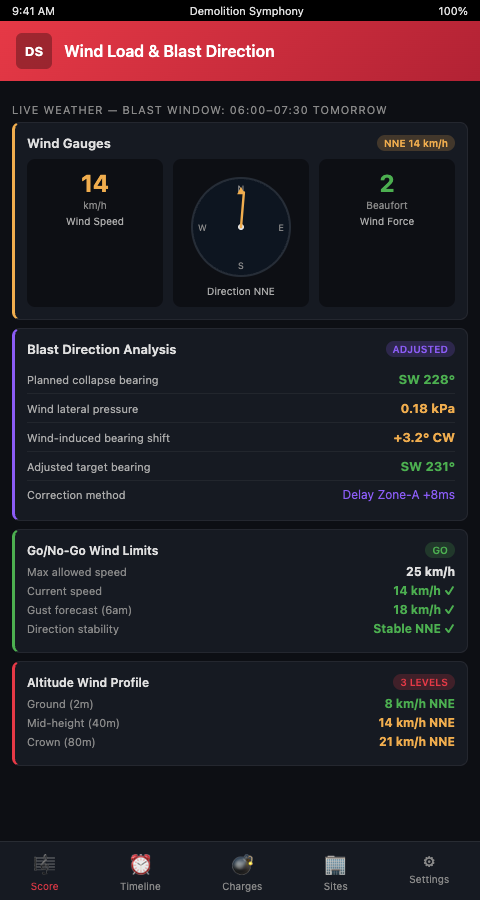
Step 6: Model the Demolition Symphony Planner score with a wind-condition variant. Build a base sequence for calm-wind conditions and a second version with the compensation adjustments applied for prevailing wind direction. If the day of the shot arrives with wind from an unexpected direction, you need a third variant or a decision matrix that tells you which adjustments to make in real time. Having these variants pre-built in the score means the firing team is not making timing adjustments under pressure on shot day.
Advanced Tactics: Facade Effects, Wind Profiling, and Regulatory Requirements
Account for facade exposure variation by floor. The ASCE 7 exposure height factor Kz is not constant over the height of a 40-story building. Wind pressure at floor 38 is substantially higher than at floor 10, meaning the wind-induced lateral force is concentrated in the upper floors. This matters for implosion sequencing because the upper floors are also the last to initiate in a standard progressive collapse sequence — they are still standing and subject to full wind load while the lower floors are already collapsing. Model the time-varying wind load on the upper block during the collapse progression, not just the static pre-shot condition.
Require a wind profile from a nearby meteorological station, not just the on-site anemometer. An on-site anemometer reads conditions at one point in time and one elevation. A meteorological wind profile gives you directional consistency over a 24-hour period, allowing you to assess whether the wind conditions are stable or variable. Variable wind conditions — rapid direction shifts, gusty periods — are more dangerous than sustained wind in one direction, because they can interact with the collapse sequence in ways that a directional compensation calculation cannot fully anticipate.
Connect wind load analysis with seismic monitoring planning. Wind-driven sway in the building at the time of firing changes the effective natural frequency of both the target structure and adjacent buildings. That frequency shift affects ground vibration response — a seismograph reading taken during a windy shot will show a different frequency signature than the same shot in calm conditions. Document wind speed at the time of each seismograph reading to allow proper interpretation of the recorded data.
Use SkyCiv Wind Load Module for rapid ASCE 7 calculations across floor levels. For a 40-story building, manually calculating qz at each floor level is feasible but time-consuming. Software tools that automate the ASCE 7 calculation by floor let you produce a full wind pressure profile in minutes, which feeds directly into the asymmetric delay compensation calculation.
Apply the same analysis to air quality monitoring transitions during industrial decommissioning. Plant decommissioning projects that involve sequential strip-out also face wind-dependent contaminant dispersal challenges. The principle of building wind condition variants into the sequencing plan — rather than treating wind as a day-of variable — applies across demolition types.
Common mistake: treating the go/no-go wind threshold as a contractor judgment call on shot day. The threshold must be calculated, documented, and signed off by the responsible engineer before the shot date. On shot day, the measurement either clears the threshold or it does not. Leaving the threshold undefined forces the shot supervisor to make a risk judgment under schedule pressure — which is the wrong person, making the wrong type of decision, at the worst possible time.
Build Wind Into Your Score Before Shot Day
Demolition Symphony Planner gives urban high-rise implosion coordinators the tools to embed wind compensation directly into the sequence score — so fall direction modeling, delay adjustments, and go/no-go thresholds are all in one document before the day of the shot.
Wind load calculations implosion direction planning works because the delay compensation for wind is a geometry problem: given the wind force acting on the facade at the moment of firing, what delay differential between the upwind and downwind column faces produces a counter-moment that offsets the lateral bias? That calculation is done once, before the shot, when there is time to verify it. The blast direction wind compensation derived from that calculation then becomes a documented variant in the sequence score — a named condition with specific delay values that the field team executes if wind conditions on shot day fall within the triggering range. Weather conditions controlled demolition outcomes more than most coordinators acknowledge in their planning documents; building the wind variant into the score before shot day is how the planning process closes that gap.
Join the waitlist and be among the first urban high-rise implosion teams to run a wind-integrated sequence plan where every compensation adjustment is visible in the firing score.