Integrating Air Quality Monitoring into Demolition Phase Transitions
A study published in PMC found that asbestos fiber concentrations exceeded the limit of detection in 53% of air samples taken during active demolition phases—not during abatement, but during the structural work that followed clearance. That finding points to one of the most expensive failures in industrial plant decommissioning: passing a clearance test at the end of abatement and then treating air quality as a solved problem for the rest of the project. Phase transitions are where contamination re-emerges, and they are where air quality monitoring demolition phase transitions protocols matter most.
The failure mode is sequential thinking applied to a parallel problem. Abatement crews clear a zone, a third-party hygienist takes samples, clearance is issued, and structural demolition begins. But the structural work disturbs settled dust in adjacent ceiling voids, opens wall cavities that abatement never accessed, and generates new particulate that mixes with legacy contamination. OSHA's air contaminants standard (1910.1000) sets permissible exposure limits for dozens of industrial contaminants, but it does not tell a project manager when during a multi-phase decommissioning sequence those limits are most likely to be breached. That is a scheduling decision, not a regulatory question.
EPA's NAAQS for particulate matter establishes the ambient standards that perimeter monitoring must meet. OSHA 1926.55 governs construction-phase PELs. Industrial demolition air quality checkpoints must satisfy both: worker-zone readings inside the work envelope and perimeter readings at the site boundary. Most decommissioning schedules treat these as two separate inspection events rather than a continuous monitoring overlay on the phase timeline.
The Phase-Transition Monitoring Problem
Think of the full decommissioning schedule as a musical score. Hazmat abatement, equipment extraction, and structural demolition are separate voices—each with its own tempo and rest requirements. Air quality monitoring is the acoustics engineer in the hall: present at every movement change, verifying that the sound from the previous section has fully dissipated before the next section begins. Without that verification, the overlapping sound waves—contamination from one phase bleeding into the next—produce noise instead of music.
The phase-transition monitoring problem has three components. First, transition timing: the moment one crew exits and another enters is the highest-risk window for airborne hazard exposure, because physical disturbance of the work area accompanies every handoff. Second, monitoring location: fixed perimeter monitors catch boundary exceedances but miss the worker-zone peaks that occur during the first hours of a new phase. Third, trigger thresholds: what reading level stops the next phase from starting, and who has authority to call that stop?
Research on airborne PM from construction sites (ScienceDirect) documents that particulate concentrations spike during the first 30 minutes of mechanical demolition activity—precisely the window when incoming crews are setting up equipment and have the highest exposure before controls are fully established. Industrial demolition air quality checkpoints placed only at the end of prior phases miss this spike entirely.
Asbestos enclosure negative pressure requirements—typically -5 to -40 Pa relative to adjacent spaces, per PMC research on enclosure ventilation—must be maintained and verified not just during abatement but during the barrier removal that precedes structural demolition. Barrier removal is itself a phase transition, and it carries re-suspension risk that standard clearance protocols do not address.
Building the Monitoring Score in Demolition Symphony Planner
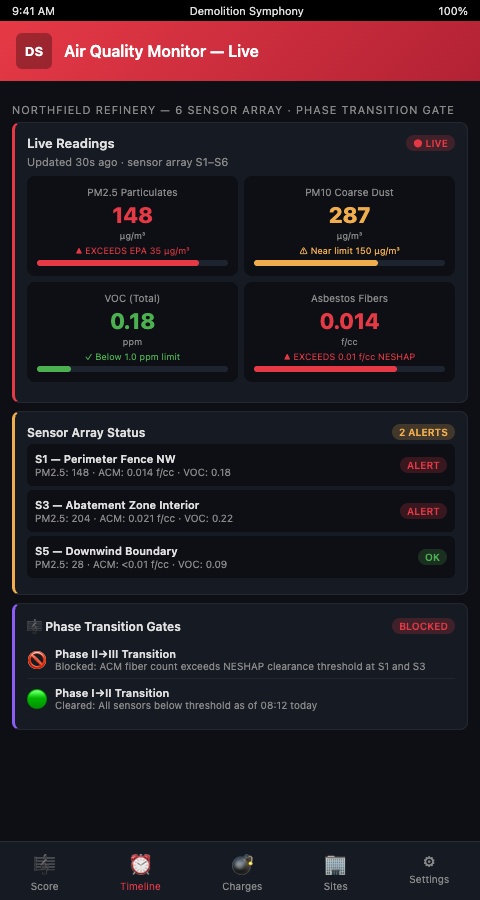
Demolition Symphony Planner treats air quality monitoring as a voice on the decommissioning score—not a separate inspection report that lives in a different file. Each phase transition between demolition voices (hazmat to extraction, extraction to structural, or any re-entry after a containment event) carries an embedded monitoring window that must resolve before the next voice is unlocked.
The monitoring voice works as follows. When a project manager marks a hazmat phase complete for a zone, Demolition Symphony Planner does not immediately enable extraction scheduling. It inserts a mandatory monitoring window—configurable by contaminant type (asbestos, silica, lead, PCB) and jurisdiction—and requires a clearance input before the phase gate opens. The clearance input can be a manual entry by the certified industrial hygienist, an API feed from a continuous monitoring device, or a third-party lab result timestamp. Until clearance is entered, the next phase remains locked on the score for that zone.
For protecting operational units adjacent to decommissioning zones, air monitoring becomes a boundary condition, not just a phase gate. Operational units that share HVAC systems or are within 50 meters of active demolition require continuous perimeter monitoring, and any exceedance in the perimeter zone triggers an automatic restriction flag on adjacent operational zone activities in the schedule.
The IES guide on air quality monitoring at demolition sites identifies three monitoring strategies applicable to phase-transition protocols: real-time particle counters for continuous readings, gravimetric samplers for regulatory compliance samples, and optical dust monitors for rapid response during high-activity transitions. Demolition Symphony Planner supports all three as data input types, letting the hygienist designate which reading type satisfies each phase gate requirement.
Advanced Tactics for Continuous Airborne Hazard Monitoring
Static monitoring plans fail on large industrial sites because the wind changes, the work location shifts, and the nearest monitor is suddenly upwind of the activity. Aeroqual's guidance on remediation site monitoring recommends a mobile monitoring strategy for sites with shifting work fronts: a base network of fixed perimeter monitors supplemented by roving real-time monitors that follow active crews through phase transitions.
The practical implementation for a multi-building decommissioning project: assign one roving monitor to each active phase transition event. When Building C transitions from abatement to extraction, the roving monitor accompanies the first extraction crew for the initial two hours of activity, taking readings every 15 minutes. Readings above 50% of the relevant PEL trigger a work pause and re-evaluation. Readings below 25% of PEL for three consecutive intervals authorize full crew mobilization. These trigger bands should be set in the project's air monitoring plan, not improvised in the field.
For soil remediation phases running concurrently with above-grade demolition, the air monitoring plan must account for re-suspension of contaminated soil particulate when excavation equipment operates near active structural demolition. The two dust sources combine; monitoring positioned to capture only one will systematically underread the worker exposure in the overlap zone.
Cross-niche relevance: the same phase-transition monitoring logic applies to dust control methods during stadium arena demolition, where structural demolition in one section of the bowl generates dust that migrates into adjacent sections where crews are still working. The monitoring voice on the score prevents that migration from becoming an exposure event.
Dust and particulate control demolition phases protocols should specify suppression method as well as monitoring method. Water suppression, foam suppression, and physical barriers each have different effectiveness profiles against different contaminant types — for example, water suppression is effective for silica and general demolition dust but provides minimal benefit for fibrous asbestos particles that require enclosure and HEPA filtration. The monitoring data from phase transitions should feed back into suppression method selection for subsequent transitions—a closed-loop system rather than a static plan.
Ready to integrate air quality monitoring into your decommissioning sequence? Load your facility layout into Demolition Symphony Planner and let the scheduling engine embed monitoring windows, clearance gates, and trigger thresholds into every phase transition before your first crew mobilizes. Start your monitoring-integrated schedule today and get every phase transition locked behind a clearance gate before the next crew enters.