Protecting Operational Units During Adjacent Building Decommissioning
J.S. Held's analysis of construction vibration impacts documents that structural damage to adjacent facilities is among the most underestimated risks in partial-plant decommissioning—not because vibration events are unpredictable, but because nobody measured the baseline vibration threshold of the operational equipment before demolition started. A chemical process reactor operating at 60% capacity has a known vibration tolerance. That tolerance is not checked against the vibration profile of a high-reach excavator working 30 meters away, because the team writing the demolition schedule and the team managing reactor operations are in different organizational hierarchies. Active facility protection during demolition fails most often not in the field but in the planning gap between the two teams.
Partial plant decommissioning—where one section of a facility is being demolished while adjacent sections continue to produce—is increasingly common as companies seek to optimize asset recovery while maintaining revenue. OSHA's 1926.850 standard on demolition preparation requires engineering surveys before demolition begins, but the survey requirement does not specify that those surveys must characterize vibration tolerance of adjacent operational equipment, utility interdependencies between the demolition zone and the live plant, or shared access routes that demolition traffic will use. Those characterization gaps become field conflicts.
Fprimec's guide on ground-borne vibration monitoring notes that demolition-induced ground vibrations can affect operational equipment at distances up to 200 meters depending on soil type and vibration frequency. Protecting operational units adjacent decommissioning zones requires continuous vibration monitoring at the live plant boundary, with trigger thresholds tied to the operational equipment's manufacturer specifications—not generic construction vibration limits.
The Adjacent Operations Scheduling Problem
Think of the full facility as a musical score where the live plant is a sustained note that must not be interrupted—a held chord in the strings while the brass section (demolition) plays a percussive passage in the same hall. The conductor's job is to ensure that the percussion never exceeds the acoustic threshold that would cause the string section to drop their bows. Operational continuity industrial demolition planning means writing the percussion part with explicit dynamic markings that respect the strings' sustained tone.
The adjacent operations scheduling problem has four distinct dimensions. First, vibration envelopes: heavy demolition equipment generates ground vibration that propagates through the substrate. The DOT's ground vibration monitoring study documents peak particle velocities and frequency profiles for common construction equipment, and those profiles must be matched against the operational equipment's tolerance specifications. Where the profiles overlap—where the demolition equipment's vibration output exceeds the operational equipment's tolerance—either the demolition method must change or the operational equipment must be temporarily shut down.
Second, utility isolation and shared services: a live plant and an adjacent decommissioning zone typically share utilities—steam, process water, electrical distribution, compressed air. Isolating utilities in the decommissioning zone without affecting live plant supply requires detailed utility tracing, shared-service risk assessment, and often temporary utility installations. OSHA's Technical Manual, Section V Chapter 1 addresses the utility isolation requirements in mixed-use construction environments.
Third, personnel access and emergency egress: demolition traffic sharing access roads with operational personnel creates both safety hazards and logistics conflicts. Emergency egress routes from the live plant must remain unobstructed during all demolition phases. The NYC Building Code safeguards chapter (UpCodes) provides a useful framework for access segregation requirements that applies beyond New York for industrial sites with mixed operational and demolition activity.
Fourth, contamination migration: abatement activities in the decommissioning zone generate airborne hazards that can migrate into the live plant through shared HVAC systems or open interfaces. Containment barrier integrity between the zones must be maintained and monitored continuously, not just inspected at shift start.
Applying the Score to Live Plant Protection
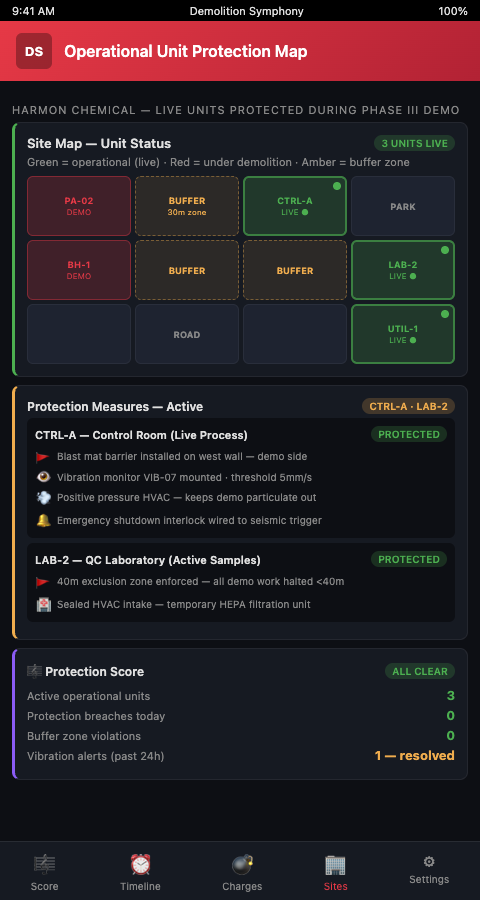
Demolition Symphony Planner models the live plant as a protected voice on the score—a voice with fixed dynamic constraints that the demolition voices cannot exceed. When a project manager schedules high-vibration demolition activity in Zone C, the score checks Zone C's proximity to operational units and applies the relevant vibration threshold. If the scheduled activity profile exceeds that threshold for the adjacent operational equipment, the score flags the conflict before the activity is approved.
The live plant protection model works across four layers. The vibration layer: each demolition activity type has an assigned vibration profile; each operational unit has an assigned tolerance threshold; the score enforces that no scheduled demolition activity in proximity zones can exceed the tolerance threshold without a documented engineering override. The utility layer: utility isolation states in the decommissioning zone are tracked on the score, and any isolation action that touches a shared service requires a live plant impact assessment before it can be scheduled. The access layer: demolition traffic routes are mapped against operational personnel egress routes, and shared-use windows require coordinated access management. The contamination layer: air quality monitoring at the operational unit boundary feeds back into the score as a real-time gate, restricting demolition activities that breach the contamination threshold at the live plant interface.
Sonitus's vibration limit guidance provides the specific peak particle velocity thresholds—typically 5mm/s for sensitive equipment, up to 50mm/s for robust industrial structures—that should be programmed as dynamic constraints in the score. These thresholds vary by equipment type and frequency, and they should be set per operational unit, not as a single site-wide limit.
Advanced Tactics for Operational Continuity
For large partial-plant decommissioning projects, the live plant protection protocol requires a dedicated interface coordinator—a role that sits between the demolition project management team and the plant operations team. The interface coordinator attends both the daily demolition coordination meeting and the plant operations shift handoff, carrying real-time information about demolition phase states into operational planning decisions and vice versa.
Environmental compliance checkpoints integrated into demolition phase gates must include an operational impact assessment at each gate: before any demolition phase advances to a higher-intensity activity, the interface coordinator must confirm that the live plant has been notified and that operational shutdown sequences have been activated where necessary. That confirmation appears on the score as a required input before the phase gate opens.
Cross-niche reference: the vibration envelope and access segregation logic that governs partial plant decommissioning is the same logic applied to critical safety zone planning for urban highrise implosion, where occupied buildings near the implosion site require equivalent protection against vibration, debris, and access disruption. The score-based constraint model works across both contexts.
Live plant operation near demolition zone success depends on a planning document that treats the live plant not as background context but as a first-class scheduling constraint. Every demolition activity that touches the adjacent zone interface must be evaluated against the operational envelope before it is approved — including activities that appear unrelated to the live plant boundary but share utility systems or drainage pathways that cross into the operational area. Demolition Symphony Planner enforces that evaluation automatically, ensuring that operational continuity industrial demolition requirements are embedded in the schedule rather than managed through field-level improvisation.
Ready to protect your operational units while decommissioning proceeds? Map your live plant boundaries, utility interdependencies, and vibration tolerances into Demolition Symphony Planner and let the score enforce the operational envelope before any demolition crew enters an adjacent zone. Start your live-plant protection plan today and get vibration thresholds, utility isolation states, and contamination barriers mapped into the score before the first demolition activity touches an adjacent zone.