Integrating Seismic Monitoring with Implosion Sequence Plans
Why Ground Vibration Limits Define the Entire Implosion Sequence
The USBM RI-8507 standard sets safe peak particle velocity (PPV) thresholds between 0.5 and 2.0 in/sec depending on structure type and dominant frequency — and these numbers are not conservative engineering cushions. They reflect the point at which gypsum board cracks, mortar joints open, and unreinforced masonry begins to separate. In a dense urban core, where a 40-story implosion may have hospitals, metro tunnels, or century-old brick facades within 150 meters, every charge group fires inside a compliance window that is literally measured in fractions of an inch per second.
The core problem with high-rise implosion planning is that vibration does not scale linearly. Doubling the explosive weight per delay does not double PPV at a fixed distance — attenuation varies with geology, saturation depth, and the presence of underground voids. A federal study on PPV monitoring requirements found persistent exceedances in urban blasting operations precisely because planners relied on scaled-distance formulas calibrated for open-pit quarry conditions rather than city geology. The formula works as a starting estimate; seismograph data from the actual site replaces the estimate with ground truth.
For urban high-rise implosion coordinators, this means seismic monitoring is not just a compliance checkbox — it is the primary instrument that tells you whether your delay intervals are working. Seismograph integration blast planning requires treating the monitoring network as a design input, not a post-blast documentation task: the sensor locations, PPV thresholds, and trigger points all belong in the implosion sequence plan before the first charge is specified. Urban demolition vibration limits — whether set by USBM RI-8507, local ordinance, or project-specific engineering review — are only enforceable if ground vibration monitoring demolition protocols are in place and actively reporting during the shot.
The Seismic Monitoring Framework for Implosion Sequence Design
Think of your delay network as a musical score. Each charge group is a note, each delay interval is a rest between notes, and the PPV waveform at a monitoring station is the acoustic output that tells you whether the composition is coherent or dissonant. If two note clusters land too close together, their waveforms combine constructively — peak amplitude at the receiver spikes above your compliance threshold. The job of seismic monitoring integration is to keep every combined waveform within bounds, at every receiver location, across all 40 floors of your demolition score.
Step 1: Pre-blast baseline survey. Before any explosive work begins, deploy triaxial seismographs at three classes of locations: the nearest occupied structure, the nearest underground utility corridor, and any historic or unreinforced masonry building within the exclusion zone. Log 48-72 hours of ambient vibration. This baseline matters because many urban sites carry persistent micro-vibration from transit or industrial operations — your compliance margin is net of that baseline, not net of zero.
Step 2: Scaled-distance modeling tied to delay groups. Use the USBM scaled-distance formula (SD = D / √W, where D is distance in feet and W is maximum charge weight per delay in pounds) to predict PPV at each monitoring station for each delay group. Feed these predictions into your implosion sequence plan before you assign any timing intervals. The goal is to confirm that no two adjacent delay groups, when their seismic waves travel to the same receiver, arrive within the constructive interference window — typically within 8 milliseconds of each other at the receiver. Note that wind load impact on the structure at the time of firing can shift the effective vibration frequency by altering the building's sway state — a factor that scaled-distance models do not account for automatically.
Step 3: Real-time seismograph integration during the shot. Modern seismograph systems can now compress analysis that once took days into seconds. Real-time seismograph integration has reduced post-blast compliance verification from multi-day analysis to near-instantaneous feedback, which matters enormously when you are firing 200+ charge groups across a 40-story building. If a live reading exceeds threshold, the firing officer has actionable data before post-blast inspection even begins.
Step 4: Post-event data logging against delay sequence records. Cross-referencing seismograph time-stamps with your electronic detonator firing log lets you reconstruct exactly which charge groups contributed to any PPV spike. Real-world data logging has revealed persistent PPV exceedances that then drove updated delay sequences on subsequent shots, because the raw waveform data exposes timing drift that paper calculations never catch.
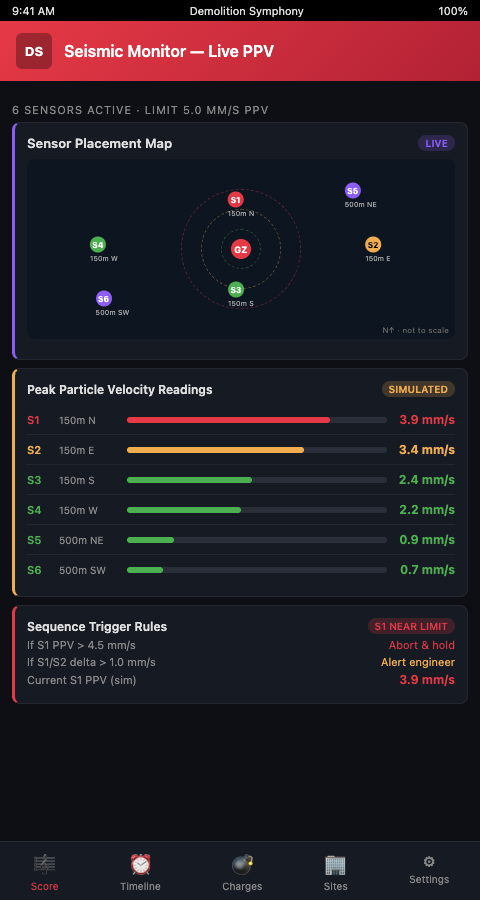
Step 5: Integrate monitoring station coordinates into the Demolition Symphony Planner score. Each monitoring station becomes a constraint annotation on the visual score — a vibration limit marking that the sequence must stay under, the same way a dynamic marking in sheet music tells a performer to stay below a certain volume. When you adjust a delay interval on floor 18 to reduce vibration at monitoring station 3, the visual score immediately shows how that change propagates across floors 19-22. That closed-loop visibility is what separates sequence planning from sequence hoping.
Advanced Tactics: Geology, Redundancy, and Regulatory Documentation
Account for site geology before finalizing delay intervals. Blast vibration attenuation varies significantly with distance and geology — saturated soils transmit energy more efficiently than dry fill, and bedrock channels waves directionally. Underground blast vibration attenuation varies with distance and geology, meaning a single scaled-distance formula applied uniformly across a city block can underpredict PPV at a geologically anomalous receiver location by 30-40%. If your site includes fill over old basements or shallow rock outcroppings, run site-specific attenuation tests with small-yield shots before the primary sequence.
Deploy the OSMRE BIVDEP analysis tool for regulatory submissions. The OSMRE Blast-Induced Vibration Data Evaluation Program is a federal software tool specifically designed to evaluate seismograph-recorded blast data against regulatory limits. Most state regulatory agencies recognize BIVDEP output as acceptable documentation. Running your post-blast records through BIVDEP before submitting to the permitting authority removes ambiguity about whether your data meets the standard — it either passes or it does not, in a format the regulator already understands.
Use vibration prediction in vibration prediction for adjacent building protection as the pre-shot design input, and seismic monitoring as the post-shot verification. These are two sides of the same compliance proof. Prediction tells you the sequence should work; monitoring records confirm it did. Regulators increasingly require both.
Common mistake: monitoring only at the nearest structure. Proximity is not the only risk factor. A stiff, resonant structure at mid-range may amplify ground waves more than a flexible building at close range. Place at least one seismograph at any structure with a natural frequency that could couple with your dominant blast frequency. Wind-driven structural sway also changes the effective natural frequency of adjacent buildings during the implosion window, which is another reason to monitor dynamically rather than relying on static pre-blast calculations alone.
Distinguish structural vibration response from cosmetic damage thresholds. The USBM limits protect against structural damage. Cosmetic damage — hairline cracks in plaster, paint separation — can occur at PPV as low as 0.2 in/sec in older residential buildings. If your exclusion zone includes pre-war residential construction or buildings with significant aging and deterioration, set a lower internal trigger threshold — typically 60-70% of the regulatory limit — as an operational stop-work threshold, before you reach the regulatory limit that triggers mandatory reporting.
Document monitoring station coordinates in the sequence plan, not just the monitoring report. Regulators reviewing a permit application want to see that monitoring was designed as part of the sequence — not added afterward. Embedding station coordinates, PPV thresholds, and expected waveform arrival times into the implosion sequence plan demonstrates that ground vibration management is integrated with charge timing, not treated as a parallel compliance activity.
Start Your Monitored Implosion Score
Demolition Symphony Planner gives urban high-rise implosion coordinators a visual workspace where seismic monitoring constraints live on the same score as charge groups and delay intervals — not in a separate compliance spreadsheet. Buildings with existing structural deterioration in the blast shadow require lower internal PPV trigger thresholds and more conservative go/no-go criteria — factors that belong in the sequence plan's monitoring layer, not in a post-blast compliance review.
The sequence plan and the monitoring plan must develop in tandem: as delay intervals shift to manage vibration interference, the predicted waveform arrival times at each sensor location shift too, and the trigger thresholds must be validated against the revised predictions. Coordinators who finalize monitoring station placement after the delay schedule is locked often discover that their sensor positions are no longer optimal for the revised timing. Building the monitoring framework into the same score as the delay intervals prevents this decoupling. Every change to a delay window propagates immediately into the sensor coverage analysis, so the monitoring network is always designed for the schedule that will actually be executed. Join the waitlist and be among the first urban high-rise implosion coordinators to run a sequence where every PPV threshold is embedded directly in the timing architecture before the first detonator is wired.