Advanced Vibration Prediction for Adjacent Building Protection
Advanced Vibration Prediction for Adjacent Building Protection
In 2023, the San Francisco Bay Area's ground vibration monitoring protocol for a major bridge demolition project required sensor placement at 14 locations between the blast source and the nearest occupied structure — not because PPV limits were likely to be exceeded, but because the regulatory framework demanded continuous sensor coverage to demonstrate that the monitoring was adequate (ROSAP/DOT). That requirement reflects where urban demolition vibration management now sits: prediction is necessary but insufficient; real-time monitoring with documented sensor placement is the standard.
For urban high-rise implosion, vibration prediction for adjacent building protection is a three-variable problem. Peak particle velocity (PPV) is the primary regulatory metric. Frequency content determines whether a given PPV at a specific structure will produce resonance. Duration determines the accumulated damage potential. All three must be predicted, and the prediction must be validated against actual sensor data during execution.
The Three-Variable Vibration Problem
PPV, frequency, and duration are the primary parameters for characterizing blast vibration impact on structures (MDPI). Standard regulatory limits — ISO 4866, BS 5228-2, DIN 4150-3 — specify PPV thresholds by building type and foundation condition (Sonitus Systems). A residential masonry building on shallow foundations has a lower PPV threshold than a reinforced concrete frame on deep piles. The threshold is the easy part; the prediction of what PPV the implosion will produce at each adjacent structure is the hard part.
Empirical attenuation formulas — scaled distance relationships derived from historical blast data — produce PPV estimates with uncertainty ranges of ±50% or more in heterogeneous urban soil conditions. The soil column between a high-rise implosion and an adjacent building 60 meters away may include fill, clay lenses, buried utilities, and basement structures, each of which modifies the attenuation rate in ways that the standard formula does not capture. The consequence: peak particle velocity demolition adjacent buildings prediction based on standard formulas can be off by a factor of 2 in heterogeneous urban soil, which is the difference between a compliant implosion and a regulatory exceedance. Blast vibration neighboring structure impact assessment that uses site-measured wave propagation velocities instead of formula defaults closes most of that uncertainty gap.
Low-frequency vibrations are particularly prone to resonance with adjacent buildings, which have natural frequencies in the 1-10 Hz range (Nature). An implosion that produces a ground motion predominantly below 4 Hz at a neighboring building's foundation may cause structural response well above what the PPV alone would predict, because the energy couples efficiently into the building's fundamental sway mode. Frequency prediction requires a site-specific ground response model, not just a PPV attenuation curve.
Duration compounds both effects. A charge sequence that runs 12 seconds — common for a 40-floor high-rise — exposes adjacent structures to repeated loading cycles across the full sequence. The cumulative strain on masonry joints or non-structural elements (glazing, partition walls) may exceed the damage threshold even if no single cycle exceeds the PPV limit.
Delay Sequencing for Destructive Interference
The most effective vibration control strategy for adjacent building protection in urban high-rise implosion is delay sequencing designed to produce destructive interference between seismic waves from sequential charges. Research on tunnel blasting with millisecond delays has shown PPV reductions of up to 50% when delays are set to produce destructive interference at the monitoring point (PLOS One).
The physics: when two charges fire with a delay equal to the time it takes the shear wave from the first charge to reach the target point, the compression phase of the first wave arrives simultaneously with the rarefaction phase of the second wave. The two waves partially cancel, reducing the peak amplitude. The delay interval for destructive interference at a specific location depends on the wave propagation velocity in the soil, which must be measured (not assumed) for each site.
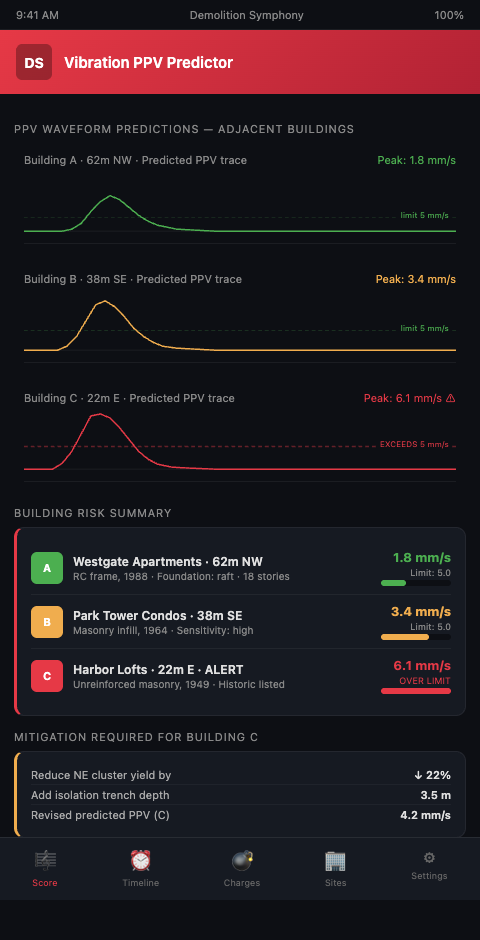
In the Demolition Symphony Planner, vibration interference is notated on the demolition score as a predicted PPV contour map that updates as the coordinator adjusts delay intervals. When two adjacent charges are close enough in timing to produce additive rather than destructive interference at the nearest sensor location, the score flags the conflict — the same way a score editor flags parallel fifths in a harmony exercise. The coordinator adjusts the delay, and the contour map recalculates.
For seismic monitoring integration, the delay values that produce destructive interference at specific sensor locations are derived from the same ground motion model that defines the monitoring network placement. The score, the sensor array, and the delay schedule are designed together.
Pipe, Barrier, and Burial-Depth Effects
PPV and strain data used to establish safety criteria for buried pipelines demonstrate that underground infrastructure within the blast influence zone — pipelines, conduits, utility tunnels — requires separate vibration analysis from above-grade structures (PMC). Buried pipelines respond to ground strain rather than PPV; the conversion from surface PPV measurement to subsurface pipe strain requires knowledge of soil stiffness and pipe embedment conditions.
Urban high-rise implosion sites commonly have legacy utility infrastructure at depths and conditions that are incompletely documented. Before the vibration analysis is finalized, utility survey data — including depth, material, condition rating, and joint type — must be collected and incorporated into the ground motion model. Jointed clay or cast-iron pipe at shallow depth is significantly more sensitive to ground strain than continuous welded steel pipe at depth.
Wave barriers — trenches, sheet pile walls, or concrete panels installed between the blast source and a sensitive receiver — can attenuate vibration by 20-40% at the receiver location when properly designed (ScienceDirect). The attenuation depends on barrier depth (it must exceed the Rayleigh wave wavelength to be effective), barrier stiffness, and the separation between barrier and receiver. In urban settings where delay-based interference reduction alone cannot bring PPV within limits, a temporary wave barrier in the right-of-way between the implosion site and an adjacent structure can close the remaining gap.
Monitoring Execution and Post-Event Reporting
Sensor placement between the blast source and the protected structure is critical — not sensors placed only at the protected structure (ROSAP/DOT). Intermediate sensors provide early-warning data: if the first few charges produce higher PPV at the intermediate sensor than predicted, the firing sequence can potentially be interrupted before the next charge fires. This requires real-time sensor data fed into the monitoring system, not post-event download from standalone recorders.
For fragmentation analysis coordination, the vibration monitoring network and the fragment exclusion zone are both defined by the same structural geometry inputs and must be reviewed together: a charge configuration that meets the PPV limit at the monitoring point may still produce fragments at the 99th percentile range that exceed the exclusion boundary on the same side.
The cross-niche parallel is clear in vibration isolation techniques for demolition near historic structures, where the same three-variable analysis — PPV, frequency, duration — applies to demolition blasting within a constrained right-of-way adjacent to historic masonry.
Practical Steps for High-Accuracy Vibration Prediction
Commission a site-specific wave propagation study. Measure shear wave velocity and soil layer thickness between the blast site and each adjacent structure before the blast design is finalized. This takes 1-2 days and reduces PPV prediction uncertainty by more than half compared to formula-based estimates.
Design delays for destructive interference at the nearest receiver. Use the measured wave velocity to calculate the delay interval that produces destructive interference at the first critical sensor. Build the delay schedule around this constraint before optimizing for collapse directionality.
Set hard PPV limits with buffer margins. If the regulatory limit is 12 mm/s PPV, design to 8 mm/s. Prediction models have residual uncertainty even with site measurements; buffer margins ensure that the actual event stays within the regulatory envelope under realistic uncertainty conditions.
Pre-condition adjacent masonry. For historic or deteriorated masonry structures within the influence zone, pre-implosion inspection and temporary stabilization of cracked sections prevent pre-existing damage from being exacerbated by blast vibration and misconstrued as blast-caused damage in post-event inspections. Ground shock protection for nearby structures must also account for the dynamic soil pressure wave that travels horizontally through the foundation layer — separate from the surface PPV — particularly where buildings share a shallow bearing stratum.
Document implosion vibration damage prevention measures in the permit record. Regulators reviewing post-event claims require evidence that the vibration prediction and suppression design were in place before the shot, not assembled in response to complaints. A pre-shot package that includes the site-specific attenuation model, the destructive interference delay design, and the PPV buffer margins demonstrates that implosion vibration damage prevention was engineered into the sequence from day one.
Urban high-rise implosion coordinators working in built-up areas with PPV-sensitive adjacent structures need vibration prediction that integrates site-specific soil data, delay interference design, and real-time monitoring feedback — not an attenuation formula applied in isolation. The Demolition Symphony Planner's vibration annotation layer connects PPV contour prediction directly to the delay schedule in the score, so every timing adjustment shows its vibration consequence before the blasting caps are connected. Join the waitlist to run your next urban implosion with vibration compliance built into the score from day one.