Full Demolition vs Partial Repurposing for Arena Sites
Full Demolition vs Partial Repurposing for Arena Sites
Stadium Australia's 2022 redevelopment took what had been a 110,000-seat Olympic venue and converted it into an 83,500-seat modern stadium — while reusing 90% of the existing concrete structure (Populous Stadium Australia Redevelopment). The concrete reuse alone avoided an estimated 15,000 tonnes of CO2 equivalent in embodied carbon — a direct argument for adaptive reuse stadium versus teardown when the structural geometry of the retained concrete is compatible with the new use. At the same time, the research on reusing stadiums for a greener future confirms that adaptive reuse is not automatically the lower-cost or lower-risk option: stadium structures were designed for original operational requirements that may not match the new use, and structural retrofit costs can exceed demolition-and-rebuild costs when the retained structure requires significant modification (PMC Reusing Stadiums Greener Future).
The full demolition vs partial repurposing decision for arena sites requires a structured comparison that goes beyond initial cost estimates. This post provides the framework for that comparison.
The Hidden Costs of Full Demolition
The visible costs of full stadium demolition — contractor fees, waste disposal, site clearance — are well understood and relatively straightforward to estimate. The hidden costs are less visible but frequently material:
Structural decommissioning complexity. A stadium contains systems that must be decommissioned before demolition can begin: electrical distribution, mechanical HVAC, fire suppression, telecommunications infrastructure, and in many cases, buried utility connections serving adjacent areas. Decommissioning these systems — including safe disconnection, hazardous material abatement for older systems, and documentation for utility authorities — commonly adds 8-15% to the total demolition cost in projects where it was not adequately estimated upfront.
Asbestos and hazardous material abatement. For stadiums built before 1980, asbestos-containing materials in roofing, insulation, joint filler, and mechanical system components require professional abatement before demolition can proceed. The Rider Levett Bucknall analysis of renovation projects identifies hazardous material costs as one of the most systematically underestimated line items in pre-demolition budgets — because the full scope of hazardous materials is not determinable without intrusive survey work that is often delayed until the demolition contract is already signed (RLB Hidden Costs Renovation).
Site remediation. Stadium sites commonly have underground infrastructure — drainage systems, concession utility tunnels, field drainage grids, foundation systems — that must be removed or properly abandoned before the site can be redeveloped. This remediation work is rarely included in demolition contractor scope, meaning it is discovered as an additional cost during the site preparation phase that follows the demolition contract's completion.
The Hidden Costs of Partial Repurposing
Partial repurposing of an arena structure carries its own category of hidden costs, with a fundamentally different risk profile:
Structural retrofit to meet current codes. A stadium structure designed in the 1970s or 1980s was designed to seismic, wind, and live load standards that have been revised significantly since. Partial repurposing requires bringing the retained structure into compliance with current codes for its new use — which may require retrofitting columns, adding lateral bracing, or upgrading foundation systems. A Polish study on the economics of adaptive reuse found that structural retrofit costs for sports venue conversions averaged 41.15 million PLN above the initial cost estimates in cases where full code-compliance assessment was delayed until after the repurposing decision was committed (MDPI Economics Adaptive Reuse).
Operational constraints during construction. If the retained arena remains partially operational during the repurposing work — a common scenario when the venue serves an active sports franchise — construction costs are elevated by access restrictions, noise and vibration limits during event periods, and the requirement to maintain life-safety systems in the occupied zones throughout the construction period.
Compatibility limitations. The retained structural geometry determines what is possible in the new configuration. A bowl designed for 60,000 seats cannot easily be converted to an 82,000-seat configuration without structural additions that largely defeat the cost savings of retention. Stadium 974 in Qatar was specifically designed for disassembly and full reconfiguration after the World Cup — a result that required purpose-engineered modular structural connections that few existing stadiums possess (Structure Magazine Stadium 974 Disassembly). Most existing stadiums lack this design intent, and the cost of retrofitting disassembly capability after the fact is generally prohibitive.
Arena Redevelopment Options Analysis: The Decision Framework
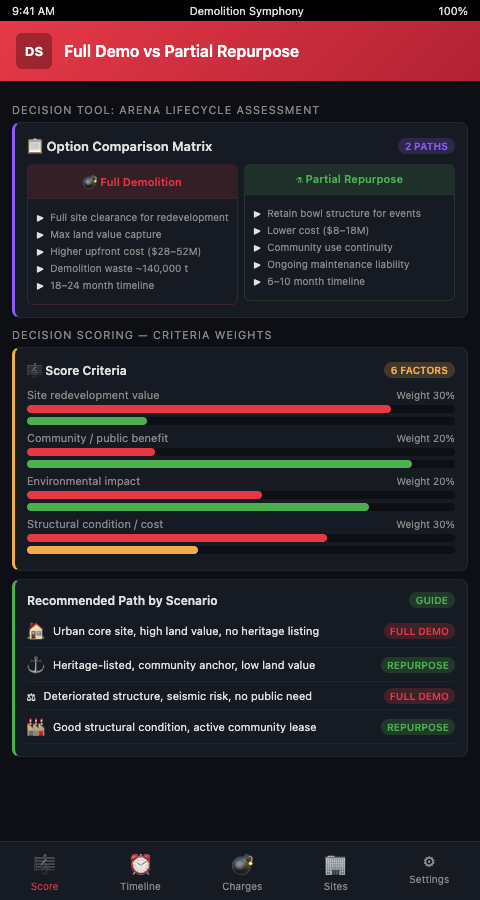
A structured venue demolition or renovation decision should compare the two paths across five dimensions:
Total lifecycle cost. Not just the upfront demolition or retrofit cost, but the 20-30 year operating cost of the resulting facility. A fully demolished and rebuilt venue can be optimized for current operational and energy standards. A retrofitted retained structure carries the operating cost legacy of its original construction unless the retrofit specifically addresses mechanical and energy systems.
Revenue capacity of the new use. Urban Land Magazine's analysis of new arena districts identifies the $8 billion T-Mobile Arena development in Las Vegas as an example of how a purpose-built new venue in a sports-anchored district generates dramatically different revenue potential than a converted existing structure (Urban Land Magazine New Arena Districts). When the revenue profile of the new use is sufficiently different from what a retained structure can support, the higher upfront cost of full demolition is justified by the incremental revenue over the asset's life.
Environmental impact accounting. Retained concrete structure represents significant embodied carbon that is preserved in partial repurposing and lost in full demolition. When carbon accounting is part of the project's financial structure — through carbon credits, green financing premiums, or regulatory requirements — this embodied carbon value is real money, not just an environmental metric.
Schedule risk. Full demolition followed by new construction has a predictable schedule profile: the demolition removes all legacy complexity before the new structure is designed and built. Partial repurposing introduces the schedule risk of discovering structural conditions during retrofit that were not visible in pre-demolition surveys — conditions that require structural redesign mid-project.
Community and stakeholder alignment. Public venues carry community identity value that makes full demolition politically complicated in ways that technical analysis alone cannot capture. Multi-stakeholder coordination processes for public venues must account for historic preservation interests, community groups with emotional attachment to the structure, and elected officials who face accountability for the demolition decision in ways that private owners do not.
Advanced Tactics: Hybrid Deconstruction Strategies
The most productive arena redevelopment strategies are often not full demolition or full retention — they are partial deconstruction stadium adaptive reuse approaches that remove the portions of the existing structure that are structurally incompatible with the new use, while retaining those that provide genuine value. Full demolition vs partial repurposing arena site decisions made without this zone-by-zone structural compatibility assessment frequently either over-demolish (removing retained elements that would have been perfectly functional) or under-demolish (retaining structural elements that require such extensive retrofit that demolition would have been cheaper).
The domed stadium case study illustrates the selective approach: the dome roof — which defined the stadium's operational character and was technically complex to retain — was demolished in its entirety, while the bowl substructure was evaluated sector by sector for compatibility with the new use. Selective deconstruction requires a detailed structural compatibility assessment of each retained zone, followed by a demolition plan that removes incompatible zones without destabilizing the retained ones.
In the Demolition Symphony Planner, a hybrid deconstruction strategy is encoded as two overlapping scores: the demolition score for the zones being removed, and the retention and retrofit score for the zones being kept. The interaction between the two — the points where demolition in one zone creates structural conditions that the adjacent retained zone must accommodate — is managed through the same phase gate system that coordinates purely demolition-focused projects.
The strategy comparison with simultaneous vs sequential industrial decommissioning is instructive here: the decision between full and partial deconstruction has the same fundamental structure as the decision between simultaneous and sequential decommissioning — what looks like the faster path often carries hidden dependencies that make it slower in practice, and the right answer depends on the specific structural and operational constraints of the individual project.
Full demolition vs partial repurposing for arena sites is not a binary choice that can be made on cost estimates alone. Score Your Stadium Teardown with Demolition Symphony Planner and build the complete structural and logistical picture — for both paths — before the redevelopment decision is finalized. Get started with a zone-by-zone structural compatibility assessment that quantifies the true cost and schedule implications of each deconstruction strategy before the redevelopment contract is awarded.