Multi-Stakeholder Coordination for Public Venue Demolition
Multi-Stakeholder Coordination for Public Venue Demolition
When the Miller Park stadium project in Milwaukee ran into permitting and coordination delays during construction, the PMI case study analysis identified stakeholder alignment as the primary driver of schedule risk — not engineering complexity, not contractor performance, but the number of decision-making bodies involved and the absence of a structured process for managing their interdependencies (PMI Miller Park Stadium Case). Demolition projects at public venues face the same dynamic in concentrated form: a building that took years to construct must be taken down in months, by a team that requires approvals from every authority that had jurisdiction over the original construction — plus several authorities that did not exist when it was built.
The venue demolition approval workflow for a major public stadium typically involves 15-25 distinct permit types, notifications, and approvals across federal, state, and municipal agencies. McKinsey's analysis of US federal permitting found that infrastructure projects involving multiple agency jurisdictions take an average of 4.5 years longer than projects with single-agency oversight — largely because no single party has authority to resolve conflicts between agencies (McKinsey Permitting US Infrastructure). For demolition projects, where the schedule pressure is intense and the public interest is high, this coordination problem is acute. The connection to schedule overrun lessons is direct: approval delays are consistently among the top causes of stadium demolition schedule overruns — and the difference between a project that recovers and one that compounds the delay is almost always whether the stakeholder coordination process was mapped before mobilization began.
Mapping the Stakeholder Landscape
The first task in multi-stakeholder coordination for public venue demolition is producing a complete stakeholder map — not a list of contacts, but a structured document that identifies each party's decision authority, decision timeline, and dependencies on other parties' decisions.
A typical large stadium teardown involves at minimum:
Regulatory authorities — municipal building department, environmental agency (for asbestos, stormwater, dust), traffic and transportation authority, EPA (for NESHAP notification requirements), state historic preservation office if the venue is within a historic district.
Public ownership entities — the municipality or sports authority that owns the facility, which often requires separate board approvals for the demolition contract, the salvage plan, and the site disposition plan.
Adjacent interest parties — neighborhood associations with formal comment rights, business improvement districts adjacent to the site, utilities with infrastructure in or under the site.
Financing and insurance parties — bond trustees if the facility carries outstanding debt, insurance carriers who must issue demolition riders, and lenders for the replacement development who may have conditions on demolition completion.
Academic analysis of stakeholder management in sports facility projects — including the Emirates Stadium case — consistently finds that early and structured engagement with all stakeholder groups reduces both the number of late-stage objections and the time required to resolve them (Emirates Stadium Stakeholder Management). The key word is structured: ad-hoc communication with individual stakeholders produces inconsistent information and unresolved conflicts. A formal stakeholder engagement protocol — with documented meeting cadence, decision registers, and issue escalation paths — is the minimum requirement for a project of this scale.
The Venue Demolition Approval Workflow
Effective venue demolition approval workflow management treats each permit and approval as a node in a dependency network, not an item on a sequential checklist. Some approvals can be pursued in parallel; others cannot begin until a prior approval is final. Mapping these dependencies early reveals the critical path through the regulatory process — which is almost never the same as the critical path through the physical demolition sequence.
EPA NESHAP notification for asbestos demolition, for example, requires a minimum 10-working-day advance notice — but the notification can only be submitted after the asbestos survey is complete, the abatement contractor is under contract, and the demolition start date is established. If the asbestos survey takes 8 weeks, that 10-day notification is already nested inside an 8-week predecessor. Teams that treat NESHAP as a simple 10-day item discover the 8-week predecessor only when they are trying to start demolition on a schedule that did not account for it (EPA Asbestos Demolition).
The NDA and EPA's communications best practices guidance for demolition projects identifies transparent community communication as a distinct project workstream — not an afterthought — with its own schedule, deliverables, and responsible parties (NDA/EPA Communications Best Practices). Public venue demolition projects that skip or underinvest in community communication consistently face late-stage objections from neighborhood groups or historic preservation advocates that restart portions of the approval process. Treating community communication as a public interest demolition planning process — with its own schedule, responsible parties, and documented deliverables — is what distinguishes projects that anticipate these objections from those that absorb them as unplanned delays. The venue demolition approval workflow stakeholders who generate the most consequential late-stage objections are almost never new discoveries; they are parties whose concerns were foreseeable but whose formal engagement was deferred until after the approval process had already committed the project to a sequence they opposed.
Integrating Stakeholder Coordination with the Demolition Score
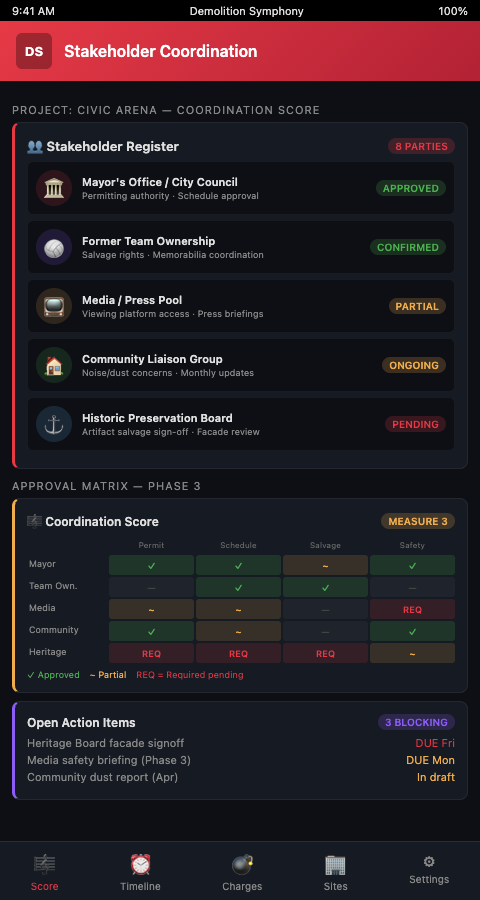
In the Demolition Symphony Planner, the stakeholder coordination workflow is not managed in a separate project management tool — it is embedded directly in the demolition score as a coordination layer that runs in parallel with the structural and material phases. Each approval that gates a demolition phase appears as a hold marker in the score at the measure where physical work cannot begin without it. If the approval is pending, the score shows the gate as open; when the approval is confirmed, the gate closes and the next demolition measure is unlocked.
This integration prevents the most common coordination failure in government agency demolition project management: the physical demolition plan proceeding faster than the approval plan, with work beginning in zones that have not yet received the necessary approvals. By making approvals visible as hard gates in the same visual plan that the demolition crew is executing against, the Demolition Symphony Planner ensures that the approval timeline and the physical demolition timeline are managed as a single integrated schedule — not two parallel plans that are expected to stay in sync without a mechanism to enforce it.
The demolition project management framework for large venue work consistently identifies this integration as the defining difference between projects that complete on schedule and projects that accumulate delays at each phase boundary.
Advanced Tactics: Parallel-Path Approval Management
Two tactics consistently compress the regulatory timeline for public venue demolition without cutting corners on required approvals:
Pre-application meetings with key agencies. Most regulatory agencies will conduct informal pre-application meetings to clarify requirements before a formal application is submitted. These meetings identify issues early — when they can be addressed in the application rather than as post-submission comments — and establish a relationship with the agency reviewer that speeds formal review. For a stadium demolition project, pre-application meetings with the municipal building department, environmental agency, and historic preservation office should be completed before the demolition contract is awarded.
Phased permit applications. Where a demolition project has a well-defined early phase — typically hazardous material abatement — it is often possible to obtain the abatement permit before the full demolition permit application is submitted. This allows abatement to begin on the physical critical path while the demolition permit is still in review, compressing the total elapsed time by 4-8 weeks on a typical large venue project.
The Optus Stadium stakeholder consultation process in Perth demonstrates how structured early engagement with municipal authorities, local businesses, and community groups shortened the formal approval timeline by establishing shared understanding of the project's scope and constraints before the formal process began (FM Media Optus Stadium). The full demolition versus partial repurposing decision is often the first topic that structured stakeholder engagement must resolve, because every downstream permit and approval depends on which scope alternative the project is pursuing.
Schedule overrun data from comparable projects confirms this pattern: the most common source of stadium demolition overruns is not structural complexity or equipment failure — it is approval delays that were foreseeable but not proactively managed. The multi-contractor orchestration parallels from industrial decommissioning apply equally here: when multiple parties must coordinate decisions in sequence, the absence of a structured dependency map guarantees delays.
Municipality stadium teardown stakeholder alignment is not a soft skill — it is a project management discipline with documented techniques and measurable outcomes. Score Your Stadium Teardown with Demolition Symphony Planner and bring the same visual coordination rigor to your approval workflow that you apply to your structural demolition sequence. Get started with a permit dependency map that sequences every agency approval, community consultation, and stakeholder sign-off as a scored phase gate before demolition begins.