Lessons from Stadium Demolition Overruns: Schedule Risk Mitigation
Lessons from Stadium Demolition Overruns: Schedule Risk Mitigation
Research on infrastructure project cost performance found that 85% of large projects finish over budget, with an average overrun of 28% (ScienceDirect Cost Overruns Infrastructure). For sports venue construction and demolition, the overrun pattern is even more pronounced: the legal and insurance exposure from venue demolition schedule failures is a distinct professional practice area, with attorneys specializing in the disputes that arise when demolition projects miss the delivery dates that were committed to replacement development partners, sports franchise relocation agreements, and municipal financing timelines (Greenberg Law Sports Venue Construction). The Highmark Stadium demolition in Buffalo, where stakeholders received regular timeline updates precisely because the schedule had become publicly sensitive, illustrates how quickly a stadium demolition delay becomes a matter of public record and public pressure (SI Highmark Stadium Demolition Timeline).
Stadium demolition schedule overrun risk mitigation requires understanding demolition project delay causes arena-specifically — not generic construction delay categories, but the patterns particular to venue teardowns with their structural complexity, multi-agency permitting requirements, and politically sensitive timelines.
The Five Leading Causes of Stadium Demolition Overruns
1. Undiscovered structural conditions. Pre-demolition structural surveys are conducted on accessible surfaces. Steel corrosion in embedded connections, concrete delamination behind retained cladding, and foundation degradation below grade are not visible without intrusive investigation — investigation that is usually not performed in full detail before the demolition schedule is committed. When these conditions are discovered during demolition, they require immediate structural engineering response: temporary shoring, revised phase plans, and in some cases complete revision of the removal sequence. Each of these responses takes time that was not in the schedule.
The HSE's documentation of demolition hazards identifies unknown structural condition as the leading cause of unplanned structural events during demolition — events that trigger mandatory site stops, regulatory notification, and investigation delays before work can resume (HSE Blog 16 Demolition Hazards). A 5-day mandatory site stop, occurring three times during a 6-month project, adds 15 days to the schedule — more than enough to trigger liquidated damages under a typical venue demolition contract.
2. Hazardous material surprises. The asbestos survey conducted before contract award is based on accessible sampling locations. Post-tensioning system corrosion inhibitors, embedded pipe insulation in columns, and joint filler materials behind cladding are routinely missed in pre-demolition surveys and discovered during active demolition. Each new hazardous material discovery triggers a work stoppage in the affected zone, mandatory air monitoring, a revised abatement plan, and regulatory notification — a sequence that takes 3-10 days regardless of how quickly the contractor responds.
3. Regulatory approval delays. Stadium demolition projects require approvals from multiple agencies at each phase boundary. When any single approval is delayed — because a reviewer is unavailable, because the submission was incomplete, or because a community objection triggers a mandatory comment period — the demolition phase that depends on that approval cannot proceed. These delays are almost impossible to compress after the fact: a 30-day mandatory public comment period is 30 days, regardless of the contractor's schedule pressure.
Propeller Aero's construction cost overrun statistics confirm that regulatory and permitting delays account for 20-45% of schedule overruns in projects with multi-agency permitting requirements (Propeller Aero Cost Overrun Stats). For public venue demolition, where the permitting landscape is particularly complex, this is a known risk that requires buffer time in the schedule — not an assumption that approvals will proceed on the first application.
4. Equipment availability and mobilization delays. Specialized demolition equipment — long-reach high-rise excavators, mobile crusher plants, robotic demolition platforms — has limited availability in most regional markets. A schedule that assumes this equipment is available on the planned start date without confirmed reservations is a schedule that will slip when a prior project runs long and the equipment is not released as expected.
5. Scope changes from stakeholder decisions. Stadium demolition projects frequently encounter scope changes driven by stakeholder decisions that occur during the demolition itself: a sports franchise requests the preservation of a specific field element; a municipality decides to retain an entrance structure for the site's redevelopment; an environmental authority requires additional soil sampling that was not in the original scope. Each of these changes requires a revised plan, revised schedule, and in many cases revised permits — producing delays that are technically avoidable but practically inevitable when the stakeholder decision-making process was not completed before demolition began.
Building Stadium Deconstruction Contingency Planning
Effective contingency planning for stadium demolition schedule risk operates at two levels: quantitative reserves and qualitative protocols.
Quantitative reserves. Black Ridge Research identifies the most common cost overrun in construction projects as the failure to reserve adequate contingency — not the failure to predict the specific cause of overrun (Black Ridge 9 Reasons Cost Overruns). For stadium demolition, a minimum 15% schedule contingency buffer is appropriate for projects with full structural information; 20-25% is appropriate when pre-demolition structural surveys are limited or when the structure has known deterioration issues. This buffer should be built into the project schedule as a contractual provision, not held as an internal management reserve that disappears under schedule pressure. The failed implosion lessons from urban high-rise projects confirm this principle: the most costly overruns arose from structural conditions inconsistent with pre-demolition survey data — risks that adequate contingency reserves and pre-defined response protocols would have absorbed rather than allowed to cascade.
Qualitative protocols. Every potential delay cause should have a pre-defined response protocol — not written during the delay, but agreed between the contractor, the structural engineer, and the owner's representative before demolition begins. The protocol specifies who makes decisions, how quickly decisions must be made, what information is required before each decision, and who has authority to authorize scope changes that affect the critical path.
Grant Mackay's demolition overrun lessons learned case study documentation identifies this protocol-based approach as the single most effective differentiator between projects that recover from unexpected delays and those that compound them: when the response process is pre-defined, a 3-day structural discovery delay stays at 3 days; when the response process must be negotiated in real time, the same 3-day discovery becomes a 15-day delay (Grant Mackay Demolition Case Studies).
Using the Demolition Score to Manage Schedule Risk
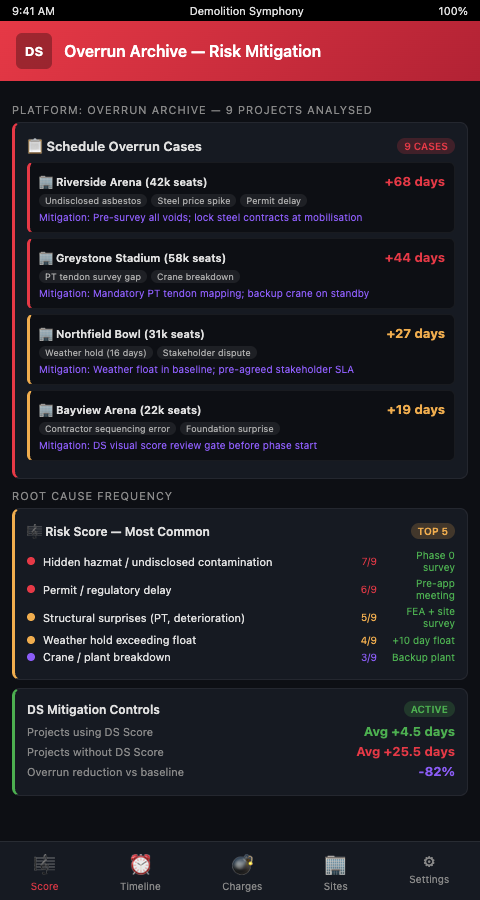
In the Demolition Symphony Planner, venue teardown timeline risk management is built into the visual score structure. Each phase gate in the score has two properties: a planned completion date and a buffer absorption limit — the maximum number of days by which the gate can be delayed before it triggers a critical path review. When monitoring data, regulatory status, or equipment tracking indicates that a gate is approaching its buffer limit, the score generates an automatic alert for the project manager and the structural engineer.
This real-time buffer tracking converts the standard schedule management question — "are we on time?" — into a more useful operational question: "which gates are consuming contingency faster than planned, and what do we need to do now to prevent them from going critical?" The difference is the same as the difference between a conductor who watches the clock and one who reads each instrument's tempo relative to the score: the score reader detects drift before it becomes a problem; the clock-watcher discovers it after the damage is done.
Advanced Tactics: Pre-Demolition Risk Register
The most effective schedule risk mitigation tool for stadium demolition is a project-specific risk register completed before the demolition contract is awarded — not after. The risk register identifies each potential delay cause, estimates its probability of occurrence, quantifies the expected schedule impact if it occurs, and specifies the pre-defined response protocol.
For a 70,000-seat stadium with known deterioration issues and multi-agency permitting requirements, a complete risk register typically identifies 25-40 distinct schedule risks. Of these, 5-8 will be rated as both high-probability and high-impact — these are the risks that must receive explicit contingency allocation in the schedule, not general buffer. The remaining risks share the general contingency pool, with the register providing the framework for allocating buffer when individual risks materialize.
The connection to multi-stakeholder coordination is direct: stakeholder-driven scope changes are almost always foreseeable if the stakeholder decision process was mapped in advance. A risk register that identifies "preservation decision pending for main entrance façade" as a high-probability risk prompts the team to resolve that decision before demolition begins — converting a foreseeable delay into a proactively managed decision.
The demolition vs repurposing decision also affects schedule risk materially: partial repurposing projects carry higher structural condition uncertainty than full demolition projects, because the retained structure's condition affects the new construction scope in ways that are not fully determinable before the retained structure is fully exposed. Projects pursuing partial repurposing should build additional contingency for post-exposure structural discoveries that can change the scope of retained work mid-demolition.
Stadium demolition teams committed to finishing on time need a planning platform that treats schedule risk as a first-class element of the demolition score — not an afterthought managed in a separate risk spreadsheet. Score Your Stadium Teardown with Demolition Symphony Planner and build your contingency plan, risk register, and phase gate buffer tracking into the same visual score that your structural engineers, equipment operators, and regulatory team are all reading in real time. Get started with a risk-integrated demolition score that identifies your top schedule threats and pre-assigns contingency before the first permit is submitted.