Building a Grove Evacuation Priority List From Block-Level Data
Why Property-Line Evacuation Lists Fail
When Hurricane Milton approached, UF/IFAS CREC's extension guidance directed growers to check damage nearest the track first and tag trees for continued observation — simple logic that implies block-level prioritization already exists (Citrus Industry: Post-Hurricane Damage Assessment and Fruit Drop). The Milton resource bundle UF/IFAS published covered preparation, triage, and recovery (UF/IFAS CREC Hurricane Milton Resources), and EDIS CH178 on hurricane preparedness for citrus groves lays out pre-hurricane pruning, equipment staging, and post-storm triage order (UF/IFAS EDIS CH178: Hurricane Preparedness For Citrus Groves). But most grove plans still treat the grove as one unit.
That fails on two fronts. FDACS's Citrus Loss Block Grant Program documents losses at the block level and requires block-level production records to trigger payout (FDACS Citrus Loss Block Grant Program). USDA FSA's WHIP indemnity program ties payouts to block-level production records as well (USDA FSA Wildfires and Hurricanes Indemnity Program citrus). So the block unit is the unit the payouts are built around — your evacuation priority list needs the same granularity.
The second failure is crew. Migrant farmworker evacuation remains a documented blind spot in grove disaster plans (WUSF: Migrant farmworkers vulnerable to natural disasters), and Seso's post-Helene guidance details H-2A housing, transport, and 3/4 guarantee obligations during hurricane disruptions (Seso Labor: Supporting Ag Businesses After Hurricane Helene).
The third failure is mental model. A grove that treats the storm as a single event to "weather through" misses the cascade — harvest pull-forward decisions drive crew deployment, crew deployment drives equipment staging, and equipment staging drives packinghouse dispatch. Each of those decisions has its own lead time, and when they're sequenced rather than run in parallel, the grove loses hours it can't recover. A block-level priority list turns the cascade into a set of parallel lanes, each with its own clock.
Building the Priority List on the Helm-Charted Yield Forecast
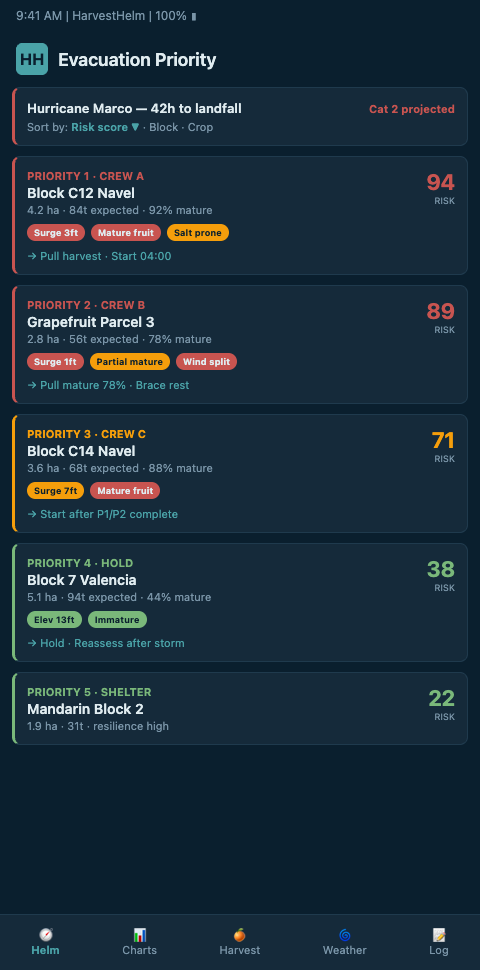
HarvestHelm frames the priority list as three stacked lanes on the yacht navigation dashboard. The helm-charted yield forecast shows the captain three tracks: harvest pull-forward sequence, crew evacuation chain, and equipment staging order — each block-by-block, each with decision lead times. The captain steers through all three in parallel, not serially.
Priority lane one — harvest pull-forward. Blocks are ranked by maturity-at-risk times surge-and-wind exposure. A nearly-ripe Valencia block in the surge cone leads the list; a young Hamlin block sitting above surge elevation lands near the bottom. HarvestHelm's block-level surge map feeds this lane directly, and the depression track timing read upstream keeps the rank fresh as the intensification probability shifts.
Priority lane two — crew evacuation. H-2A housing, transport availability, 3/4 wage guarantee timing, and distance to shelter all score. Blocks with crews already on-site get higher relocation priority, and blocks requiring last-day pick get crew retention priority. The dashboard shows H-2A and domestic labor as separate channels because the regulatory obligations differ.
Priority lane three — equipment staging. Bins, carts, irrigation controllers, and sensor nodes all need pre-storm positioning. UF/IFAS EDIS CH178 covers the mechanical side; HarvestHelm automates the sequencing based on block access routes and wind-load timing.
The helm chart flags interdependencies: you cannot pull block 7 forward if the packinghouse dispatch queue already has block 4 ahead of it, so block 7 gets staged and block 4 gets pushed. The captain sees these dependencies as chart lanes, not as buried logic — so the call to pull forward or delay is always legible.
A worked scenario. Tuesday afternoon, 60 hours before expected landfall. Twelve blocks in the grove. Block-level priority list reads: blocks 3 and 7 (mature Valencia in surge cone) get pulled Wednesday morning with the main H-2A crew; blocks 1 and 4 (fresh grapefruit, high canker exposure) get canopy triage Wednesday afternoon with a smaller crew; blocks 8 through 12 (young Murcott, above surge elevation) get equipment staging but no pull-forward. Crew lodging for H-2A gets reserved Wednesday evening at an inland motel. Packinghouse dispatch gets the pull-forward tonnage allocated for Wednesday 10 a.m. and Thursday 2 p.m. slots. Each lane has its own timeline, its own responsible party, and its own documentation trail back to FDACS block-grant requirements.
Re-running the chart as the forecast evolves is what keeps the priority list alive. At 48 hours out, the cone shifts west and the intensity forecast moves from Cat 1 to Cat 2. HarvestHelm updates the chart: blocks 3 and 7 still lead the pull-forward, but now blocks 8 through 12 move from staging-only to partial pull-forward because the Cat 2 wind field will reach them. Crew lodging gets expanded and a second H-2A group is requested. Packinghouse dispatch reallocates throughput. The chart captures every update with timestamps so the operational trail is defensible against FDACS and FSA documentation review post-storm.
Crew communication during an active decision sequence deserves its own treatment. A priority list that's perfectly structured at the captain's end but poorly communicated to the crews in the field generates exactly the same outcome as no priority list at all. HarvestHelm supports crew-side views of the priority chart — each crew supervisor sees the blocks assigned to their team, the timing, the sequence, and the dependencies — delivered through a mobile interface that works on cell-network and SMS fallback. When power goes out and cell service degrades, the crew-side interface queues updates and pushes them when connectivity returns. The captain's decisions reach the field even under degraded communications, which is what the storm-season operational environment actually requires.
Advanced Tactics: Coupling the Priority List to Storm-Track Evolution
A priority list that's frozen at 72 hours out is a priority list that stops being useful the moment the cone shifts. The HarvestHelm chart re-computes the three lanes on every NHC advisory cycle and on every local sensor trigger. When the forecast escalates from tropical storm to category 2 harvest threshold, the list re-ranks with higher weight on wind exposure and less weight on flood depth.
Pre-landfall decisions need to track with the upstream storm trajectory, so the priority list works hand-in-hand with the depression-track read the captain ran at the 2-day outlook stage. A depression intensifying 30 hours from landfall produces a different priority order than one holding steady — HarvestHelm weights each block's pull-forward cost against the intensification probability.
Cross-niche, the evacuation-planning discipline matches what desert operators build around sandstorm crew evacuation — different threat, same "who goes where, with what, and in what order" operational rigor. The pattern transfers.
Common mistakes that hold back the priority list:
- Writing the list once in June and not re-running it for each advisory.
- Leaving H-2A housing and transport out of the crew lane until 24 hours before landfall.
- Staging bins at the wrong end of the access road and blocking crew evacuation.
- Pulling forward fruit that cannot be absorbed by packinghouse capacity — creating a waste line rather than a revenue line.
- Relying on a single dispatch channel — texts and calls break when power and cell service go.
- Missing the documentation capture that FDACS and FSA require — block-level production records have to come out of the priority-list execution, not be reconstructed afterward.
Scaling across multi-grove operations adds one more complexity: cross-grove crew movement. If a grower has H-2A crews working at Grove A on Tuesday and Grove B on Wednesday, the priority list at each grove has to know where the crew will be. HarvestHelm handles this as a linked resource layer so the captain can see the crew position across groves and avoid the double-booking failure that blows up multi-parcel operations during storm season.
Pre-season discipline is what makes in-season execution smooth. Growers who run through the priority list once in June — before the first depression of the season — catch gaps that would be expensive to discover in August or September. The pre-season run-through walks the chart against a hypothetical Cat 2 landfall and confirms that crew contracts, packinghouse slots, and equipment leases all align with the plan. Gaps get closed before they matter. HarvestHelm supports the pre-season run as a tabletop exercise that produces an updated priority chart and a gap report — and growers who use it report substantially fewer surprises during the active storm season.
Post-storm, the priority list transitions into a recovery sequence. The same block-by-block ranking that drove pre-storm pull-forward drives post-storm damage assessment — blocks hit hardest get inspected first, and the inspection data feeds the FDACS block-grant paperwork directly from the chart. The recovery sequence also coordinates crew redeployment, equipment recovery, and packinghouse restart scheduling. Growers who run the full priority-list lifecycle — pre-season tabletop, in-season pull-forward, post-storm recovery — capture the full operational benefit. Growers who run only the in-season portion capture perhaps half. The pre-season and post-storm phases are what separate a functional priority chart from a great one.
Get Early Access to the Coastal Citrus Grove Dashboard
Coastal citrus growers with 5 or more blocks and H-2A crews running through hurricane season are stacking HarvestHelm into their pre-storm checklist. The helm-charted priority list integrates with your existing FDACS block-grant documentation so payout paperwork is already half done when the storm passes. Join the Coastal Citrus Grove waitlist with your block count, crew size, and packinghouse contact — we'll stand up the three-lane priority chart and calibrate it to your logistics. Operations joining the April cohort run the pre-season tabletop exercise against a hypothetical Cat 2 landfall before June, so crew contracts, packinghouse slots, and equipment leases get their gap report closed before the first depression of the season.
Day one of your dashboard shows the three lanes — harvest pull-forward ordered by maturity-and-surge exposure, crew evacuation separated into H-2A and domestic channels with 3/4 wage guarantee tracking, and equipment staging sequenced by access-route and wind-load timing. Multi-parcel operations running H-2A crews across grove A on Tuesday and grove B on Wednesday see the linked resource layer that prevents the double-booking failure, with crew-side mobile views that queue updates via SMS fallback when cell service degrades. Send us your last-storm crew deployment record and packinghouse dispatch history so the chart's interdependency logic — block 7 pulled forward only if packinghouse queue has not already committed block 4 — gets calibrated to your actual throughput rather than a generic model.