Building a Pack-House Throughput Plan Around Hurricane Season
The 45-to-25 Consolidation Squeeze
State of the Florida Citrus-Packing Segment (Citrus Industry Magazine) documented the numbers plainly: Florida packhouses consolidated from 45 operators to 25 between 2010 and 2018, and post-Irma fresh volume could physically fit into just 2 to 3 of the remaining facilities. The consolidation trend has continued. Commercial Citrus Inventory 2024-25 (USDA NASS) reports 208,186 total acres of Florida citrus, down 24 percent year over year, but the packing infrastructure has shrunk faster than acreage.
The math does not reconcile in most hurricane scenarios. If every grove inside a 100-mile radius of landfall pulls forward 20 to 40 percent of remaining harvest volume simultaneously, the surge throughput demand exceeds the consolidated packhouse network by a factor of 2 to 3. Somebody's fruit routes to commodity juice-plant pricing. Which somebody depends entirely on who placed reservations when, who has backup contracts, and who has the pre-negotiated surge-pricing clauses that actually compel delivery.
What that means in practice: when a Category 2 track threatens Polk, Hardee, and Highlands counties simultaneously, every grove inside the 72-hour cone is trying to reserve the same 3 packhouses on the same 48-hour pull-forward window. The growers who placed reservations during pre-season capacity planning get slots. The ones calling on the day of the NHC watch issuance often don't. Florida Citrus Statistics 2023-2024 (USDA NASS) provides the utilization and pack-out baselines that anchor realistic capacity math.
A grove running 50,000 boxes that misses its packhouse reservation rarely loses all 50,000 — but it often loses the 80-count and 125-count premium cartons to commodity juice-plant routing, which drops effective gross by 8 to 14 cents per pound. On 50,000 boxes at 6.5 pounds of solids each, that is $26,000 to $45,000 left on the pavement.
Helm-Charted Packhouse Throughput Planning
HarvestHelm models packhouse throughput the way a yacht captain models berth availability in a busy harbor: you do not show up hoping for a slot, you reserve in advance and monitor availability updates as conditions change. The helm-charted yield forecast couples grove-side pull-forward triggers with packhouse-side capacity state, so the harvest commitment and the receiving capacity land in the same decision packet rather than colliding at the loading dock.
Packingline Machinery for Florida Citrus Packinghouses (UF/IFAS IRREC) provides the throughput baseline physics — a well-tuned Florida pack-line handles roughly 800 to 1,500 boxes per hour per lane depending on sizing complexity. How citrus packhouses improve profitability with sorting solutions (TOMRA) documents the dynamic lane balancer technology enabling up to 320 percent packing speed gains on the same line count. HarvestHelm uses these parameters to build realistic capacity curves for each packhouse your grove has a relationship with, then updates the curves as operators publish seasonal availability.
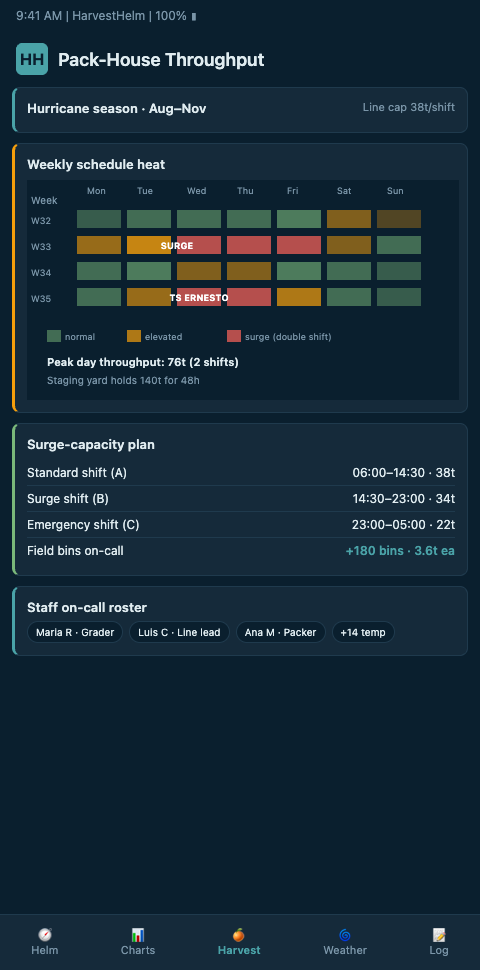
The throughput plan has three horizons. Pre-season (April-June): lock base reservations with two or three packhouses, sized to expected harvest volume plus a 20 percent hurricane-pull-forward buffer. Mid-season (July-September): update reservations as Atlantic hurricane activity develops, using HarvestHelm's basin probability model. Active track (within 5-day cone): execute pre-agreed surge protocols with your primary packhouse, fall back to secondary if primary is saturated, document diversion timestamps for later claims if fruit is downgraded.
Critical coordination: packhouse surge capacity is finite. IMG Citrus completes packhouse consolidation (Fruitnet) details a $3M facility upgrade at one flagship, but even modernized lines hit throughput walls during hurricane surges. HarvestHelm tracks actual throughput telemetry from integrated packhouse partners — boxes-in-per-hour, grading rejection rates, juice diversion percentages — and warns grove managers when their reserved slot is slipping, 12 to 24 hours before the fruit arrives at the dock.
See our category 2 early harvest framework for how the upstream harvest trigger ties to the packhouse reservation — the two decisions are one decision in practice, and HarvestHelm keeps them synchronized.
Advanced Tactics: Crew Staging, Fuel Reserves, and Cross-County Routing
Packhouse capacity alone does not solve the hurricane-pull-forward puzzle. You also need picking crews staged to the block-level harvest order, fuel for the trucking fleet, and cross-county routing contingency for when your primary packhouse takes a track hit of its own.
Hurricane Preparedness for Citrus Groves: Part 1 (Citrus Industry Magazine) lays out the 72-, 48-, and 24-hour personnel and fuel commitments that keep the packhouse supply chain running. HarvestHelm codifies these commitments into a block-level dispatch queue that updates as the NHC advisory cycle progresses. The yacht-style helm shows crew assignment, truck staging, and packhouse ETA on a single chart.
Cross-county routing is the sleeper advantage. When Milton clipped the Heartland packhouses in 2024, growers with pre-negotiated backup arrangements at Indian River packhouses on the Atlantic side moved fruit 90 miles east and preserved 35 to 50 percent of their premium-tier pack-out. HarvestHelm maintains a distance-and-availability matrix across your packhouse network and flags cross-county routing options as soon as the primary facility drops capacity.
Cross-crop analogy: mango plantations running staggered flush programs face similar crew-staging challenges during monsoon windows. Our staggered flush labor workflow applies the same coordination pattern — sensor-triggered timing, pre-staged crews, cross-facility fallback routing. The coordination architecture generalizes across labor-intensive harvest operations.
Case study application: our 4200-box hurricane save walkthrough shows a specific Heartland grower who preserved 4,200 boxes of Valencia during a late-season Cat 2 using the surge-throughput playbook HarvestHelm codifies. The primary lever was pre-negotiated secondary packhouse capacity 60 miles off the storm track.
Contracts matter. Packhouse surge agreements should be in writing, with explicit guaranteed minimum throughput rates, juice-diversion handling, and force-majeure terms that cover packhouse equipment failures under storm conditions. The Hurricane Preparedness For Citrus Groves (UF/IFAS EDIS CH178) document covers the operational side; the contract side is where many growers under-document and overpay later.
Packhouse Power and Water Contingency
Packhouses run on electricity, water, and cold-chain infrastructure that all become fragile during active hurricane tracks. A packhouse with full surge capacity on paper but a non-redundant power supply becomes a bottleneck the moment utility power drops. Growers should audit each packhouse partner's backup-generator capacity, fuel-reserve duration, and water-supply redundancy before the reservation gets treated as guaranteed.
HarvestHelm maintains packhouse infrastructure profiles: generator capacity, fuel-tank hours, water-tank or well-redundancy, cold-room backup power, and historical uptime during past hurricane events. The profile drives the reservation-risk score on the dashboard — a fully-reserved packhouse with low infrastructure resilience gets a different status badge than an equivalently-reserved packhouse with full redundancy.
When a primary packhouse shows infrastructure degradation during an active track — fuel-tank level dropping faster than expected, generator failure reports from neighboring operations, water-supply issues — HarvestHelm flags the risk 6 to 12 hours ahead of a likely capacity disruption. The grove manager uses the lead time to divert loads to backup facilities before the primary fails, not after.
Juice-Plant Premium-Tier Protection
Fresh-pack throughput is half the story. Juice-plant premium-tier routing is the other half. A Valencia or Hamlin block picked early to beat a Cat 2 track still needs to clear the juice-plant's premium-tier acceptance window to earn premium pricing — orange oil content, brix level, and soluble-solids ratio all have tighter tolerances for premium-tier than for commodity juice.
Storm-pulled fruit often fails premium-tier criteria because the early pick was timed against the storm, not against commercial maturity. HarvestHelm's helm-charted yield forecast shows the projected premium-tier acceptance rate per block at the planned pull time, so the grower knows before committing crews whether the block will clear premium or get commodity pricing. This changes the prioritization math for some blocks — a mid-maturity Valencia block might be better held for post-storm recovery than picked early into commodity routing.
Juice-plant relationships also provide surge-receiving capacity when fresh-pack packhouses saturate. Growers with dual commercial relationships — a primary fresh-pack house and a secondary juice-plant routing partner — have more options during Cat 2 compression than growers tied to a single outlet. The dashboard shows both routing options with per-block economics.
Labor Pipeline and Crew Housing Logistics
Surge pack-out requires surge labor. Packhouse partners need sorters, grader operators, forklift drivers, and line technicians in numbers that normal-season operations do not require. H-2A visa coordination, temporary staffing agency contracts, and overtime authorization all need pre-season setup so the labor pipeline is ready when the 72-hour surge fires. Growers whose packhouse partners lack surge-labor contracts will see reservation-confirmed slots quietly under-deliver as the packhouse runs understaffed.
Crew housing is the adjacent constraint. Hurricane evacuation orders displace workers who may no longer be within practical commuting distance of the packhouse. HarvestHelm tracks packhouse labor-pool geography so the dispatch schedule accounts for likely crew availability under evacuation scenarios. Packhouses with on-site worker housing or pre-arranged lodging agreements maintain throughput more reliably during evacuations than ones relying on daily commuting.
Reserve Capacity Before the Basin Warms
Coastal Valencia, Hamlin, Murcott, and Navel growers running fresh-pack programs cannot leave packhouse capacity to chance during hurricane season. HarvestHelm couples harvest pull-forward triggers with live packhouse throughput telemetry on the helm-charted yield forecast, so reserved slots stay synchronized with the NHC advisory cycle and your cross-county fallback routing activates automatically when primary facilities hit saturation. Zero platform fee. The kilo-cut on successful harvest aligns the tool with the premium-tier cartons that actually clear your pack-line in the hurricane-compressed window. Operations joining the April-June pre-season cohort get their base reservations across two or three packhouses sized to expected volume plus the 20% hurricane-pull-forward buffer, with generator and fuel-reserve profiles loaded for each facility before the first depression forms.