How to Stage Plantation Labor Around Staggered Flush Events
The Labour Cost Black Hole Staggered Flushes Create
Mango is not a synchronized crop. TNAU canopy management research documents four to five flushing episodes per year per cultivar, with flush timing shifting by block, aspect, and paclobutrazol application date. On a mixed Alphonso-Kesar plantation, the flush waves spread across three to five distinct pulses between February and May, each producing a different harvest window two to three months later. Calendar-based crew scheduling assumes a central harvest peak that does not exist, and the gap between assumption and reality gets paid in idle labour wages.
The SAGE Open study of Philippine mango labour quantified the coordination problem — harvest labour utilization routinely runs below 60 percent because crews arrive ahead of ripe fruit or behind the peak. UF/IFAS cost estimates for South Florida mango operations pin picking, packing, and marketing costs at roughly $667 per acre per year, with labour representing 40 to 50 percent of operating cost. For a 50-acre Indian plantation running at INR equivalents, that translates to labour exposure of 16 to 22 lakh rupees per season — and mis-staged crews inflate that number by another 15 to 25 percent through idle time and overtime-premium catch-up.
The compounding issue is flush-to-harvest timing variance. Two blocks treated with paclobutrazol 14 days apart produce flushes that reach harvest maturity 9 to 11 days apart. Research on paclobutrazol soil drenching shows PBZ suppresses vegetative growth and synchronizes flowering within treated blocks, but variance between blocks under different application timing remains large. A plantation manager who staffs a flat 18-picker crew across three blocks ends up with either painful under-utilization on block one while waiting for block two, or scramble hiring when blocks two and three peak simultaneously.
Staging Labour on a Helm-Charted Yield Forecast
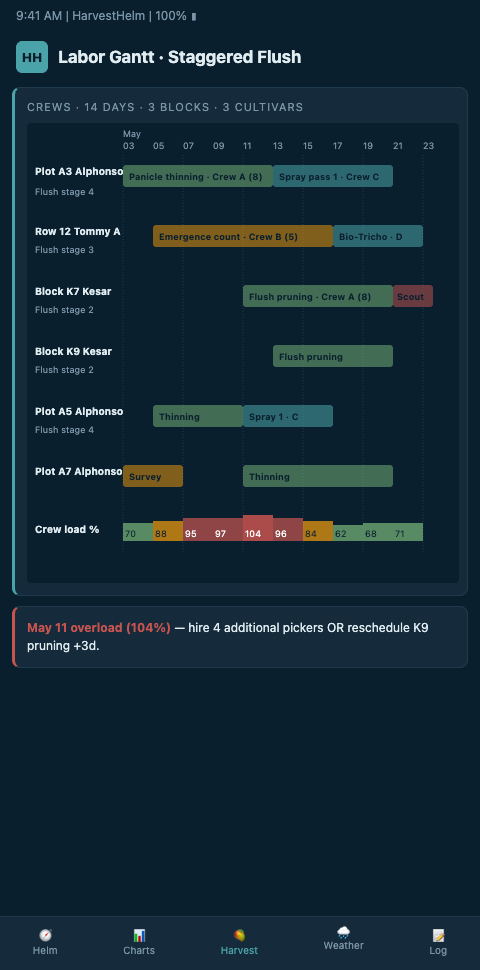
HarvestHelm approaches flush-driven labour staging the way a yacht captain staggers watch rotations across a multi-day passage. The helm-charted yield forecast pulls flush emergence dates per block, heat-unit accumulation since panicle appearance, and projected harvest windows into a single Gantt view on the dashboard. Labour demand is rendered as a curve across the harvest season rather than a point estimate, and the curve gets resampled daily as sensor data refines the maturity projections. A captain does not put the whole crew on deck at once during a 36-hour squall — the captain rotates watches based on actual conditions, and that is exactly how a plantation manager should approach flush-driven labour.
The dashboard architecture starts with block-level flush tracking. HarvestHelm sensors capture the first emergence date for each panicle cluster, tag it with the block coordinate, and roll up into block-level flush histograms. The histograms feed a heat-unit accumulation model that projects harvest readiness for each block with a 3-to-5-day uncertainty band. Block 1 might peak on May 4 plus or minus 2 days; block 2 peaks May 12 plus or minus 3 days; block 3 peaks May 19. Rendered as overlapping curves on the yacht-style dashboard, the labour demand profile becomes obvious: crew of 12 during week 1, ramp to 22 during week 2, hold 18 through week 3.
Layer two is crew pre-positioning. Indian mango plantations typically rely on a mix of permanent staff and migrant seasonal crews, and the seasonal crews often move between regions chasing harvest peaks. HarvestHelm's dashboard projects labour demand 14 days ahead with refreshed confidence bands, so plantation managers can commit seasonal crews through aggregator platforms before the ripple effect of a shifted flush collides with regional labour scarcity. Research on agricultural workforce management from Shyft documents that harvest operations may scale workforce 10x within weeks — and the shift marketplaces that enable that scaling require accurate demand forecasts at least a week in advance.
Layer three is task-specific crew deployment. Flush-driven staging is not just about picker count — it is about the right skill mix. Panicle thinning, fruit bagging, hand-selective picking, bin runner, and grading-line feeder are distinct roles with different skill curves. The dashboard breaks labour demand down by task type per block per day, so the plantation manager sees not just "22 workers needed on May 12" but "14 pickers, 4 bin runners, 2 grading-line feeders, 2 quality inspectors." Software like Croptracker orchard management handles the piecemeal pay tracking, but the upstream forecasting is where most plantations still run blind. Staging also needs to align with monsoon pull-forward decisions, because a pull-forward compresses labour demand into a shorter window and requires rapid crew scaling.
Advanced Tactics for Multi-Cultivar Crew Coordination
The next tactical layer addresses multi-cultivar plantations where Alphonso, Kesar, Tommy Atkins, and sometimes Haden share the same acreage. Each cultivar has distinct flush timing, picking technique, and quality inspection criteria. An advanced staging tactic is crew skill stratification: pickers trained for Alphonso hand-selection are not fungibly substitutable for Tommy Atkins bulk picking. HarvestHelm's dashboard segments crews by cultivar certification and routes the right skill mix to the right block on the right day. This is the same coordination problem that monsoon dashboard workflow handles during arrival windows — the difference is temporal granularity, with flush staging running on weekly timescales rather than hourly ones.
The second advanced tactic is tip-pruning synchronization. Research compiled by Growables on mango pruning strategies documents that tip pruning promotes synchronized flush of vegetative growth across canopies and entire orchards. A plantation that tip-prunes selected blocks in July-August can deliberately engineer flush spread across the subsequent season — creating a more gradual labour demand curve rather than a single spike. HarvestHelm's dashboard lets plantation managers simulate flush outcomes from hypothetical pruning schedules, effectively turning the labour demand curve into a design parameter rather than a fixed constraint.
The third advanced tactic is packhouse throughput matching. Pickers fill bins faster than packhouse grading lines can process them during peak flush overlap, which creates bin pile-ups that push ripening and accelerate latent anthracnose expression. The Frontiers mango supply chain review documents how post-harvest quality losses accelerate when field-to-packhouse intervals stretch beyond 6 to 8 hours. HarvestHelm sizes picker crews against packhouse throughput per hour — adding pickers beyond that ceiling just stockpiles bins without moving export-grade fruit through the chain. Coastal citrus operations facing a similar coordination problem use pack-house throughput modeling approaches that translate directly to mango plantations during flush-driven labour surges.
Crew Retention Economics Under Sensor-Driven Staging
The secondary benefit of flush-driven labour staging that most plantations underestimate is crew retention. Pickers and seasonal workers who experience consistent deployment at their expected skill level — with minimal idle days and predictable daily earnings — return season after season at rates 40 to 50 percent higher than workers who experience erratic deployment. Retention matters because trained pickers achieve 1.6x to 2.2x the hourly throughput of newly trained workers, particularly on Alphonso where hand-selection technique takes 3 to 5 seasons to develop fully. HarvestHelm's dashboard tracks per-worker deployment history and flags crews approaching the idle-day thresholds that predict next-season attrition, letting the plantation manager adjust deployments proactively.
The economic math compounds quickly. A plantation that retains 70 percent of its seasonal workforce year over year runs its full harvest with roughly 30 percent trained workers in any given season; a plantation that retains 40 percent runs its harvest with 60 percent new workers who take three weeks to reach full productivity. For a 50-acre operation, that difference translates to 180 to 250 tonnes of reduced throughput across the harvest window — a direct hit to export-grade conversion that has nothing to do with disease pressure or weather. Staging discipline that protects crew retention is therefore an investment in next season's productivity, not just this season's labour cost.
The third-order benefit is the shift toward higher-skill tasks. Plantations that retain experienced crews can deploy them on panicle hand-bagging, selective thinning, and grading-line quality inspection — higher-value tasks that newer crews cannot perform reliably. HarvestHelm's dashboard makes this deployment shift visible by tracking task completion rates and quality outcomes per crew, letting the plantation manager gradually move retained crews up the skill ladder. That skill ladder is how small plantations graduate into reliable export suppliers.
The Plantation That Staffs Around the Forecast Beats the One That Staffs Around the Calendar
Labour is the largest variable cost on a mango plantation and the hardest to scale up or down on short notice. A plantation manager who treats crew scheduling as a calendar problem rather than a forecasting problem loses 15 to 25 percent of labour value every season to idle time and scramble hiring. HarvestHelm's kilo-cut monetization model means the platform only succeeds when the plantation clears export-grade fruit — aligning dashboard labour recommendations directly with realized value. A helm-charted yield forecast that projects flush-driven labour demand across the full harvest window is the difference between a plantation that runs on autopilot and one that runs on instruments. Plantation managers in Ratnagiri, Junagadh, and Krishnagiri who have moved to sensor-driven crew staging report 18 to 24 percent improvements in labour productivity. The flush waves will come staggered. Your dashboard decides whether your crew is ready when each one breaks.