Dashboard Workflows During 10-Day Monsoon Arrival Windows
Why Monsoon Arrival Windows Break Most Plantation Workflows
The 10 days before monsoon onset pack more operational decisions than any other comparable period on a mango plantation. Harvest pull-forward timing, packhouse throughput ramp, labour crew calls, pre-monsoon fungicide passes, bin logistics, cold storage pre-cooling, and export shipping bookings all have to resolve together within a compressed window while the actual monsoon arrival date drifts by 3 to 7 days against the initial forecast. Research summarized in the Springer district-level extended range forecast paper confirms that IMD extended-range district forecasts run at 65-68 percent accuracy in week 1, declining to 52-56 percent in week 4 — which means the plantation manager is navigating a probability cloud that tightens as arrival approaches but never fully resolves until the rain actually falls.
The coordination problem is what breaks most plantations. Harvest crews get called for May 18, then the monsoon forecast shifts to May 22 and the crews stand idle for four days at full day-rate cost. Then the forecast shifts back to May 17 and the plantation has to scramble crews it already paid. Packhouse pre-cooling runs on a calendar schedule set three weeks prior, which means cold storage capacity is either wasted or overwhelmed. Fungicide passes timed to hit the final pre-monsoon window fire either too early (when the pressure is still low) or too late (when free water is already on the panicles). Each sub-system running its own calendar produces a plantation-wide coordination failure that costs meaningfully more than the sum of the individual timing errors.
The IGC Working Paper on long-range forecasts for Indian farmers demonstrates that a 30-day forecast platform delivered to 38 million farmers via SMS showed measurable impact on planting and harvest timing decisions — monsoon onset timing is the single most valuable piece of information for agricultural decision-making. But a forecast delivered as a single date to an SMS inbox does not solve the coordination problem. The forecast has to translate into a synchronized cascade of operational decisions across harvest, labour, chemistry, and logistics, and that translation is a workflow problem rather than a forecasting problem.
Building the Monsoon Arrival Workflow on a Helm-Charted Yield Forecast
HarvestHelm treats the 10-day monsoon arrival window the way a yacht captain treats the final approach to a protected harbour during worsening weather. The helm-charted yield forecast consolidates all arrival-sensitive decisions into a single dashboard view with a countdown clock, a probability distribution of arrival dates, and specific action cards for each decision domain. The captain does not manage anchor, sails, engine, and crew calls as separate systems during the approach — the captain runs one coordinated sequence. Plantation monsoon workflows work the same way.
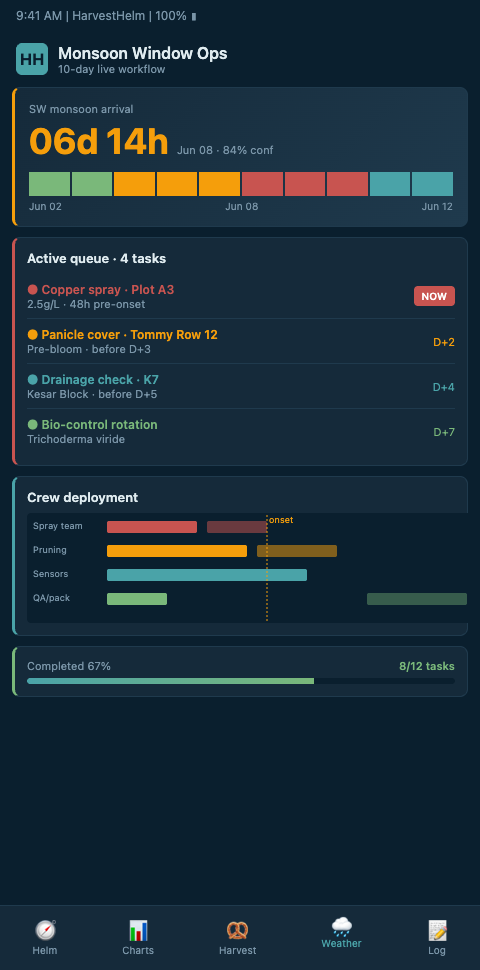
The dashboard architecture stacks four synchronized layers. Layer one is the arrival probability distribution — a rolling 10-day curve showing the likelihood of monsoon onset on each day, updated every 6 hours as new sensor and forecast data arrives. HarvestHelm blends IMD's official onset forecast with canopy pressure, dewpoint, and soil moisture trajectories at the plantation scale. Research from HCWF on forecasting the Indian monsoon onset documents that AI-blended models combining NeuralGCM, ECMWF, and IMD historical rainfall produce 30-day probabilistic onset forecasts with meaningfully better accuracy than any single-source forecast. The dashboard renders this as a curve, not a point, so the grower sees uncertainty honestly.
Layer two is decision cards. Each arrival-sensitive decision domain (harvest, labour, chemistry, packhouse, logistics) has its own card with current recommendation, updated daily. The harvest card shows the expected optimum pull-forward date and the tonnage at risk if the decision shifts by 1 day in either direction. The labour card shows the crew call date and the scaling parameters. The chemistry card shows the final pre-monsoon spray window and the residue budget remaining. The packhouse card shows throughput capacity against expected bin volume. The logistics card shows container booking windows and the pre-cooling schedule. Each card updates as the probability curve shifts, and the grower sees which decisions are moving toward hardening (because the probability distribution is tightening around a specific window) versus which remain fluid.
Layer three is cross-card dependency tracking. A shift in the harvest pull-forward date automatically propagates to labour call dates, packhouse throughput needs, and pre-cooling schedules. HarvestHelm renders these dependencies as a graph on the dashboard, so the grower sees which decisions hinge on which. This is the workflow equivalent of the IMD mausam portal integrating with agronomic advisories — the IMD Monsoon Information portal provides the regional onset declaration that feeds into the plantation's specific workflow. This also connects directly to monsoon pull-forward decisions because pull-forward is the single highest-stakes decision inside the 10-day window and shapes all the downstream timing.
Layer four is action logging and confirmation. Every dashboard recommendation that the grower accepts, modifies, or rejects gets logged with timestamp, rationale, and eventual outcome. At the end of the monsoon arrival window, the plantation has a complete audit trail of decisions made against the probability distribution that was live at the time. That log serves two purposes: post-season review for workflow improvement, and evidence trail for insurance claims or export compliance audits. Plantations that integrate with doppler radar alerts extend the arrival-probability distribution with sub-daily precipitation tracking inside the final 48 hours.
Advanced Tactics for Monsoon Arrival Decision Cascades
The advanced layer of workflow tactics separates plantations that execute monsoon arrival windows smoothly from those that scramble. The first tactic is decision pre-commitment thresholds. The harvest pull-forward decision becomes costly to reverse once labour crews are called and packhouse pre-cooling has started. HarvestHelm's dashboard identifies each decision's pre-commitment threshold — the point at which the grower can no longer costlessly reverse course — and shows how many days remain before each threshold. The grower can then either accept the dashboard's recommendation before the threshold hits or explicitly defer the commit, understanding the cost of later course correction.
The second advanced tactic is agromet advisory integration. Springer research on agromet advisory services documents how district-level advisories translate forecasts into crop-specific management actions, and HarvestHelm's dashboard imports the relevant agromet advisories as supplemental signal rather than primary direction. A KVK advisory recommending immediate pre-monsoon spray across the district gets displayed on the dashboard as confirmation or contradiction of the plantation-specific trigger logic — if the two signals align, confidence rises and pre-commitment thresholds get relaxed. If the two signals disagree, the dashboard surfaces the disagreement so the grower can investigate the cause before acting. Platforms like Farm21's farm dashboard approach demonstrate how central-hub dashboards integrate weather, soil, and imagery data for operational decisions — the mango monsoon workflow is a specialized instance of that general pattern.
The third advanced tactic is cross-niche decision pattern transfer. Desert date palm oases face a parallel 10-day decision window during haboob arrival sequences, and the workflow architecture transfers with domain-specific parameter substitution. Plantation managers running HarvestHelm across multiple crop domains can study haboob dashboard workflow patterns for cross-pollination of decision cascade design. The monsoon arrival case study from the IMD 2024 monsoon report documents specific arrival-timing variance across years that makes workflow-based coordination more valuable than point-forecast decision-making. Plantation managers who have tuned their dashboards across multiple seasons refine the decision cascade until the workflow survives a wide range of arrival scenarios.
Post-Window Review Protocols That Improve Next Year's Workflow
The operational discipline that separates plantations running mature monsoon-arrival workflows from those still learning is the post-window review. After monsoon arrival has actually happened and the workflow has run through its decisions, the plantation manager conducts a structured review of how the workflow performed against the actual arrival date and pressure pattern. HarvestHelm's dashboard generates the review automatically — comparing the probability distributions that drove each decision to the actual outcome, flagging decisions that were either correctly executed or incorrectly executed against the retrospective ground truth.
The review produces three categories of findings. Category one is timing gaps — decisions where the workflow recommended action 2 to 4 days earlier or later than retrospectively optimal. Category two is coordination breaks — where one sub-system ran on a timing that conflicted with another, typically where harvest and packhouse pre-cooling got out of sync. Category three is information gaps — where the workflow lacked sensor data or forecast input that would have changed the recommendation. Each category drives a specific next-season improvement: threshold parameter tuning for timing gaps, dependency graph refinement for coordination breaks, sensor network expansion for information gaps.
The compounding effect across seasons is what makes post-window review worth the discipline. A plantation that systematically improves workflow timing, coordination, and information coverage across three consecutive monsoon seasons accumulates improvements that push export-grade conversion 15 to 25 percent above starting baseline — while a plantation running the same workflow year after year without review plateaus at its first-season performance level. The monsoon arrives differently each year; the workflow has to learn faster than the arrival pattern drifts, and post-window review is the mechanism by which learning happens.
Running the Arrival Window Like a Captain, Not a Dispatcher
The 10-day monsoon arrival window is the highest-stakes period on the mango plantation calendar. A plantation running calendar-based uncoordinated workflows during that window burns through 20 to 35 percent of its theoretical margin every season on idle labour, wasted chemistry, and mistimed harvest calls. HarvestHelm's kilo-cut monetization model means the platform earns only when the plantation actually clears export-grade fruit during the window — aligning the dashboard's workflow recommendations directly with the grower's realized outcome. The plantation that runs the arrival window with a coordinated decision cascade treats the monsoon as a navigable weather system rather than an operational disaster. Ratnagiri, Junagadh, and Krishnagiri plantations that have implemented dashboard-driven monsoon arrival workflows report 14 to 22 percent improvements in export-grade conversion across the arrival window. The monsoon will arrive. Your dashboard decides whether your plantation arrives with it, prepared, or chases it with scrambled crews three days behind.