Best Practices for Monsoon-Window Harvest Pull-Forward Decisions
Why District Monsoon Forecasts Wreck Harvest Timing
The Alphonso harvest window in coastal Maharashtra runs roughly 45 days, from mid-April through late May, with peak export-grade quality concentrated in a 12-to-18-day band. Kesar in Gujarat runs later — mid-May through June — and overlaps the early monsoon onset in a way that makes timing even tighter. When USDA FAS documents monsoon withdrawal delays and arrival variance across multiple consecutive seasons, growers face a forecast distribution that has literally widened over the past decade, and district-level advisories arrive with 52 to 68 percent accuracy depending on the lead time.
The pull-forward question sits inside that uncertainty. Pick four days too early on Alphonso and you hit the pulp quality cliff documented in PMC research on Dusehri mango, where fruit harvested at 101 days after fruit set ripens slower and holds firmer peel than fruit at 111 days — but also loses the aromatic compound development that drives export pricing. Pick four days too late and a single monsoon burst causes fruit split, surface scarring, and latent anthracnose that manifests in transit. The Frontiers review of mango supply chain management attributes 40 to 50 percent of post-harvest losses to maturity timing errors and pre-monsoon pick decisions — an enormous pool of value lost to calendars that never read canopy conditions.
The cost structure turns brutal at scale. A 60-acre Alphonso plantation generating 240 tonnes of export-grade fruit at average export prices faces a 48 to 60 lakh rupee swing between a correctly-timed pull-forward and a week-too-early or week-too-late call. Compounding the problem, most plantation managers are deciding based on the same IMD district advisory their neighbours see, which means the whole region tries to harvest the same three days, packhouse throughput collapses, and labour rates spike 40 percent. District forecasts are necessary context, but they are not sufficient navigation.
Building Pull-Forward Decisions on Helm-Charted Yield Forecast Logic
HarvestHelm treats the monsoon-window harvest decision the way a yacht captain treats an approaching squall: you read the wind shift, the swell pattern, and the barometric trend from your own instruments, not from the regional forecast. The helm-charted yield forecast pulls three signal streams into one dashboard view: cumulative heat units per block (tracking physiological maturity), panicle-to-fruit-set interval per tree cluster (flagging which blocks are mature enough to pull), and 200-metre-resolution monsoon onset probability from canopy-adjacent sensors cross-referenced against district trends. A captain does not guess when the storm arrives — the captain watches the glass drop and acts on that specific reading.
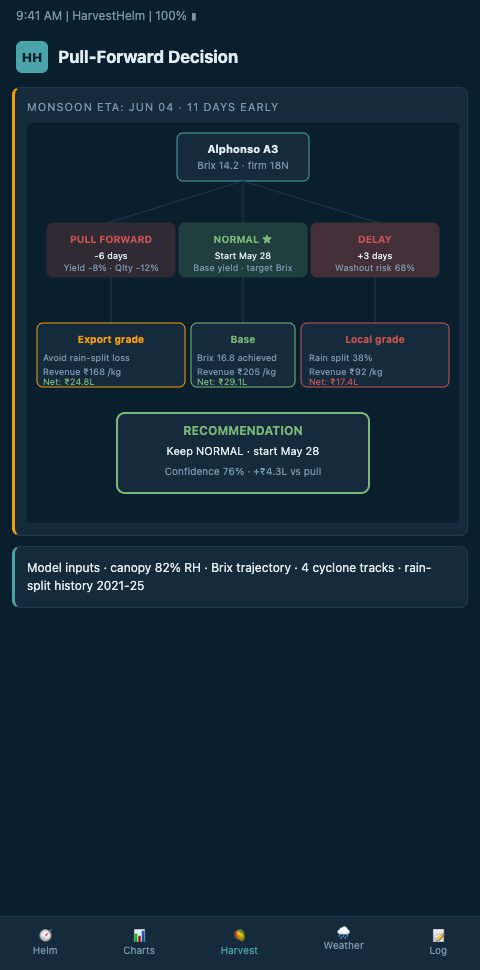
The solution architecture starts with block-level maturity tracking. Cumulative heat-unit targets for Alphonso sit around 2,100 to 2,350 growing degree days from full bloom, depending on scion age and rootstock. HarvestHelm's dashboard reads canopy temperature sensors every five minutes, integrates the heat-unit curve, and projects three maturity scenarios: conservative (high pulp quality, lower tonnage), standard (target export grade), and aggressive (tonnage priority, higher ripening risk). The grower sees the three scenarios side-by-side on the yacht-style dashboard, each colour-coded by current probability of hitting the target window before monsoon.
Layer two is monsoon arrival probability. Regional grids are too coarse to drive harvest decisions, but they are useful as a prior. HarvestHelm blends the IMD district forecast with canopy pressure readings, dewpoint drift, and soil moisture trajectories that collectively signal monsoon approach 2 to 5 days before the regional grid formally declares onset. The dashboard renders this as a probability distribution over the next 10 days — not a single date, but a curve — so the pull-forward decision gets framed as "what harvest date minimizes the expected value loss given this distribution." That framing beats calendar guessing by a wide margin and maps cleanly onto the monsoon dashboard workflow that growers run during the 10-day arrival window.
Layer three is packhouse and labour coordination. Pulling forward requires more than a decision — it requires crews, bins, grading lines, and cold storage ready to absorb the volume. HarvestHelm's dashboard feeds the pull-forward date into the labour staging module, so crew supervisors can call in additional pickers from aggregator platforms and packhouse managers can prep grading lines 48 hours ahead of the harvest surge. Research from the International Growth Centre confirms that monsoon arrival timing is the single most valuable piece of information for Indian growers' operational decisions — and the value multiplies when the forecast is translated into specific actions across crews and equipment. This is where staggered flush labour staging becomes critical, because pull-forward overlaps with the natural flush wave that crews are already staging around.
Advanced Decision Tactics Under Monsoon Uncertainty
The advanced layer of pull-forward tactics separates plantations that average 82 percent export-grade conversion from those that average 91 percent. The first advanced move is cultivar-specific decision rules. Alphonso demands tighter pull-forward precision because the aromatic compound development peaks in a narrow 6-day band, while Kesar tolerates wider pull-forward windows because the sugar-acid balance holds across 10 to 12 days. Tommy Atkins, grown in coastal India for export to Gulf markets, sits between the two. HarvestHelm lets growers assign cultivar-specific maturity rules and risk tolerance parameters per block, so the same plantation can run conservative pull-forward on Alphonso while holding Kesar for maximum tonnage.
The second advanced tactic is cyclone and depression track overlay. Pre-monsoon and early-monsoon periods frequently feature Bay of Bengal depressions that track across peninsular India, delivering rainfall days or weeks before the formal monsoon onset. Research-practice tools like the PAGASA tropical cyclone agricultural warning system have demonstrated that early-harvest triggers ahead of cyclones prevent spoilage on mature crops. HarvestHelm overlays IMD depression tracks against plantation coordinates and re-prices the pull-forward decision accordingly — a depression forecast to clip the coast in 72 hours might move the pull-forward date up by two days regardless of what the primary monsoon onset curve says. Citrus growers running a similar playbook for hurricane season use depression track reading tactics that transfer directly to mango plantations facing Bay of Bengal systems.
The third advanced tactic is price-quality curve optimization. Not every pull-forward decision targets maximum export-grade conversion. When Dubai pricing for medium-grade Kesar spikes ahead of Ramadan, a plantation might deliberately pull forward by three days to capture the price premium even at a slight quality cost. The helm-charted yield forecast integrates real-time export pricing curves into the decision module, so the recommendation balances quality loss, tonnage, and price realization against monsoon risk. Regional reports like the ABC Fruits Alphonso & Totapuri crop report demonstrate that timely pre-monsoon decisions directly drive per-acre productivity — and the tactical layer on top of timing is price realization. Growers who treat pull-forward as a single-variable calendar decision leave significant value on the tree.
Common Pull-Forward Mistakes That Experienced Growers Still Make
Even experienced plantation managers make systematic pull-forward errors that audit data catches season after season. The first common mistake is anchoring on the most recent bad year. A grower who was caught by an early monsoon in 2022 tends to pull forward too aggressively in 2023 even when the probability distribution does not justify it. HarvestHelm's dashboard explicitly renders the historical distribution of arrival dates alongside the current forecast, which forces the grower to weigh the current signal against the full range of outcomes rather than just the most memorable one. This single framing correction alone reduces aggressive-pull-forward losses by meaningfully in the plantations that have adopted it.
The second common mistake is uniform pull-forward across cultivars. Alphonso, Kesar, and Tommy Atkins have different maturity curves and different monsoon sensitivities, yet plantation managers often run a single pull-forward decision across the whole plantation for simplicity. HarvestHelm's block-level decision logic lets the grower pull Alphonso blocks forward by 4 days while holding Kesar on the standard schedule and letting Tommy Atkins run longer — each cultivar optimized against its own curve. The operational complexity is real but manageable with dashboard support, and the value capture across a mixed-cultivar plantation usually exceeds the complexity cost by 3x.
The third common mistake is ignoring packhouse throughput as a hard constraint. A pull-forward decision that requires processing 40 percent more bin volume than the packhouse can handle in the compressed window produces bin pile-ups, delayed pre-cooling, and quality degradation that eats the entire benefit of the timing adjustment. HarvestHelm's dashboard checks pull-forward recommendations against packhouse capacity and flags the gap when one exists, so the grower can either expand capacity, split the pull-forward across a longer window, or accept a partial pull-forward that fits within operational constraints.
Running Monsoon Harvest Like a Captain, Not a Calendar
The pull-forward decision is the single highest-leverage call a mango plantation manager makes each year. Four days of precision in either direction determines whether 50 lakh rupees of export revenue clears or rots. HarvestHelm's kilo-cut revenue model means the platform only gets paid when export-grade fruit actually clears customs — aligning the dashboard's recommendations directly with the grower's outcome. A plantation running on calendar pull-forward rules is a ship navigating by dead reckoning; a plantation running on helm-charted yield forecast logic is reading the glass, the wind, and the swell from onboard instruments. Ratnagiri and Valsad managers who have adopted this approach report 8 to 14 percent lifts in export-grade conversion over three consecutive monsoon seasons. The monsoon will do what the monsoon does. Your dashboard decides whether you outrun it or get caught by it.