Stitching Doppler Radar Feeds Into Plantation-Level Alerts
The Squall Line That Ruined a Copper Spray Window
A 140-acre Kesar plantation in Junagadh wheeled out its spray rigs at 2 AM on April 14, 2025, targeting a copper bicarbonate application during a forecast 8-hour dry window before panicle emergence accelerated. By 4:30 AM, a fast-moving cumulonimbus cell swept across the western blocks, dropping 22 mm of rain in 40 minutes. The copper residue was stripped off 38 acres before appressorium suppression could establish, and the plantation's anthracnose control cascade shifted backward two weeks. The regional forecast from the previous evening had not flagged the cell because the 50-km grid smoothed over the sub-grid convective development. A Doppler product from the Bhuj radar had shown the cell forming two hours before spray rigs deployed — but the plantation had no pipeline for pulling Doppler data into an operational alert.
This is the gap HarvestHelm's plantation-level Doppler integration is built to close. India's IMD has been expanding its Doppler Weather Radar network aggressively — The Environment magazine's reporting on the IMD DWR buildout documents 40 radars now covering 92% of Indian territory, feeding the Bharat Forecast System at minute-by-minute cadence. The underlying data is world-class. The problem is that a plantation manager cannot read raw reflectivity products at 3 AM while spray rigs are queued; she needs a helm-charted yield forecast with monsoon dashboard workflows that have already fused the radar signal with her canopy telemetry and surfaced one decision.
How the Helm-Charted Yield Forecast Fuses Doppler With Canopy Telemetry
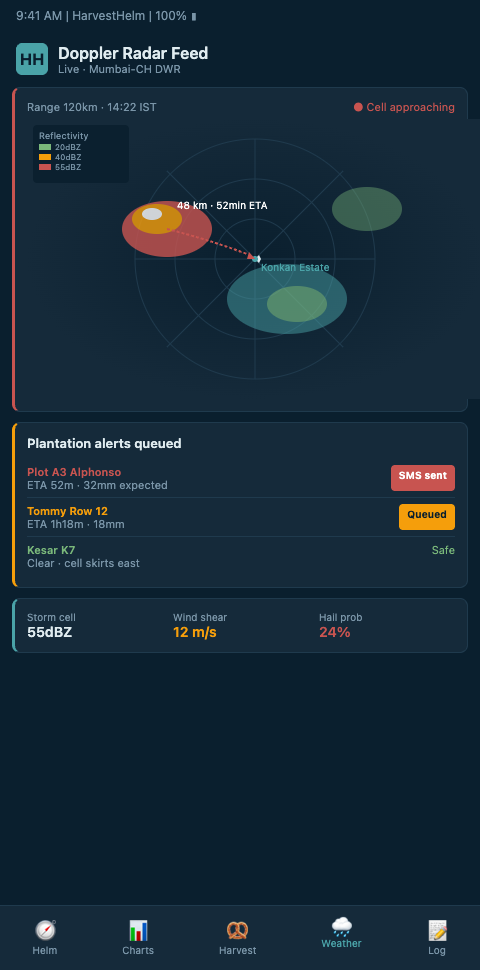
A plantation-grade Doppler fusion layer does three things the raw IMD feed cannot. First, it pulls reflectivity products from the nearest DWR — the IMD Kolkata regional center DWR page is a representative example of the public feed available for integration — and down-scales them to plantation resolution using canopy-telemetry anchors. A 1-km DWR reflectivity grid on its own cannot tell you whether the cell crossing your Alphonso block will drop 4 mm or 22 mm, but when the helm fuses DWR reflectivity with in-canopy humidity-rate-of-change and leaf-wetness integrals from the last 40 minutes, the accuracy of the 90-minute precipitation forecast jumps into a useful range.
The Agro Spectrum coverage of hyperlocal weather intelligence documents exactly this direction — meteoGAN-style AI models downscale IMD DWR/BFS feeds to 300-meter resolution for farm-level alerts. HarvestHelm's fusion engine operates in the same resolution bucket, but rather than producing a downscaled weather map, it produces a plantation-specific decision: spray now, spray in 2 hours, hold for 8 hours, or skip the window. This is where the dashboard's cultivar-specific spray-decision logic and the raw Doppler feed converge — Doppler integration feeds in the 90-minute precipitation field that the spray-decision engine needs.
Second, the helm cross-references Doppler signatures with canopy storm-damage history. A squall line approaching from the southwest behaves differently on a west-exposed Alphonso block than on an east-sheltered Kesar block. The helm stores three to five seasons of damage-signature correlations — for each radar echo pattern type, which blocks have historically taken hail, which have shed panicles to wind, which have taken canopy drenching without structural damage. A cell approaching from the southwest at 18 km/h with 48 dBZ reflectivity triggers different responses for different blocks because the helm knows the per-block historical record. The ProSensing X-band polarimetric Doppler work demonstrates how X-band Doppler enables 3-D analysis of cumulonimbus and hyper-local rainfall at plantation scale, which is the hardware direction premium plantations are moving toward for private-asset Doppler.
Third, the helm produces a synchronized radar-satellite-sensor fusion for situations where DWR coverage is sparse. The NASA GPM IMERG precipitation data product provides a complementary 10-km/30-min satellite field that fills gaps between DWR sweeps, and NASA's documentation on using GPM data for water resources and agricultural forecasting describes how the satellite product feeds crop-yield forecasts and microinsurance thresholds globally. For plantations along the edges of DWR coverage — or during the monsoon months when radar clutter accumulates — the IMERG layer provides the backup. This radar-satellite-sensor fusion connects to the multi-acre canopy telemetry architecture because the same helm server that aggregates block-level sensors is the one that ingests radar and satellite products. The satellite salt plumes work in coastal citrus groves uses an analogous fusion for hurricane-season salt deposition — the underlying radar-satellite-sensor stitching is cross-niche infrastructure.
Engineering the Spray-Window Integration
Integration with existing spray-window logic is where most plantations initially underestimate the engineering depth. The helm's spray-decision engine already factored in leaf-wetness integrals, RH trajectories, and cultivar-specific pathology sensitivity before Doppler arrived. Adding a 90-minute precipitation forecast from DWR into that decision engine required retraining the spray-window policy on historical spray-outcome data cross-referenced with reconstructed DWR records. HarvestHelm spent roughly 18 months building that cross-reference dataset — pulling DWR archives for Konkan, Gir, and Andhra Pradesh covering 2019-2024, matching them against plantation spray manifests and bloom outcomes, and fitting the fusion weights. The operational product a plantation sees at 3 AM is the output of that 18-month backend build, which is what separates a usable Doppler-integrated helm from a raw radar dashboard that the foreman cannot parse.
Advanced Tactics for Doppler-Plantation Fusion
The first advanced tactic is nowcast-to-spray-rig control logic. A Doppler-fused helm can push an abort signal directly to spray-rig GPS controllers when a cell is forecast to cross the active block within 45 minutes. Rather than the foreman pulling up a weather app and making a call, the spray rig reroutes to a sheltered block or pauses altogether. HarvestHelm's control pipeline uses a conservative margin — spray aborts on a 70% probability of >4 mm rain within 60 minutes, calibrated against copper-residue washoff curves. This is the operational layer most plantations miss; without it, the Doppler feed is descriptive rather than prescriptive.
The second tactic is archival Doppler for post-event claims. The Nature Sci Reports work on Doppler-radar-assisted desert locust tracking demonstrates how DWR digital assimilation improves rainfall estimation and storm-track landfall prediction at mesoscale. HarvestHelm archives the DWR reflectivity mosaic for every plantation event along with the canopy telemetry, which gives insurance adjusters and export contract counter-parties an auditable radar-plus-ground record when a hailstorm or flash flood triggers a claim. This matters especially for Kesar and Alphonso growers negotiating force-majeure clauses — the radar archive turns a contested event into a documented one.
The third tactic is monsoon-onset radar signatures. During the 10-day pre-monsoon window, DWR reflectivity patterns provide earlier signals of monsoon onset than the IMD statistical model alone. The helm tracks the frequency and organization of pre-monsoon convective cells across the plantation's catchment, flagging the characteristic reflectivity structure of true monsoon arrival versus pre-monsoon thunderstorm noise. For Konkan and Gir plantations, this distinction determines whether paclobutrazol goes out or gets held back for a cycle.
Radar-Driven Pest and Pattern Tactics
The fourth tactic is radar-driven hopper and midge alert triggering. Mango hoppers and midges migrate in response to atmospheric pressure-front passages, and Doppler reflectivity patterns during pre-monsoon thunderstorm clusters correlate with hopper-pressure spikes 24-48 hours later. HarvestHelm's helm fuses this with ground-based hopper-trap telemetry to raise pressure alerts before a scout walk catches the bloom under attack. This matters for export-grade Alphonso and Kesar because hopper damage on panicles during flower-set compounds fungal vulnerability — a panicle weakened by hopper sap extraction becomes more susceptible to anthracnose penetration. Radar-driven hopper alerts let the plantation pre-stage bio-control applications before the pressure spike lands on the canopy.
The fifth tactic is long-horizon radar archiving for multi-year pattern analysis. DWR archives going back 5-8 years allow the helm to identify recurring convective-cell pathways across the plantation. A Kesar estate in Gir discovered that southwest-to-northeast cell passages during April consistently drop 12-22 mm of rain on two of their eight blocks and leave the others dry, a pattern that had been invisible under single-season analysis. Armed with that archive-based pattern, the plantation shifted spray scheduling for those two blocks to a pre-cell window rather than the post-cell window used across the estate, which cut washed-off fungicide applications by 38% on the affected blocks. Multi-year radar archives turn reactive alerts into proactive block-level spray design.
Latency Budget From Radar to Spray Decision
The full latency chain from DWR sweep to spray-rig decision tracks about 4-7 minutes for HarvestHelm's pipeline: 2-3 minutes for IMD's DWR sweep-to-public-feed publication, 30 seconds for the helm to ingest the reflectivity product, 45-60 seconds for the fusion engine to combine the radar field with in-canopy readings, and 1-2 minutes for the decision engine to produce a spray recommendation. For a cell moving at 15-25 km/h, that latency budget translates into roughly 1-3 km of spatial warning before the cell reaches the plantation — enough to abort an active spray or reposition rigs to sheltered blocks. Plantations on raw IMD feeds without the fusion pipeline typically face 15-20 minute total latency, which eats most of the warning margin. The 4-7 minute budget is what makes the difference operationally actionable rather than merely informative.
The Helm That Reads Radar So You Do Not Have To
No plantation manager should be asked to parse raw DWR reflectivity at 3 AM while spray rigs wait. HarvestHelm's Doppler fusion layer pulls the 92%-coverage IMD radar network, the IMERG satellite backbone, and your canopy telemetry into a single helm-charted yield forecast that spits out one decision per spray window. Our kilo-cut contract means we absorb the engineering cost of the fusion pipeline; you only pay when the decisions we produced land Grade A fruit in the export packhouse.
If your Alphonso, Kesar, or Tommy Atkins estate has ever lost a copper-spray window to an unforecast cell, book a radar-integration review before the 2027 pre-monsoon thunderstorm season begins. Our radar-fusion onboarding walks through your last 24 months of spray manifests, reconstructs which sprays would have been aborted or rerouted under the fused pipeline, and gives your foreman a concrete preview of how the 3 AM decision process will change before the next monsoon.