Scaling Canopy Telemetry Across Multi-Acre Mango Plantations
When a Pilot Stops Scaling Around Acre 50
The engineer who wired up 14 leaf-wetness sensors across a single Ratnagiri Alphonso block usually has a story about the day the network fell over. Twenty acres in, the LoRa gateway that had been pulling clean packets from 92% of nodes dropped to 41% as the canopy closed over the receiver. Panicle-emergence sprays went out blind for three days. A 2024 Sindhudurg plantation manager measured what that cost: six hectares of bloom caught a powdery mildew flush during the blind window and pushed the block from Grade A to Grade B, shaving roughly INR 340 per kilo off the export parity price.
This is the quiet failure mode of multi-acre canopy telemetry. Pilots succeed because they live inside one radio hop, one battery-swap walk, and one person's mental model. Production plantations with 200-plus acres of Kesar, Alphonso, Banganpalli, and Totapuri planted across three microclimates break every one of those assumptions. The 50-km regional weather grid smears across the whole estate as a single value while 200-meter canopy cells quietly diverge by 8 to 14 percentage points of relative humidity during pre-monsoon flush. Without a scalable network, the dashboard inherits the regional blur and the kilo-cut revenue model collapses with it.
Redesigning the Helm-Charted Yield Forecast for 400 Acres
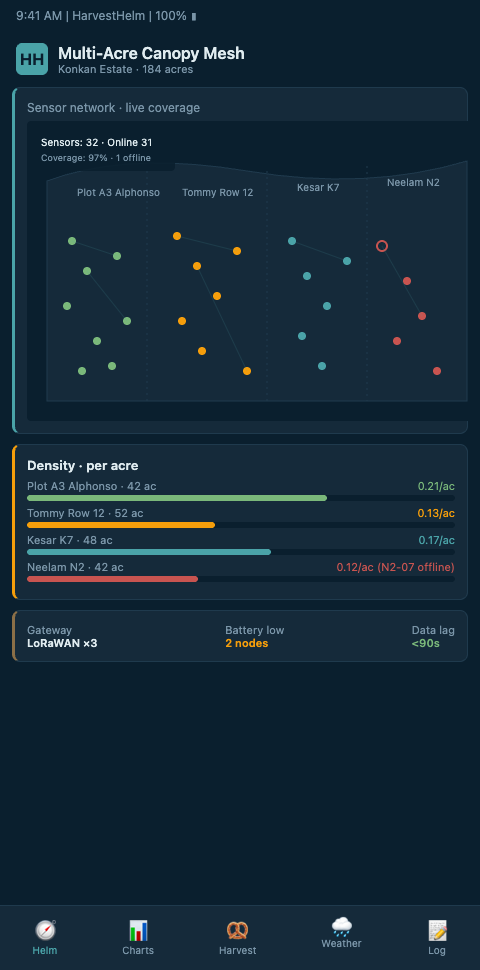
Scaling canopy telemetry on a tropical mango estate is less about adding sensors and more about redesigning the helm-charted yield forecast so the captain can still read the chart when the fleet triples. A yacht's navigation dashboard does not get harder to read when the crew expands — it gets more decisive because every instrument feeds one integrated helm. The same principle drives HarvestHelm's plantation-scale architecture. Instead of 14 panicle sensors reporting to one gateway, a 400-acre estate runs a three-tier mesh: edge nodes at the canopy, aggregators at the block, and a helm-synthesis layer that compresses thousands of readings into leaf-wetness integrals, anthracnose-pressure indices, and monsoon-onset variance tracks.
The edge-node tier is where most estate rollouts underestimate physics. Dense mango canopy absorbs 2.4 GHz and attenuates sub-GHz signals by 12 to 18 dB at full leaf-out. The LoRa Communication for Agriculture 4.0 study working through the FLog propagation model in orchards demonstrates that naive line-of-sight planning overestimates reliable range by 40% once canopy closes. HarvestHelm's deployment playbook derates range by that factor and spaces gateways assuming wet-canopy conditions, not the blue-sky benchmarks that pilot installers quote. Gateways sit on 4.5-meter masts at the windbreak edge, never inside the canopy, and each block gets a redundant second gateway so a monsoon-felled node does not blind the helm.
Between the edge and the helm, the aggregator tier is where plantation-scale math happens. A single Kesar block running 48 leaf-wetness sensors, 12 stem-flow probes, and 6 canopy-temperature strings produces roughly 14,000 readings per day. Streaming all of that to the cloud is both bandwidth-hostile and analytically noisy. Instead, block-level aggregators compute canopy-integrated humidity, conidia-germination-hour counts, and hopper-pressure deltas locally, pushing compressed feature vectors to the helm at 15-minute cadence. The LoRaFarM modular IoT architecture work validates this pattern across mixed-crop farms — modular aggregation keeps the network honest as sensor counts climb past 1,000.
The helm-synthesis layer translates this into the forecast a plantation manager actually uses. Rather than 48 dashboards for 48 sensors, the captain sees a canopy chart of the whole estate color-coded by anthracnose pressure, overlaid with monsoon-onset variance and a 72-hour Alphonso-bloom confidence band. A Kesar block that is drifting 11 points of relative humidity above its historical flush-stage envelope flags red before a spray decision goes out. This is the doppler radar alerts integration that separates plantation-scale HarvestHelm from retail-scale competitors — the helm layer fuses canopy readings with IMD's 92% radar coverage to catch squall lines before they hit the panicles. Multi-variety estates also rely on the multi-variety canopy map layer so Alphonso, Kesar, and Tommy Atkins blocks each carry their own cultivar-tuned thresholds rather than a smeared average.
Synchronization and Time-Alignment at Plantation Scale
Multi-acre plantations face a synchronization problem pilots never encounter. When 400 nodes across 200 acres all report at exactly the same interval, the LoRa network collapses under duty-cycle collisions. HarvestHelm's firmware uses pseudo-random slot assignment so nodes in the same gateway's reception window stagger their transmissions across the cadence. This drops reception-loss rates from 18-22% on naive schedules to under 3% on staggered schedules, which is the difference between a trustworthy dashboard and a dashboard that the foreman stops checking after the second phantom alert. The synchronization layer also handles time-sync across aggregators so that leaf-wetness integrals computed at one block-level aggregator reconcile correctly with conidia-germination-hour counts computed at the next aggregator over — a detail that sounds minor until a 400-acre estate tries to compare humidity drift across blocks and discovers its timestamps are misaligned by 11 minutes.
Advanced Tactics for 200-to-1,200-Acre Rollouts
Battery logistics is the silent killer of plantation-scale telemetry. At 400 sensors across 300 acres with monsoon-season humidity accelerating battery self-discharge, a naive annual replacement plan means three weeks of labor during windows when labor is better used on picking and spray. HarvestHelm estates solve this with staggered 28-month lithium-thionyl chloride nodes batched by row, rotating replacements so no block ever goes below 85% coverage. The Energy-Efficient WSN for Precision Agriculture review establishes the duty-cycle math — nodes at 0.1% duty cycle clear five-year service windows easily, which is what multi-acre economics demand.
Gateway-placement topology deserves its own playbook. The MDPI smart-agriculture architecture paper documents the $350B projected IoT-agriculture market partly because gateway-placement heuristics have matured — triangulated gateways at the block corners beat a central mast for canopy plantations because the line-of-sight is edge-on, not through-leaf. Estates that run 12 Alphonso and 18 Kesar blocks typically end up with 6 to 9 gateways, redundantly paired, with a wired backhaul to a diesel-backup helm server so a 3-day monsoon power outage does not silence the forecast. For plantations with fragmented parcels split by village roads, the fragmented parcels scaling playbook for mountain apples translates directly — the same mesh patterns that cover 80-plot Honeycrisp orchards also cover 40-parcel Konkan estates separated by mango-and-coconut mixed rows.
Digital-twin maturity is the frontier that multi-acre operators should track this planting year. Digital Twin for Orchard Production Systems describes the AgScan3D+ project building twins of 15,000 trees including mango varieties — that scale of per-tree modeling is what lets a plantation manager run a "what-if-monsoon-arrives-11-days-late" simulation against their actual canopy, not against a 50-km regional grid. HarvestHelm estates on digital-twin mode capture LiDAR scans once every 18 months and anchor their leaf-wetness integrals to cultivar-specific flower-induction responses, which is what keeps the paclobutrazol schedule honest when the monsoon drifts.
Commercial-grade LoRaWAN remains the backbone of nearly every multi-acre deployment. Semtech's LoRaWAN smart-agriculture platform documents the 10-to-15-km gateway range and multi-year battery life that make 400-to-1,200-acre rollouts economic. The Nature technical survey on IoT sensors in precision agriculture provides practical gateway-placement guidance for orchard canopies that new HarvestHelm estates use during their first-year infrastructure plan.
Commissioning Sequence and Trust Building
Commissioning sequence matters as much as hardware choice. A multi-acre rollout that tries to deploy every block simultaneously typically hits calibration bottlenecks — each leaf-wetness sensor needs 48 hours of co-located reference data against a known-good probe before its readings enter the helm. HarvestHelm sequences installations across 60 to 90 days, starting with the highest-risk Alphonso blocks and working outward, which gives the calibration team the bandwidth to validate each batch before the next one ships. Estates that try to compress this into a 21-day installation window consistently end up with 14-22% of sensors producing noisy readings during the first flower-induction cycle — noisy enough that the plantation manager stops trusting the dashboard and reverts to calendar-based sprays.
Staff training during commissioning is the under-budgeted line item that decides whether a multi-acre rollout sticks. Plantation foremen who have spent 20 years reading panicles and sniff-testing spray decisions do not inherit trust in a dashboard simply because sensors arrive. HarvestHelm's commissioning protocol runs a parallel-track first season where foremen make their normal calls and the helm makes its calls, both recorded against the actual bloom outcome. By end of season, the helm typically outperforms calendar calls on 78-84% of key decisions in drift years and ties in benign years — which is the credibility threshold that brings the foremen onto the dashboard the following season. Skipping this parallel-track phase is how plantation IoT rollouts silently fail at month 18.
The Helm Captain's Handoff at Plantation Scale
A multi-acre HarvestHelm rollout is not a sensor purchase — it is a redesign of how a plantation operator makes decisions during monsoon-onset, flower-induction, and flush-stage windows across Alphonso, Kesar, Tommy Atkins, and Haden blocks simultaneously. If your estate spans 200 acres or more and you have ever watched a regional forecast miss a canopy-level anthracnose window by two weeks, HarvestHelm's zero-upfront deployment means you can commission a plantation-scale helm without betting capex against a single monsoon. We only collect the kilo-cut when your export-grade fruit clears the packhouse, which aligns our gateways and our engineering time with your Grade A tonnage. Ask our plantation-architecture team for a walk-through of your canopy topology before the next pre-monsoon flush sets.