Adding Tab Search to Your Emergency Triage Toolkit
When Two Poisoning Cases Arrive at Once
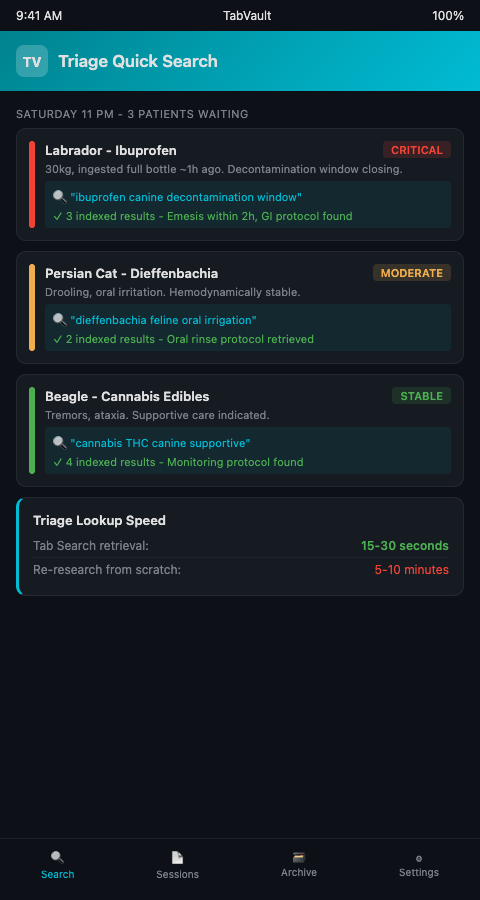
A Saturday evening at a veterinary emergency hospital: a Beagle presents with tremors after ingesting marijuana edibles, a Persian cat comes in drooling after biting into a Dieffenbachia plant, and a Labrador arrives vomiting after eating an entire bottle of ibuprofen. All three cases are classified as poisoning, but the triage priorities are completely different. The Labrador needs immediate gastrointestinal decontamination before the ibuprofen reaches peak absorption. The cat needs oral irrigation but is hemodynamically stable. The Beagle needs supportive care and monitoring but is not in immediate danger.
Veterinary triage systems like the Animal Triage Acuity Scale classify patients by severity, but they do not provide toxin-specific guidance on treatment priority (Ruys et al., 2012). The clinician must combine the triage acuity level with toxin-specific knowledge to decide who gets treated first and with what protocol. That toxin-specific knowledge lives online — in the Merck Veterinary Manual, in ASPCA toxicology references, in PubMed case reports — and accessing it under time pressure means opening tabs, scanning text, and comparing information across sources.
The ASPCA Animal Poison Control Center fielded over 401,000 cases in a single year, and their data shows that the most common toxin categories — chocolate, medications, plants, rodenticides — each require fundamentally different triage approaches (ASPCA). A veterinary triage decision support system needs to account for this variability, but no single website provides a unified triage workflow for all poisoning types. The clinician builds that workflow in their browser, one tab at a time.
The bottleneck is retrieval speed. When a critical patient is seizing on the table, the difference between finding the metaldehyde seizure protocol in 15 seconds versus 3 minutes is clinically meaningful. Bookmarks help if the clinician remembered to save the right page. Browser history helps if the clinician can recall when they last looked it up. Neither approach supports the kind of clinical signs rapid lookup that emergency toxicology demands.
Tab Search as Triage Decision Support
Adding a tab search tool to your emergency toxicology triage workflow changes the retrieval equation. Instead of navigating to specific websites and searching within them, you search your entire archive of previously viewed toxicology pages from a single search bar. This is the practical result of turning chaotic browser sessions into a searchable private database: every ASPCA reference, Merck Manual page, and PubMed case report you have ever indexed is available in one query.
TabVault turns this into a practical poisoning triage priority search. When the ibuprofen Labrador arrives, type "ibuprofen canine decontamination window" into your search. Every page you have previously indexed containing those terms appears — the Merck Manual entry on NSAID toxicosis, the ASPCA's dosing threshold page, a PubMed case report on early versus delayed decontamination outcomes. You scan the results, confirm the 2-hour emesis window, and proceed to treatment. The entire lookup took less than 30 seconds because you were searching content you had already indexed, not navigating to a website and searching within it.
This is what it means to incorporate tab search into a veterinary triage decision support framework. The archive you have built through weeks of normal clinical browsing — every poison control reference you consulted, every emergency protocol page you reviewed — becomes a triage asset. The more cases you have handled, the richer your archive becomes, and the faster your lookups get.
TabVault adds a critical dimension to the clinical signs rapid lookup problem. In toxicology, clinical signs often precede definitive identification of the toxin. A dog presenting with hypersalivation, miosis, and bradycardia might have organophosphate toxicosis or carbamate toxicosis. Searching your archive for "miosis bradycardia hypersalivation canine" retrieves every page you have indexed that describes those signs together, potentially identifying the toxin class before confirmatory testing returns.
The emergency toxicology triage workflow becomes faster with each shift. After six months of indexing, a clinician working at a busy emergency hospital has built a personal toxicology database that reflects the exact case mix their hospital sees. The chocolate toxicosis pages are there because they treat chocolate cases weekly. The lily nephrotoxicity pages are there because cat lily cases spike every Easter. The archive mirrors the clinical reality of the practice, which means the most relevant pages are always the ones most likely to be indexed.
The parallel to other research-intensive fields is direct. Architectural salvage dealers who integrate tab search into their daily sourcing routine face the same fundamental challenge: needing instant access to previously researched information under time pressure. The context is different, but the retrieval problem is identical.
Advanced Triage Search Strategies
Build toxin-class query templates. Create a mental library of search patterns organized by toxin class. For anticoagulant rodenticides: "brodifacoum PT/INR canine treatment." For tremorgenic mycotoxins: "penitrem A tremors methocarbamol." For sympathomimetic toxins: "pseudoephedrine tachycardia canine." These templates let you search precisely even when the exact toxin identity is unknown.
Index triage flowcharts and decision trees. Several veterinary toxicology textbooks and online resources publish triage flowcharts — "if ingestion was less than 2 hours ago and no signs of corrosion, induce emesis." When you view these pages during study time, TabVault indexes them. During a case, searching for the toxin name may retrieve the flowchart alongside the detailed protocol, giving you a rapid triage decision framework.
Search by time-critical interventions. Some toxin exposures have narrow decontamination windows. Ethylene glycol in cats must be treated within approximately 3 hours of ingestion before irreversible renal damage occurs, according to Merck Veterinary Manual guidelines. Search your archive for "ethylene glycol feline treatment window" to retrieve every indexed page that discusses this critical timing, ensuring you do not miss the intervention threshold during a high-stress triage.
Layer triage searches with species filters. When multiple species present with the same toxin, add the species name to your query to stratify results. "Permethrin toxicosis feline" retrieves cat-specific pyrethroid protocols, while "permethrin toxicosis canine" retrieves the dog-specific guidance. The tab search emergency triage toolkit is most powerful when it can separate species-specific protocols from general toxicology information in a single query.
Use the archive to triage education, not just patients. Architectural salvage dealers integrate tab search into their daily sourcing routine using the same rapid-retrieval principle. After each shift, review which poisoning cases required the longest lookup times. Search your archive to see if the relevant pages were already indexed or if you had to find new sources. Cases where you lacked indexed material indicate gaps in your archive that you should fill during study time, systematically strengthening your triage toolkit for future shifts. Track these gaps in a running list — after three months, the pattern of missing coverage reveals which toxin classes or species combinations your archive underserves. Proactively indexing reference pages for those gap areas during quieter shifts transforms reactive research failures into systematic preparedness that benefits every clinician at the practice.
Make Your Archive Your Fastest Triage Tool
Every toxicology reference you have ever viewed is either lost in browser history or indexed in a searchable archive. TabVault makes it the latter. If your emergency practice needs faster poisoning triage priority search and you are tired of re-navigating to the same ASPCA and Merck Manual pages under time pressure, join the waitlist. Build the tab search emergency triage toolkit that matches the speed your patients need.
Three poisoning cases arrive within an hour on a Saturday night. TabVault lets you triage the research as fast as you triage the patients. Type "ibuprofen canine emesis window" for the Labrador and retrieve the decontamination timing threshold in seconds. Switch to "Dieffenbachia feline oral irrigation" for the cat and pull up the calcium oxalate crystal management protocol you indexed last month. Check "marijuana edible canine supportive care" for the Beagle and find the VIN thread on THC monitoring parameters a colleague researched during a similar case. Each lookup draws from your practice's accumulated research history, converting what would be three separate web searches into three instant archive retrievals.