Why Emergency Vet Research Needs More Than Bookmarks
The Bookmark Folder That Failed at 2 AM
A veterinary emergency clinician maintained a carefully organized bookmark folder for toxicology references. Subfolders by toxin class — rodenticides, NSAIDs, toxic plants, household chemicals — each containing links to ASPCA pages, Merck Veterinary Manual entries, and selected PubMed articles. The system worked for the first six months. By month twelve, the folder contained over 300 bookmarks. By month eighteen, the clinician had stopped adding new ones because she could not find existing ones fast enough during emergencies. At 2 AM, with a seizing dog on the table and a frantic owner on the phone, scrolling through a nested bookmark hierarchy was slower than running a fresh search.
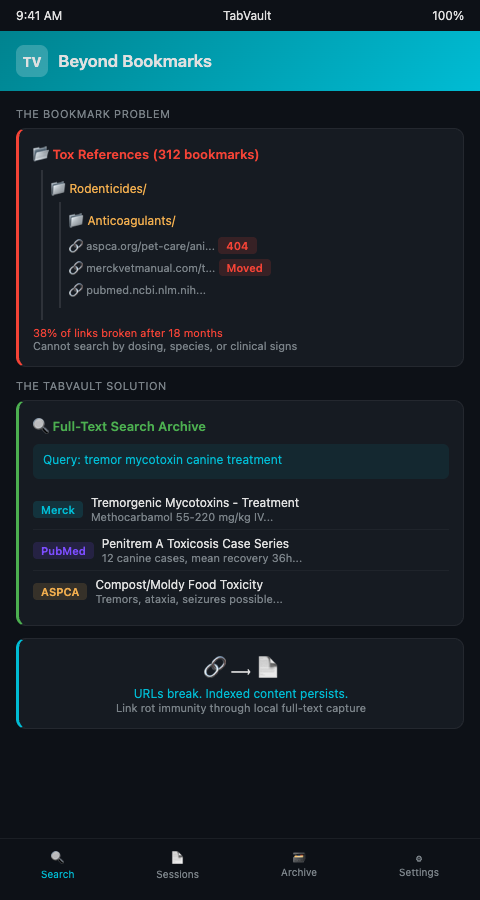
This is not an organizational failure. It is a structural limitation of bookmarks as a reference system. Bookmarks store URLs and optional labels. They do not store page content. They offer no full-text search. They break when websites restructure their URLs — a problem the Merck Veterinary Manual has experienced through multiple site redesigns. A bookmark to a specific toxin entry may return a 404 error or redirect to a different page entirely, with no way to recover the original content.
Research from Carnegie Mellon University on browser tab behavior found that people accumulate tabs and bookmarks specifically because they fear information loss, yet the tools themselves are poorly suited for long-term information retrieval (Carnegie Mellon University, 2021). For veterinary toxicology bookmark limitations, this finding is directly applicable: the bookmark folder grows because clinicians want to preserve references, but the bookmark format cannot support the retrieval patterns that emergency medicine demands.
The triage research organization problem goes beyond folder structure. During a poisoning emergency, a clinician does not think in bookmark categories. She thinks in clinical questions: "What is the toxic dose of grapes in a 5-kg dog?" "Is emesis still indicated 4 hours post-ingestion?" "What is the renal monitoring protocol for lily ingestion in cats?" No bookmark folder structure maps to these questions. The information exists in the bookmarked pages, but bookmarks provide no way to search page content.
From Bookmarks to Full-Text Clinical Decision Support
Emergency vet research beyond bookmarks starts with a different storage model. Instead of saving URLs, index the full text of every page visited during clinical research. Instead of organizing by folder, organize by searchable content. Instead of depending on URLs that may break, depend on locally captured page text that persists regardless of website changes.
TabVault implements this model by turning chaotic browser sessions into a searchable private database, indexing every page a clinician visits in the background. The ASPCA toxin page, the Merck treatment entry, the PubMed case report, the manufacturer's Safety Data Sheet — all indexed, all full-text searchable, all retained locally. The bookmark folder becomes unnecessary because the indexed archive is more comprehensive (it captures everything, not just what you remembered to bookmark), more searchable (full text, not just URLs and titles), and more durable (local content, not dependent on external URLs).
Clinical decision support browsing changes fundamentally when the entire research history is searchable. A clinician facing a tremorgenic mycotoxin case types "tremor mycotoxin canine treatment" and retrieves every page she has consulted on the topic — across cases, across months, across sources. The same search in a bookmark folder would require opening the correct subfolder (if one exists), scanning bookmark titles (which may not mention tremors specifically), and hoping the links still work.
The difference is visible in emergency vet protocol management at the shift level. A clinician starting a Friday night emergency shift has immediate access to every toxicology page she indexed during every previous shift. No bookmark folder to maintain. No broken links to clean up. No hierarchical navigation to slow down retrieval. Just a search bar and her entire research history behind it.
The tab indexing approach captures content that bookmarks structurally cannot. A single ASPCA page on chocolate toxicity contains the toxin name, theobromine concentrations by chocolate type, weight-based dose thresholds, clinical signs by severity, decontamination options, treatment protocols, and monitoring parameters. A bookmark to that page captures none of this — just the URL. Tab indexing captures all of it, making each data point individually searchable.
Architectural salvage dealers encountered the same limitations when trying to use bookmarks for competitive market intelligence, finding that tab indexing captures missed details. The veterinary toxicology context is higher-stakes but structurally identical: bookmarks save locations, not the information at those locations.
For veterinary residents building their first research workflows, starting with indexed archives rather than bookmark folders avoids years of accumulated organizational debt. The indexed approach scales automatically; bookmark folders require constant manual maintenance that competes with clinical duties for attention.
Triage research organization through indexed archives also solves the broken-link problem that plagues bookmark collections. A 2024 survey by the Berkman Klein Center at Harvard documented that 38 percent of web pages accessible in 2013 were no longer available ten years later. For veterinary bookmarks pointing to specific toxicology pages, this link rot means that a bookmark saved three years ago has a meaningful chance of returning a 404 error precisely when a clinician needs the information most. An indexed archive is immune to link rot because it captured the page content at the time of indexing — the URL can change, the page can move, the entire site can restructure, and the indexed content remains searchable.
Emergency vet protocol management through full-text indexing also scales with practice growth in a way bookmarks cannot. A single-clinician practice generates one person's bookmarks. A five-clinician practice generates five separate, unsynchronized bookmark collections with inevitable duplication and inconsistency. An indexed archive shared across clinicians contains one comprehensive collection where each clinician's research adds to the whole, and every clinician searches the same corpus.
Moving Past Bookmark Dependence
Replacing bookmarks with full-text indexing requires adjusting a few habits.
Stop bookmarking, start browsing. The counterintuitive insight is that you do not need to save anything manually. With an indexer running in the background, every page you visit during clinical research is automatically captured and made searchable. The effort you previously spent deciding what to bookmark and where to file it can be redirected to patient care.
Search your archive before searching the internet. When a toxicology question arises, search your indexed archive first. If you have researched the topic before, the relevant pages are already there — pre-vetted by your own clinical judgment, retrieved in seconds. Only go to the internet when your archive does not contain the information you need, which means you are researching something genuinely new rather than redundantly re-researching a familiar topic.
Use compound searches for clinical questions. Bookmarks force you to navigate a predetermined hierarchy. Full-text search lets you query naturally. "Grape raisin tartaric acid canine AKI" returns every page containing any combination of those terms. "Lily nephrotoxicity cat aggressive diuresis" returns the specific treatment pages you need. The search language matches clinical thinking, not folder organization.
Let the archive reveal your reference gaps. After six months, search for toxin classes you know you encounter occasionally — organophosphates, toxic mushrooms, blue-green algae. If your archive returns few or no results, those are gaps in your indexed reference collection. Veterinary residents building indexed research workflows can use this gap analysis to prioritize study topics during slower rotations. The absence of archived content indicates topics where you have relied on memory or verbal consultation rather than documented web research. Fill those gaps proactively during slower shifts. The ASPCA's comprehensive toxic substance categories can guide which areas to prioritize.
Clean up your old bookmark folders gradually. You do not need to delete existing bookmarks immediately. As you build your indexed archive, the bookmarks become redundant naturally. Visit your bookmarked pages during a quiet shift, let them index, and the content is now in your archive — searchable, durable, and independent of whether the URL continues to work.
Your Research Deserves Better Than a Link List
Bookmarks were designed for casual web browsing, not for clinical decision support in emergency veterinary medicine. Every toxicology page you consult during a case contains information that may save an animal's life during the next similar case. TabVault captures that information through full-text indexing, making your entire research history searchable by clinical content rather than URL. Join the waitlist and replace your bookmark folders with a system built for emergency medicine.
Forget bookmark folders that balloon to 300 unsorted links within a year. TabVault replaces the entire bookmarking habit by indexing page content automatically as you browse during clinical work. The Merck Veterinary Manual entry on tremorgenic mycotoxins, the Pet Poison Helpline page on macadamia nut ingestion, the VIN thread where a toxicologist described an unusual oleander presentation in a horse — all captured in full text without a single manual save. When a toxicology question arises at 2 AM, you type the clinical terms into one search bar and retrieve results from every source you have ever consulted, regardless of whether the original URLs still work or the websites have restructured since your last visit.