The Veterinary Resident's Introduction to Indexed Research
The Residency Research Problem Nobody Warns You About
A first-year veterinary emergency medicine resident at a teaching hospital opened 847 unique web pages during her first month of toxicology rotations. She knew this because her browser history counter showed it before the oldest entries started expiring. Those pages included Merck Veterinary Manual entries on forty different toxic compounds, PubMed abstracts for case reports her attending referenced during rounds, ASPCA Animal Poison Control pages consulted during live cases, and lecture supplement materials her program director posted online. She bookmarked approximately sixty of those pages. She took notes on maybe twenty. The other 767 pages — more than ninety percent of her research — were effectively gone within weeks.
This is the standard new vet research workflow, and it is failing by design. Veterinary residency programs generate an extraordinary volume of web-based research. The Association of American Veterinary Medical Colleges oversees training standards that include extensive clinical rotations where residents are expected to research unfamiliar cases independently. The Merck Veterinary Manual alone contains thousands of entries across its toxicology section, and residents are expected to become familiar with the breadth of that content during their training.
The gap between research volume and retention is not a personal failing — it is a tools problem. Bookmarks do not scale to hundreds of pages per month. Notes apps require manual effort during clinical situations when cognitive bandwidth is consumed by patient care. Browser history expires and indexes only URLs, not content. A Carnegie Mellon study confirmed that users routinely keep tabs open to avoid losing important information, yet existing browser tools provide inadequate support for retrieving that information later (Carnegie Mellon University, 2021).
The residents who thrive in toxicology training are not necessarily the ones who read the most. They are the ones who can retrieve what they have already read when they need it again. That retrieval capability is what veterinary resident indexed research provides.
Building a Research Workflow That Scales With Your Training
Indexed research means every web page you visit during your residency is automatically captured, full-text indexed, and made permanently searchable. You do not bookmark pages. You do not take notes during emergencies. You do not organize folders. You browse, you read, you learn — and the indexer preserves everything in the background.
TabVault applies this model to the veterinary resident context specifically, turning chaotic browser sessions into a searchable private database. During morning rounds, your attending mentions a case of permethrin toxicity in a cat treated overnight. You pull up the Merck Veterinary Manual entry on pyrethrin and pyrethroid toxicosis, then check the ASPCA page for feline-specific treatment. During afternoon clinic, a dog presents with suspected xylitol ingestion and you research the hepatotoxicity monitoring timeline on PubMed. During evening study time, you review a journal article on emerging treatments for anticoagulant rodenticide toxicosis. All of these pages are indexed automatically. Your toxicology training browser organization happens without any organizational effort on your part.
The vet student toxicology study tool potential becomes clear during exam preparation. Instead of trying to reconstruct which Merck pages you read during which rotation week, you search your archive by compound, by clinical sign, by species, or by treatment modality. "Organophosphate atropine pralidoxime" retrieves every page you read on the topic across your entire rotation. "Feline renal toxin" retrieves every page discussing nephrotoxic compounds in cats, whether you read it during a lily case, an ethylene glycol case, or a NSAID case.
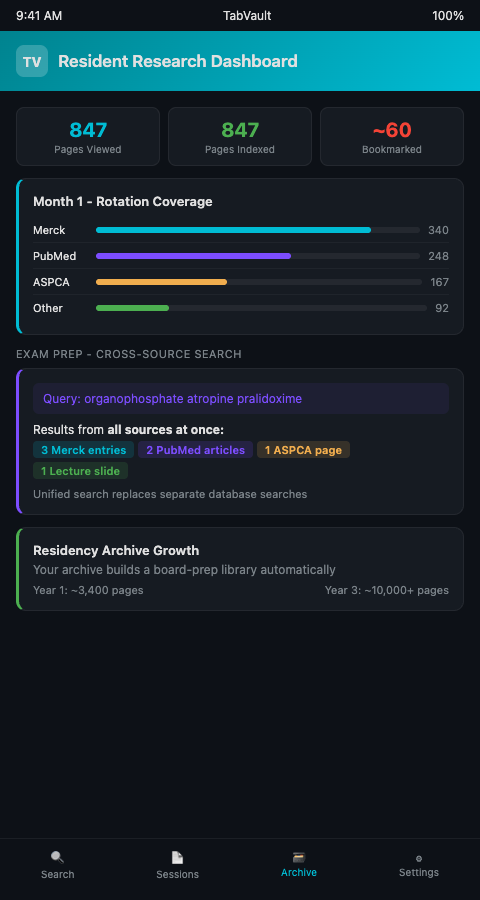
Merck Veterinary Manual search tips for residents typically focus on the site's internal search function, which searches only within the Merck database. An indexed archive searches across all sources simultaneously. When you search "metaldehyde canine seizure," you get the Merck entry, the ASPCA page, the PubMed case reports, and your program's internal protocol document — all in one search result, all from your own reading history.
This cross-source search capability distinguishes TabVault from single-source search tools. The new vet research workflow that most residents default to — searching each database separately, then trying to mentally synthesize results — is replaced by a unified search across every source you have ever consulted. The synthesis happens at the search level, not at the memory level.
The indexed approach also supports your reference indexing setup from the first week of residency. Instead of spending that first week creating an organizational system that may not survive the second week's caseload, you spend it researching cases and letting the indexer build your organizational system for you.
For residents preparing for board certification, the continuing education session approach to indexing means that every webinar, online lecture, and conference material you view in a browser also joins your searchable archive — study material that accumulates automatically over years of training.
Portal-based resources, which residents access through institutional subscriptions, present retrieval challenges due to session-specific URLs and login walls that make browser history nearly useless for re-finding specific pages.
The new vet research workflow that indexed archives support is also more honest about how residents actually learn. Textbooks present toxicology as organized chapters. Clinical practice presents it as random arrivals — a chocolate ingestion followed by an organophosphate exposure followed by a lily ingestion, with no thematic organization. Indexed archives respect this randomness by capturing whatever you research in whatever order you encounter it, then making the accumulated material searchable by any term. The organization emerges from the search, not from a predetermined structure that never matches clinical reality.
Toxicology training browser organization through indexing also creates a study resource that traditional note-taking cannot match. During a busy overnight shift, no resident has time to take detailed notes on the three toxicology cases she researched between midnight and 6 AM. But the indexer was running the entire time, capturing every page she consulted. The next morning, she can review her indexed sessions to see exactly what she read, reinforcing the clinical knowledge from cases she was too exhausted to document manually.
Strategies for Residents Starting Indexed Research
Beginning indexed research during residency creates compounding value throughout your career.
Start on day one, not after your first crisis. The best time to begin indexing is before you need to retrieve anything. Every page you index during your first rotation becomes searchable during your second. Every case researched in your first year is retrievable during your second and third. The archive's value grows exponentially with time, so starting early maximizes the return.
Index lecture supplements and assigned readings. Your program director assigns reading material, often as links to specific Merck or PubMed pages. These are high-value indexing targets because they represent curated, curriculum-relevant content. Index them during your assigned reading time, and they become part of your permanent archive alongside your case-based research.
Use your archive for case presentations. Residency programs require case presentations, and portal-based resources like FOIA portals and court systems demonstrate how indexed sessions preserve content behind login walls. Supporting those presentations with specific citations is expected. Your indexed archive provides a timestamped record of every page you consulted during the case — ready-made citation material that demonstrates the depth of your research.
Search your archive before asking your attending. Attendings value residents who demonstrate independent research capability. Before asking a clinical question, search your archive. You may have already read the answer during a previous rotation. The ability to say "I reviewed the Merck entry on this compound last month during a similar case" shows both clinical memory and research discipline. The ASPCA's annual toxin reports document which exposures are most common — pre-indexing these high-frequency toxins prepares you for the cases you are most likely to encounter.
Build toward your specialty. If you plan to pursue board certification in veterinary toxicology, your indexed archive is the beginning of a career-long reference library. Three years of residency research, automatically indexed, gives you a searchable corpus of thousands of pages when you sit for boards — every PubMed article, every Merck entry, every ASPCA page, every clinical guideline you read during training.
Your Residency Research Should Outlast Your Residency
The pages you read during residency training contain the foundational clinical knowledge your career will build on. Losing ninety percent of that research to browser history expiration and bookmark entropy is a waste of the extraordinary effort residency demands. TabVault indexes every page automatically, building a searchable research archive that grows with your training and persists throughout your career. Join the waitlist and start building the reference library your residency is already generating.
Start your residency with TabVault running and every rotation builds your archive automatically. The permethrin feline neurotoxicity page from your first emergency case, the PubMed abstract on zinc chelation timing your attending mentioned during rounds, the ASPCA sago palm hepatotoxicity profile you reviewed before a board prep session — all indexed, all searchable, all accumulating in the background while you focus on learning. By the time you sit for specialty boards, your archive contains years of curated references drawn from hundreds of real cases, organized not by chapter headings but by the clinical questions you actually needed to answer.