Indexing FOIA Portals, Court Systems, and News Archives From Day One
The First Week Sets the Foundation or Creates the Gaps
A podcast team launching an investigation into a county jail's use of solitary confinement began their first week with FOIA requests to three agencies, PACER searches for related federal litigation, state court docket searches for local lawsuits, and a news archive sweep of four regional newspapers. By Friday, the lead producer had visited over 80 distinct web pages. He bookmarked about a dozen. The rest lived in browser history as anonymous URLs or disappeared when he closed tabs to manage the clutter.
Six weeks later, a source mentioned a federal judge's ruling that the producer vaguely remembered reading during that first week. He searched his bookmarks — not there. He scrolled through browser history — the URLs from week one had either been purged by Chrome's 90-day limit or were indistinguishable from hundreds of other PACER links. He spent an afternoon re-searching PACER, re-reading docket entries, and eventually re-found the ruling. The information had been in his browser once. It was not in his archive because he had no archive.
This pattern is the norm, not the exception. The federal government processes over 1.5 million FOIA requests annually, and the portals that serve those requests — FOIA.gov, individual agency systems, and formerly FOIAonline — each generate pages worth preserving. PACER handles hundreds of millions of docket entries across federal courts. News archives from services like ProQuest provide access to thousands of historical newspapers spanning centuries. Each of these sources generates dozens of pages per research session, and none of them builds a personal archive for the researcher.
The Global Investigative Journalism Network emphasizes that the research infrastructure for an investigation must be established before the investigation begins in earnest. Waiting until the middle of a project to implement an organizational system guarantees that the earliest — and often most exploratory — research is the least preserved.
Building Your FOIA Court News Research Setup on Day One
The setup is straightforward: install TabVault before your first research session and configure it to index every page you visit in your research browser profile. From that point forward, every FOIA portal page, every PACER docket, every news archive article, and every government database entry enters your local full-text index automatically. You are turning chaotic browser sessions into a searchable private database from the very start.
Indexing FOIA portals automatically means that the moment you check the status of a request on FOIA.gov or an agency-specific portal, the full text of that status page — request number, agency response, any linked documents — enters your archive. When a response arrives weeks later, you can search your index for the original request to see what you filed, when you filed it, and what the portal showed at the time. FOIA responses themselves, when opened as PDFs in the browser, get indexed as well. The request and the response become linked in your searchable archive.
Court system tab indexing follows the same logic. PACER docket pages, individual filing summaries, and case search results all contain structured text — party names, case numbers, dates, filing types — that TabVault indexes in full. State court systems, which vary widely in interface and URL structure, are treated identically: if the page renders text in your browser, TabVault indexes it. The inconsistency between portals does not matter because the index normalizes everything into searchable full text.
News archive search tool functionality emerges naturally from indexing your news research sessions. When you search a local newspaper's archive for coverage of a specific event, the search results page and every article you open get indexed. Weeks later, searching your TabVault archive for a person's name returns both the court records and the news articles where that name appeared — a cross-source retrieval that no individual archive or database can provide on its own.
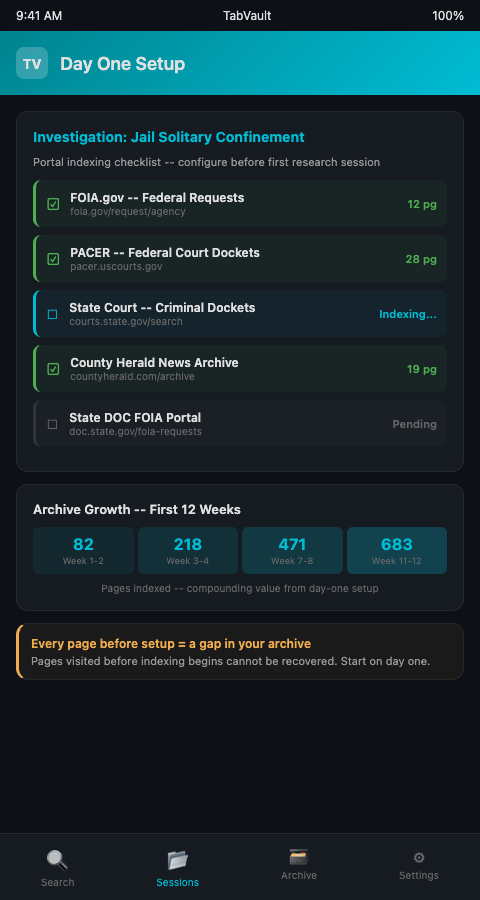
The compounding value of early setup is significant. By week four, your archive already contains hundreds of indexed pages. By month three, it contains a comprehensive record of every public-facing document, article, and portal page you touched during the investigation. This archive feeds directly into FOIA tab search and recovery when you need to retrieve something you read months ago, and it provides the raw material for your indexing strategy for scaling investigations.
Other research-heavy professions have adopted the same day-one indexing approach. Veterinary toxicology responders set up first-week reference indexing because the emergency reference material they browse during their first days on a case becomes the foundation for every subsequent lookup.
Why Early Indexing Pays Compound Dividends
The day-one principle applies with particular force to FOIA portals because request tracking is time-sensitive. When you file a FOIA request, the portal confirms the filing with a request number, a date, and an estimated processing time. Indexing that confirmation page preserves your evidence of when the request was filed — documentation you may need if you later challenge a delayed response or appeal a denial. The U.S. GAO has documented how FOIA backlogs hinder transparency, and having a timestamped record of your original request strengthens any administrative appeal.
Court system tab indexing from day one also captures the baseline state of a case before subsequent filings alter the docket. A docket page indexed in week one shows the case as it existed at that point — the parties, the pending motions, the scheduled hearings. Months later, after new filings and amended pleadings have changed the docket substantially, your early snapshot provides a reference point for understanding how the case evolved. This temporal dimension of indexing is impossible to recreate after the fact.
News archive indexing benefits from the same early-start principle. Local newspaper websites frequently restructure their archives, move articles behind paywalls, or remove older content entirely. A news article that was freely accessible during your first week of research may require a paid subscription by month three. If you indexed the full text during that initial visit, the content persists in your archive regardless of what the newspaper does with its paywall. For investigative podcast producers who rely on local news coverage to establish the public narrative around a case, preserving that coverage from the earliest research sessions ensures that the factual record remains intact throughout the production cycle.
The FOIA court news research setup pays dividends at every stage of production. During scripting, search for specific facts to verify claims. During editing, search for source material to support or cut a segment. During legal review, retrieve every document underlying a contested statement. The archive built from day-one indexing supports every downstream workflow because it contains the most complete possible record of the team's research.
Advanced Tactics for Portal-Specific Indexing
Index the login landing pages of portals you use frequently. FOIA.gov, PACER, and state court systems each have landing pages with navigation links, help documentation, and fee schedules. Indexing these pages means you can later search for specific procedural information — fee waivers, filing requirements, appeal processes — without navigating back to the portal.
Create a day-one checklist of portals to visit. Before each new investigation, compile a list of the FOIA portals, court systems, and news archives most likely to be relevant. Visit each one during your first research session, even if only to run preliminary searches. This seeds your archive with baseline content from every source you expect to use.
Index public record websites at the state and local level. Federal portals get the most attention, but state and county databases — property assessors, business registrations, campaign finance disclosures, building permits — are often where the most granular details live. Include these in your indexing public record websites routine from day one.
Re-index key portals periodically. Court dockets get updated with new filings. FOIA portals show updated request statuses. News archives add new articles. Revisit the most important portal pages monthly and let TabVault re-index them. Your archive then contains both the original snapshot and the updated version, letting you track changes over time.
Use session labels to mark portal type. Label sessions by the type of portal — "FOIA," "federal court," "state court," "news archive" — so you can filter search results by source category. When you need specifically a court filing rather than a news article, filter by session label to narrow results.
Index reference pages alongside research pages. Veterinary toxicology responders apply the same day-one principle to first-week reference indexing, building their foundation from the earliest research sessions. Legal glossaries, FOIA request guides from the Reporters Committee for Freedom of the Press, and court system help documentation are reference materials you will consult throughout the investigation. Index them on day one so they become searchable alongside your substantive research.
Day One Is the Only Day That Matters
Every page you visit before setting up indexing is a page you might need to re-find later. Every page you visit after is permanently archived and searchable. TabVault makes the setup trivial — install it, start browsing, and let the index build itself from your FOIA portals, court systems, and news archives. Join the waitlist and make day one the last day you lose a research page.
A county jail investigation that touches three FOIA agencies, PACER, four state court systems, and four regional newspaper archives in its first week generates over 80 distinct web pages. Without day-one indexing, those pages exist only in browser history that Chrome purges after 90 days. With TabVault active from the first search query, every portal confirmation, every docket entry, and every news article enters a permanent archive. Six weeks later, when a source references a federal ruling from that first week, the archive retrieves it in seconds. The cost of waiting even one week to start indexing is measured in pages you will need to re-find and may never recover. Join the waitlist and make your first research session the foundation of your entire investigation.