Where Your Lost FOIA Findings Live: Tab Search for Podcasters
Six Weeks of FOIA Work, Gone in a Restart
A producer on an investigative podcast about municipal corruption spent six weeks filing FOIA requests with three separate federal agencies, tracking responses across browser tabs — PDF viewers open to redacted memos, portal pages showing request status, and cross-references to news archives that contextualized each document. Then Chrome updated overnight. Every tab closed. The trail she had assembled existed only in her memory and a few hastily bookmarked URLs that led to login walls.
She is not an outlier. The federal government received a record-setting 1,501,432 FOIA requests in fiscal year 2024, a 25 percent increase over the prior year. At the same time, backlogs are deepening: the Department of Defense alone saw its FOIA backlog rise by 42 percent to over 30,000 cases by the end of fiscal 2025, driven by staff cuts and increasing request complexity (Federal News Network, 2026). For podcast producers filing dozens of requests per investigation, the sheer volume of portal pages, PDF responses, and cross-referenced records generates browser sessions that can sprawl across 50 or 60 tabs at a time.
A Carnegie Mellon University study on browser behavior found that participants feared closing tabs because "as soon as something went out of sight, it was gone," with 25 percent reporting browser crashes caused by tab overload (Carnegie Mellon University, 2021). For investigative podcasters whose lost research tabs represent months of FOIA work, the stakes dwarf those of casual browsing.
The problem is structural. Browsers were built to display pages, not to function as research archives. FOIA portals require authentication, meaning a closed tab cannot be reopened without logging back in and navigating a bureaucratic interface. Response PDFs opened in-browser leave no durable trace in history. And browser history itself records only URLs and page titles — not the full text of the documents you were reading. For a producer juggling requests across multiple agencies, the fragility of browser-based research becomes the bottleneck that slows every other part of the production process.
Turning FOIA Browsing Into a Searchable Private Database
The fix requires changing what a browser session produces. Instead of leaving behind a list of URLs that may or may not still work, every page you visit during a FOIA research session should flow into a permanent, full-text index — turning chaotic browser sessions into a searchable private database. That is what TabVault does.
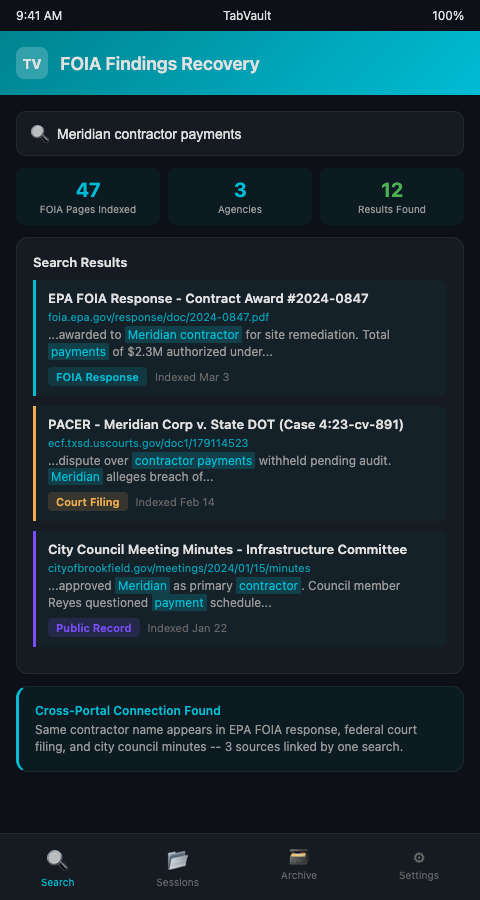
When you open a FOIA portal response page, a PDF viewer displaying a redacted document, or a news article that contextualizes a government record, TabVault indexes the full rendered text of that page locally on your machine. Close the tab whenever you want. The content persists in your private index. Three weeks later, when you remember that one of the documents mentioned a specific contractor name but cannot recall which agency's portal you found it on, you type that name into TabVault's search bar. Every indexed page containing the term appears — FOIA responses, news articles, portal status pages — regardless of which site they came from.
This matters for FOIA findings recovery because portal pages are volatile. Agencies update their systems, move documents to different URLs, and sometimes take portals offline entirely. MuckRock documented that FOIAonline, the federal government's centralized FOIA portal used by 34,000 registered users, shut down after a decade of operation, putting 1.5 million filed requests at risk. Producers who had indexed those portal pages locally retained access to material that others scrambled to recover.
TabVault's investigative podcast browser search works across every site you visit during research. A single investigation might span FOIA.gov, individual agency portals, PACER for court records, local news archives, and nonprofit databases. Rather than maintaining separate bookmarks or spreadsheets for each source, the index collapses them into one searchable layer. Query once, find results from every portal and archive you touched.
The cross-portal search capability is especially valuable for FOIA-driven work because responses from different agencies frequently reference the same people, dates, and events using different terminology. A search for a contractor's name might surface a FOIA response from the EPA, a PACER filing from a related lawsuit, and a news article covering the same contract dispute. Without a unified index, spotting that three-way connection requires the producer to remember all three sources and manually compare them. With TabVault, the connection surfaces from a single query.
Journalists comprise only about 7.6 percent of all FOIA requesters, according to the largest-ever analysis of FOIA request logs published by the Columbia Journalism Review. That small percentage means podcast producers are competing for agency attention alongside businesses, law firms, and individuals — making every successfully obtained document too valuable to lose to a browser crash.
The tab indexing for podcasters compounds over the life of an investigation. After three months of weekly research sessions, your archive contains hundreds of indexed pages — a chronological record of every document you reviewed, when you reviewed it, and what it contained. When it comes time to build your searchable case file from public record browsing, that indexed corpus becomes the foundation. And because every page carries a timestamp, you can reconstruct your research timeline for fact-checking or legal review.
The same structural approach that benefits investigative podcasters applies to other research-heavy fields. Genealogy cold case researchers face an identical problem with volatile DNA match pages and have built searchable archives from their browser sessions using the same indexing logic.
Advanced Tactics for FOIA Tab Indexing
Once you have the indexing habit in place, these strategies sharpen its value for investigative podcast work.
Index before you file, not only after. Many producers index only the response documents. But the research you do before filing a request — identifying the right agency, reading existing disclosures, finding the correct FOIA officer contact — is equally valuable. Index those preparatory sessions too. When a request comes back incomplete, your archive of pre-filing research helps you draft a more targeted appeal.
Build an FOIA portal indexing routine from day one. Do not wait until you are deep into an investigation to start indexing. Set up TabVault at the start of every new project so that every portal visit, every PDF preview, and every background article enters the index automatically. The Reporters Committee for Freedom of the Press maintains a comprehensive FOIA guide covering request strategies across federal and state agencies — index those reference pages too so you can search them later without hunting through bookmarks.
Cross-reference FOIA responses with news coverage. When you receive a FOIA response, spend a session searching news archives for coverage of the same events or individuals mentioned in the documents. Index everything. Later, a single search for a name or date pulls up both the government documents and the press coverage, letting you spot discrepancies or confirm details without toggling between sources.
Use session labels to separate investigations. If you produce multiple episodes or series simultaneously, label your research sessions by project. When you search for a term that appears in documents from two different investigations, the session labels let you filter results and avoid cross-contamination between stories.
Track redaction patterns. FOIA responses frequently arrive with heavy redactions. Index the redacted documents anyway. Over time, as you receive additional responses or as other requesters publish overlapping documents, you can search your archive for the surrounding context of a redaction and sometimes reconstruct what was withheld by triangulating across multiple partial disclosures.
Compare responses across agencies for the same event. When multiple agencies were involved in the same incident — say, a joint federal-state enforcement action — file FOIA requests with each and index every response. Searching your archive for a specific date or event name then surfaces all agencies' documents side by side, revealing differences in how each agency documented the same facts. These discrepancies are where the most compelling investigative findings hide.
Archive the portal, not only the document. The portal page that lists your request status, the confirmation email rendered in your browser, and the download page for a released document all contain metadata that the document itself does not. Index all of these surrounding pages so your archive preserves the full context of how and when you obtained each piece of evidence.
Stop Losing What the Government Already Gave You
Every FOIA response you received and read in a browser tab represents weeks or months of waiting, filing, and following up. Losing that material to a browser crash or a portal shutdown is not merely inconvenient — it can stall an investigation. TabVault gives investigative podcast producers a private, local, full-text search index of every FOIA page, portal response, and research document they visit. If you are tired of rebuilding lost research trails, join the waitlist and start indexing your FOIA sessions today.
Picture filing a FOIA request about a pharmaceutical company's safety violations and receiving the response four months later. Without an indexed archive, you scramble to remember which news articles prompted the request. With TabVault, you search the company name and instantly see every portal page, response document, and background article you touched during those four months. One producer tracking EPA enforcement actions across twelve facilities built an archive of 1,400 indexed pages over nine months -- and when a whistleblower's tip referenced a facility she had researched in week three, the connection surfaced in under ten seconds. Your FOIA research deserves the same permanence as the government records you are requesting.