Your First Week Indexing MSDS, PubMed, and Merck Manual Tabs
Day One: Three Sources, One Search Bar
A newly hired emergency veterinarian at a 24-hour animal hospital started her first overnight shift with a case involving a dog that had chewed open a bottle of lawn and garden insecticide. She needed three things immediately: the manufacturer's Safety Data Sheet to identify the active ingredient and concentration, the Merck Veterinary Manual entry on that compound's toxicity in dogs, and a PubMed search for recent case reports on treatment outcomes. She found all three — across three different websites, in three separate browser tabs — and used them together to determine the treatment protocol. When the tabs closed at the end of her shift, the research assembly was gone.
That three-source research pattern — MSDS for chemical specifics, Merck for clinical protocols, PubMed for evidence — is the foundation of veterinary toxicology practice. The Occupational Safety and Health Administration mandates that manufacturers provide Safety Data Sheets for hazardous chemicals, making SDS documents the primary source for ingredient identification and concentration data in exposure cases. The Merck Veterinary Manual provides the clinical bridge between chemical identification and treatment. PubMed, maintained by the National Library of Medicine, adds the evidence layer — case reports, clinical trials, treatment comparisons.
Your first week of veterinary reference tab setup should establish indexing habits across these three sources. The goal is not to preemptively index every possible toxin reference. The goal is to begin indexing the pages you actually consult during live cases, so your archive starts growing from day one with clinically relevant material.
MSDS safety data sheet veterinary information is particularly vulnerable to loss. Manufacturers update SDS documents when formulations change, often retiring previous versions. URLs shift. Product lines are discontinued. The SDS you consulted during a specific exposure case may not be available at the same URL six months later. Indexing it during the case preserves the exact document version that was current at the time of exposure — a detail that matters for both clinical and legal purposes.
Setting Up Your Three-Source Indexing Workflow
The veterinary reference tab setup for your first week follows a simple principle: index everything you consult during clinical work, starting with these three core sources. No manual organization required. No folder structures to create. Just browse, research, and let the indexer capture the content.
TabVault runs in the background during your browsing sessions, indexing the full text of every page you visit. During your first week, this means every SDS you open, every Merck entry you read, and every PubMed abstract you review joins your searchable archive automatically. By Friday, you have indexed the content from every toxicology case you handled that week — turning chaotic browser sessions into a searchable private database built from your own clinical research.
Days 1-2: MSDS Indexing. When a case involves a commercial product — a cleaning agent, a pesticide, an automotive fluid — pull up the manufacturer's SDS and let it index. The SDS contains the product name, active ingredients, concentrations, toxicological data, and first-aid measures. Indexing MSDS PubMed Merck Manual tabs during these first cases means the SDS content is searchable later by product name, ingredient, or any other term on the page. If you see a second case involving the same product class three weeks later, you search the product name and retrieve the SDS immediately.
Days 3-4: Merck Veterinary Manual Indexing. The Merck Veterinary Manual tab archive builds itself as you consult entries during case research. The Manual's toxicology section covers everything from common household toxins to agricultural chemicals to venomous animal exposures. Each page you visit during case research joins your index. The Merck's internal search is helpful but limited to its own content. Your indexed archive searches Merck pages alongside every other source you have consulted, providing cross-reference capability that the Merck site itself does not offer.
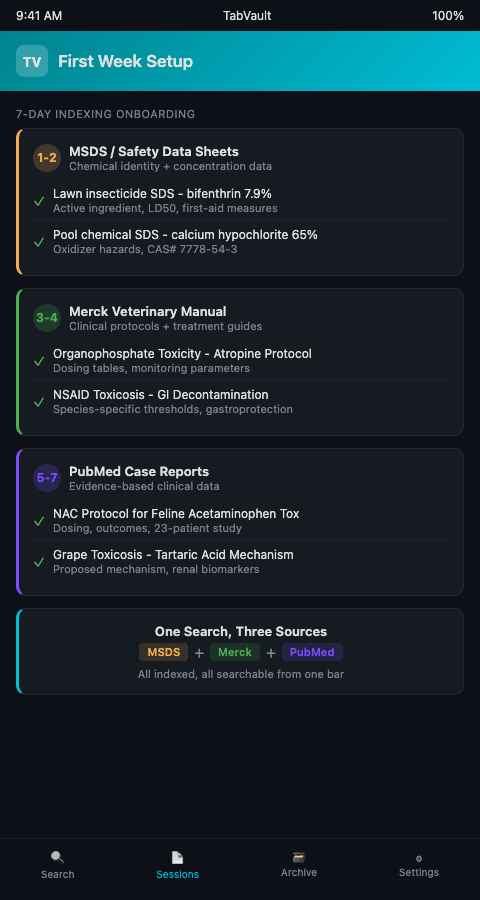
Days 5-7: PubMed Veterinary Toxicology Indexing. PubMed abstracts are dense with clinical data — study populations, dosing protocols, outcome measures, statistical results. PubMed veterinary toxicology indexing captures this data in full text, making it searchable by any term in the abstract. When your attending mentions a recent study on N-acetylcysteine protocols for acetaminophen toxicity in cats, and you read the abstract on PubMed, that abstract is now in your archive. Six months later, when you need the study details for a similar case, you search "NAC acetaminophen feline" and retrieve it — without needing to remember the authors, the journal, or the publication date.
The personal toxin reference library that emerges from this first-week setup grows with every subsequent case. Your archive is not a static collection you built once — it is a living reference that expands each time you research a case.
The three-source approach also creates natural redundancy in your archive. The Merck Veterinary Manual entry on a compound may cite a dosing range. The PubMed case report may cite a different dosing range based on a specific clinical study. The SDS may list the manufacturer's recommended exposure limits. Having all three indexed means a single search retrieves multiple perspectives on the same compound, giving you the comparative view that no single source provides. This multi-source triangulation is how experienced toxicologists approach clinical decisions, and the indexed archive makes it automatic.
The MSDS data indexing approach also relies on local-first architecture, which means sensitive chemical and clinical data stays on your machine, not on a third-party server.
The veterinary reference tab setup you establish during your first week also creates a foundation for institutional knowledge sharing. When a new colleague joins the practice and asks how to research a specific toxin class, your indexed archive demonstrates the workflow by example — search the compound, review the results from MSDS, Merck, and PubMed, and see how the three sources complement each other for clinical decision-making.
First-Week Strategies for Maximum Index Value
Deliberate choices during your first week of indexing set the foundation for a useful long-term archive.
Index the SDS, not just the product label. When researching a product exposure, many clinicians stop at identifying the active ingredient. The full SDS contains additional data — LD50 values, species-specific toxicity notes, recommended decontamination procedures, storage incompatibilities — that may become relevant for future cases involving the same compound class. Index the complete SDS page, not just the summary section.
Follow PubMed links to full-text articles when available. PubMed abstracts are valuable, but full-text articles available through open-access journals or institutional subscriptions contain methods, discussion, and clinical details that abstracts omit. When a full-text version is available, open it and let it index. Your archive then contains the complete article content, searchable by any term in the methods, results, or discussion sections.
Index Merck Veterinary Manual treatment pages alongside toxicology entries. The Merck Manual separates toxicology descriptions from treatment protocols in some entries. Both pages are clinically relevant. When you read the toxicology entry for a compound, click through to the treatment page and let it index as well. Your search results then return both the diagnostic and treatment information for that compound.
Create a first-week search test. At the end of your first week, test your archive by searching for a case you handled on Day 1 or Day 2. Search by toxin name, by species, by clinical sign — verify that the pages you consulted are retrievable. This test confirms that your indexing workflow is functioning and gives you confidence in the archive's reliability before you depend on it during a future emergency.
Note which sources resist indexing. The same challenge applies to sensitive research material in other fields where local indexing preserves privacy. Some clinical resources use formats that are difficult to index — PDF-only SDS documents, image-based toxicology charts, Flash-based interactive tools. Identify these during your first week and develop supplementary capture strategies for them — manual notes, screenshots, or alternative text-based sources that cover the same content. The ASPCA Animal Poison Control database renders most content as indexable text, making it an ideal primary source for toxin-specific information.
Your Archive Starts Now
The three sources you index during your first week — MSDS documents, Merck Veterinary Manual entries, and PubMed articles — form the backbone of a veterinary toxicology reference system that grows with every case for the rest of your career. TabVault indexes them automatically as you browse, requiring no manual effort beyond the research you are already doing. Join the waitlist and spend your first week building the reference library that your hundredth week will depend on.
By Friday of your first week with TabVault, your archive already contains every SDS you opened for chemical exposure cases, every Merck Veterinary Manual treatment entry you consulted, and every PubMed abstract you scanned during rounds. That three-source foundation grows with each subsequent shift. A month in, your index holds the organophosphate atropine protocol from the Tuesday night farm dog case, the PubMed meta-analysis on NAC efficacy your attending recommended, and the manufacturer SDS for the specific rodenticide brand your clinic encounters most often. Each source type reinforces the others, and a single search query cuts across all three simultaneously.