Connecting MSDS Safety Data With Clinical Decontamination Protocols
The Information Gap Between Chemistry and Clinics
A Boxer presents to an emergency veterinary hospital after ingesting a pool chemical stored in the garage. The owner brings the product container, and the attending veterinarian pulls up the Material Safety Data Sheet online. The MSDS lists the active ingredient as calcium hypochlorite at 65% concentration, identifies it as an oxidizer, and provides human first-aid measures: "remove contaminated clothing, flush skin with water for 15 minutes." None of that tells the veterinarian whether to induce emesis, what dose of activated charcoal to use, or whether calcium hypochlorite at that concentration causes corrosive esophageal injury in dogs that contraindicates vomiting.
This disconnect is structural, not accidental. MSDS documents are written for occupational health compliance under OSHA's Hazard Communication Standard, which requires chemical manufacturers to provide safety information for human workers (OSHA Hazard Communication Standard). They are not designed for veterinary clinical use. Yet veterinary emergency clinicians consult them constantly, because the MSDS is often the fastest way to identify what chemical an animal was exposed to.
The ASPCA Animal Poison Control Center reports that household chemicals and cleaning products account for a substantial portion of their annual caseload, and industrial chemical exposures — pesticides, solvents, pool chemicals — make up another significant share (ASPCA). In each of these cases, the treating veterinarian must cross-reference the MSDS with species-specific toxicological data to determine the correct decontamination protocol. A 2019 analysis of chemical exposure cases in companion animals noted that delayed or inappropriate decontamination was a leading contributor to poor outcomes, often because the clinical team lacked rapid access to both the chemical identity and the corresponding veterinary treatment protocol (Wismer & Means, 2019).
The problem is one of correlation. The MSDS lives on one tab. The veterinary decontamination protocol lives on another. The PubMed case report describing outcomes for this specific chemical in dogs lives on a third. Connecting them depends entirely on the clinician's ability to hold all three sources in working memory while treating a critical patient.
Bridging MSDS Data and Decontamination With Indexed Search
The solution is to stop treating MSDS lookups and clinical protocol searches as separate activities. When you index both types of pages during your normal research workflow, you create a single searchable layer that bridges chemistry and clinical medicine. This is the core principle of turning chaotic browser sessions into a searchable private database: the index does not care whether a page is an OSHA safety data sheet or a veterinary decontamination guideline. It indexes the full text of both and lets you query across them.
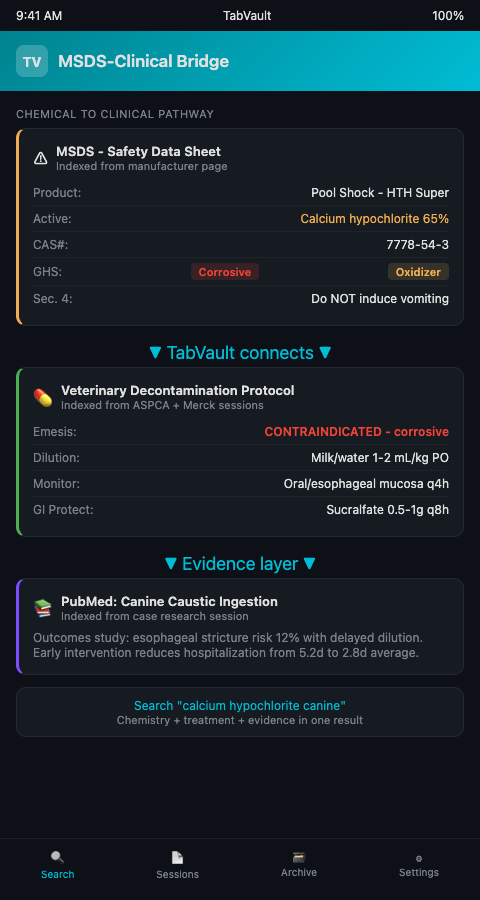
TabVault makes this decontamination protocol cross-reference automatic. During a shift, you pull up the MSDS for calcium hypochlorite, then open the ASPCA's treatment protocol for oxidizing pool chemicals, then check a PubMed case report on canine caustic ingestion. All three pages are indexed. Close them all. Next month, when a similar case arrives, search "calcium hypochlorite canine" and every relevant page you have ever viewed surfaces in one result set — the chemical data and the clinical protocol side by side.
This approach transforms the safety data sheet clinical correlation problem from a manual, memory-dependent process into a searchable one. If you have already started indexing MSDS, PubMed, and Merck Manual tabs, you have the foundation. The MSDS indexing habit captures the chemical identity. The clinical protocol indexing habit captures the treatment. TabVault's search brings them together.
Consider what this means for industrial toxin animal poisoning cases, which are often the most complex. A farm dog exposed to an organophosphate insecticide needs atropine and pralidoxime, but the specific organophosphate compound determines the dosing urgency and duration. The MSDS identifies the compound. Your indexed archive of veterinary treatment protocols tells you how to treat it. Without that index, you are re-researching the same compound from scratch every time it appears, or relying on memory from a case you handled months ago.
TabVault lets you search for a specific CAS number from the MSDS and retrieve every clinical page you have ever indexed that mentions it. The chemical exposure veterinary treatment pathway becomes traceable: from product label to MSDS to clinical protocol to PubMed evidence, all connected through a single full-text search.
The correlation also works in reverse. If you remember treating a "pool chemical ingestion" but cannot recall the specific product, search your archive for "pool chemical canine emesis" and retrieve the MSDS alongside the treatment notes. Tracking decontamination timelines becomes far easier when the chemical identity and the treatment protocol are both retrievable from the same search.
Investigative researchers in other fields face a parallel challenge. Podcast producers who need to decide what to index from public records deal with the same question of connecting disparate document types through a single search layer. The underlying problem is the same: information that belongs together lives in sources that were never designed to be searched together.
Advanced MSDS-to-Protocol Correlation Tactics
Index the GHS pictogram descriptions. The Globally Harmonized System of Classification and Labelling of Chemicals uses standardized pictograms (skull and crossbones, corrosion symbol, exclamation mark) that map to specific hazard categories. When you index an MSDS page, the GHS pictogram descriptions are captured as text. Searching for "corrosion GHS" later retrieves every corrosive chemical you have encountered, and your corresponding decontamination protocols for corrosive ingestion appear alongside them.
Create a mental map of MSDS Section 4 to veterinary treatment. Section 4 of every MSDS contains first-aid measures for human exposure. These often hint at the correct veterinary approach: if the human protocol says "do not induce vomiting" because the substance is corrosive, the veterinary protocol will similarly contraindicate emesis. Index these Section 4 pages, and when you search your archive, the human first-aid guidance appears next to the species-specific veterinary protocol, giving you a quick cross-check.
Track repeat chemical exposures by CAS number. Every chemical listed on an MSDS has a unique CAS Registry Number assigned by the Chemical Abstracts Service. Searching your TabVault archive by CAS number retrieves every MSDS and every clinical reference you have indexed for that specific compound, regardless of trade names or product labels. This is especially valuable for pesticides, which are sold under dozens of brand names but share the same active ingredient.
Supplement with ATSDR toxicological profiles. The Agency for Toxic Substances and Disease Registry publishes detailed toxicological profiles for hundreds of hazardous substances (ATSDR Toxicological Profiles). These profiles provide far more clinical detail than a standard MSDS. Index the ATSDR profile alongside the MSDS for any industrial chemical you encounter, and your archive gains a richer clinical context that informs decontamination decisions.
Share indexed MSDS-protocol pairs across the clinic. Podcast producers face the same challenge when deciding what to index from public records -- the principle of connecting disparate document types through a single search layer applies equally to clinical teams. When one veterinarian builds a strong chemical-to-protocol correlation in their archive, that indexed session can inform the entire team's practice. The MSDS safety data decontamination protocol connection you built during a Tuesday night shift should be available to the clinician working Wednesday morning.
Stop Researching the Same Chemical Twice
Every MSDS you look up during a chemical exposure case is clinical intelligence waiting to be connected to a decontamination protocol. TabVault captures both sides of that equation and makes them searchable from a single query. If your emergency practice handles industrial toxin animal poisoning cases and you are tired of re-researching chemicals you have already treated, join the waitlist and start building an archive that bridges the gap between safety data and clinical action.
Picture the next industrial chemical exposure that walks into your ER. The owner hands you a product label with a brand name you have never seen. With TabVault, you pull up the Safety Data Sheet, identify the active ingredient by CAS number, then search your archive for that compound. Every clinical decontamination page, every ATSDR toxicological profile, every PubMed outcome study you or any colleague previously indexed for that chemical appears together — bridging the gap between the MSDS chemistry and the veterinary treatment protocol in a single query rather than a multi-tab scramble under time pressure.