Tracking Decontamination Timelines Across Repeat Presentations
The Repeat Offender Problem
A four-year-old Labrador Retriever arrives at an emergency veterinary hospital for the second time in eight months after confirmed ingestion of bromethalin-based rodenticide. The first visit involved emesis induction within 45 minutes of ingestion, followed by a single dose of activated charcoal. The dog recovered without neurological signs. This time, the owner estimates ingestion occurred 3 to 4 hours ago, and the dog is showing mild hindlimb ataxia. The attending veterinarian needs to know exactly what decontamination was performed last time, what the timeline was, and whether the current delayed presentation changes the protocol.
Repeat poisoning presentations are not rare. The ASPCA Animal Poison Control Center data consistently shows that certain breeds — Labradors, Beagles, Golden Retrievers — appear disproportionately in toxin exposure reports, often with repeat incidents involving the same or similar agents (ASPCA). A 2019 retrospective study on canine toxin exposures noted that approximately 10-15% of dogs presenting for poisoning had a documented prior exposure within the preceding 24 months (Cortinovis & Caloni, 2016). For these serial cases, the decontamination timeline from the previous visit directly informs treatment decisions for the current one.
The clinical significance of timing in decontamination cannot be overstated. Emesis is generally most effective within 1 to 2 hours of ingestion for most toxins, and its effectiveness drops sharply after that window. Activated charcoal dosing may be single-dose or multi-dose depending on the toxin's enterohepatic recirculation characteristics. The Merck Veterinary Manual notes that the specific decontamination protocol depends on time since ingestion, the toxin involved, and the patient's current clinical status (Merck Veterinary Manual). When a repeat patient arrives, comparing the previous timeline to the current one is a direct clinical necessity.
The problem is access. The original decontamination research — the ASPCA consultation notes, the PubMed references checked, the dosing calculations — lives in browser tabs that were closed months ago. The medical record may note "emesis induced, activated charcoal administered," but it rarely includes links to the specific references the clinician consulted or the detailed dosing rationale.
Indexed Sessions as Decontamination Timelines
Tracking decontamination timelines across repeat cases becomes straightforward when every research session is indexed — when you stop treating browser tabs as disposable and start turning chaotic browser sessions into a searchable private database. Each time you research a decontamination protocol during a case, the browser pages you consult — the dosing guidelines, the toxin-specific decontamination recommendations, the timing thresholds — are captured in a full-text searchable archive. When the same patient returns, you search for the patient's scenario or the toxin name and retrieve the exact references you used during the previous presentation.
TabVault makes this treatment timeline cross-reference automatic. During the Labrador's first bromethalin visit, you opened the ASPCA's bromethalin protocol, a PubMed article on delayed bromethalin neurotoxicity, and a Merck Manual page on activated charcoal multi-dose regimens. All three were indexed. Eight months later, searching "bromethalin canine activated charcoal" retrieves those exact pages alongside their timestamps. You can see what you researched, when you researched it, and compare it against the current presentation.
The emesis activated charcoal timing search is where this archive proves its clinical value. The first visit: emesis at 45 minutes post-ingestion, charcoal administered. The current visit: 3-4 hours post-ingestion, ataxia already present. Your archived references from the first case include a PubMed article discussing why emesis is contraindicated when neurological signs are present with bromethalin exposure. That article — the one you might not have remembered or been able to find — appears in your search results because you indexed it eight months ago.
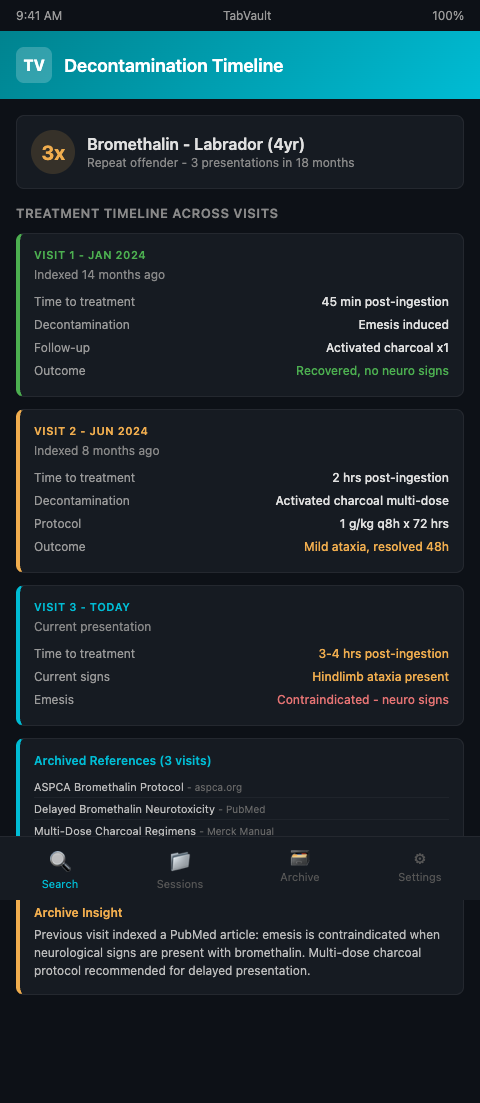
Serial toxin exposure case management benefits from this longitudinal view. When you search your archive for a specific toxin, you do not just get the references from the most recent case. You get every reference you have ever indexed for that toxin, organized with timestamps. This lets you track how your decontamination approach evolved across repeat presentations — did you use a different charcoal dose the second time? Did you find a newer protocol? The archive provides a transparent decision trail.
TabVault preserves the research context that medical records cannot. The record says "activated charcoal 1 g/kg PO." Your indexed archive says you consulted the Merck Manual page that recommends 1-2 g/kg for bromethalin specifically because of its enterohepatic recirculation, and that you also reviewed a case report where multi-dose charcoal at 8-hour intervals was associated with better outcomes. This level of clinical rationale preservation is what transforms a repeat poisoning presentation veterinary visit from a fresh research problem into an incremental update.
The connection to your broader searchable poisoning case archive is direct. The case archive captures every toxin you have researched. The decontamination timeline tracking layer adds the temporal dimension — not just what protocols exist, but when you used them and what outcomes followed. This temporal view also strengthens the connection between MSDS safety data and decontamination protocols — knowing which chemical was involved and when decontamination was performed lets you evaluate whether the timing was appropriate for that specific compound.
Matching historical treatment data to current cases appears in other domains too. Architectural salvage dealers who match styles across their available inventory rely on the same principle: past research informs present decisions, but only if the past research is retrievable.
Building Decontamination Timeline Archives
Document the ingestion-to-treatment interval in your searches. When you research a decontamination protocol, include the time factor in the pages you view. If you search for "activated charcoal canine 4 hours post ingestion," those time-specific pages get indexed with those time-specific terms. The next time a delayed-presentation case arrives, searching for the time interval retrieves references specifically relevant to that window.
Index repeat-patient research as a connected series. After the second or third presentation of a repeat offender, search your archive for the toxin to review your complete research history for that patient scenario. Compare the decontamination approaches across visits. Did the previous protocol succeed? Did the timing differ? Were there complications? The longitudinal archive lets you conduct a personal case review that the medical record alone cannot support.
Track multi-dose charcoal schedules. For toxins with enterohepatic recirculation — bromethalin, cholecalciferol, certain NSAIDs — multi-dose activated charcoal protocols require precise timing over 24 to 72 hours. Index each dosing reference you consult during these extended protocols. When the next similar case arrives, your archive preserves the complete multi-dose schedule you used previously, including the intervals, the monitoring parameters between doses, and the references that supported each decision. The National Library of Medicine hosts the definitive literature on charcoal dosing intervals for specific toxins.
Compare outcomes across different decontamination approaches. The same retrieval logic that lets salvage dealers match historical inventory applies to comparing clinical protocols over time. If you indexed research for a bromethalin case where you used single-dose charcoal and a second case where you used multi-dose charcoal, searching "bromethalin charcoal outcomes" retrieves the references from both cases. This built-in comparison informs your future protocol selection with evidence drawn from your own practice experience.
Use the timeline archive during client conversations. Owners of repeat-offender pets benefit from understanding the treatment timeline and its urgency. When you can pull up the indexed references showing that the decontamination window for a specific toxin is 1-2 hours, the educational impact on the client is immediate and evidence-based.
Every Timeline You Track Makes the Next Case Faster
Repeat poisoning presentations are a predictable feature of veterinary emergency practice. Each one is an opportunity to build on what you already know — but only if your previous research is accessible. TabVault turns decontamination timeline tracking across repeat cases into a searchable history that grows more valuable with every presentation. Join the waitlist and stop researching the same decontamination protocols from scratch every time a repeat offender walks through the door.
That Labrador is back for the third bromethalin exposure in eighteen months. With TabVault, you search "bromethalin canine activated charcoal" and retrieve timestamped research from both previous visits — the PubMed article on why emesis is contraindicated once neurological signs appear, the Merck Manual page recommending multi-dose charcoal for enterohepatic recirculation, and the ASPCA monitoring timeline you followed during the first successful recovery. You compare past decontamination decisions against the current delayed presentation and adjust the protocol with evidence from your own case history rather than starting the research from zero.