Matching Architectural Styles to Available Salvage Inventory
When the Style Has to Be Right
An interior designer in Charleston contacted a salvage dealer requesting six matching pairs of pocket door hardware compatible with an 1870s Italianate townhouse. The hardware needed to be period-appropriate: bronze or brass, with the low-relief foliate motifs typical of the Italianate style, not the geometric patterns of later Eastlake or the exuberant ornament of High Victorian Gothic. The dealer knew the difference. The problem was finding matching inventory across a fragmented market — and doing it before the designer moved on to a reproduction supplier.
Victorian architecture alone encompasses multiple distinct substyles — Queen Anne, Italianate, Second Empire, Stick, Shingle, Romanesque Revival — each with characteristic materials, ornamental vocabularies, and hardware patterns. Architecture Courses.org's guide to Victorian period architecture identifies key features including steeply pitched roofs, towers, bay windows, ornate woodwork, and polychromy, but the variation within the era is enormous. A bracket salvaged from a Queen Anne porch is stylistically incompatible with an Italianate cornice, even though both date to the same decade.
The matching challenge extends beyond Victorian. Arts and Crafts, Colonial Revival, Art Deco, and mid-century modern each have distinctive material palettes and design vocabularies. The Secretary of the Interior's Standards for Rehabilitation specify that replacement features must match the original in design, color, texture, and materials — a mandate that makes architectural style salvage matching a compliance requirement, not just an aesthetic preference.
For dealers, the volume of available inventory compounds the difficulty. Listings across estate sales, auction catalogs, and online marketplaces describe items with varying levels of specificity. Some list "Victorian door hardware." Others specify "Eastlake pattern, circa 1885, cast bronze." Searching for the right match means reading through dozens of descriptions, comparing against reference images, and cross-referencing across sources — all tasks that fragment across tabs and rely on the dealer's memory to hold together.
The consequences of a mismatch are expensive. Installing Eastlake hardware in an Italianate restoration, or using machine-made reproductions where hand-forged originals are specified, can result in failed inspections on projects governed by the Secretary of the Interior's Standards, rejected work on historic tax credit projects, or simply a dissatisfied client who knows the difference. The margin for error is slim, and the research burden falls on the dealer who must correctly identify, source, and verify every element before purchase.
The market itself offers no centralized solution. Unlike new construction, where a dealer can order matching hardware sets from a single manufacturer's catalog, the architectural salvage market distributes matching elements across geographically dispersed sellers who may not know what they have. A listing described as "ornate brass knob set, late 1800s" could be Queen Anne, Eastlake, Renaissance Revival, or something else entirely. Accurate matching styles reclaimed materials demands the dealer's own expertise — and a system for searching accumulated research at scale.
Style-Specific Search Across Every Source You Have Browsed
The demand for period-specific restoration materials is growing as preservation incentives expand. Federal historic tax credits, administered under the IRS rehabilitation credit requirements, require documented compliance with period-appropriate material selection. State and local historic district regulations add additional layers of specificity. The dealer who can quickly match a style specification to available inventory wins the contract. The dealer who cannot — because their research is scattered across closed tabs and fading memory — loses it to someone faster.
TabVault resolves this by making every listing, catalog page, and reference page you have ever browsed searchable from a single query. The approach is grounded in turning chaotic browser sessions into a searchable private database. When your browsing sessions are indexed, a search for "Italianate bronze" returns every page containing those terms — whether it is a listing from last week, a reference article from last month, or a catalog page from six months ago.
The Victorian salvage inventory search becomes precise because you are searching full text, not tags or categories. A listing that describes hardware as "low-relief foliate design, circa 1875, likely Italianate influence" will surface on a search for "Italianate" even if the listing was not formally categorized under that style. This full-text capability catches matches that platform search filters miss, because sellers describe items in natural language, not standardized taxonomies.
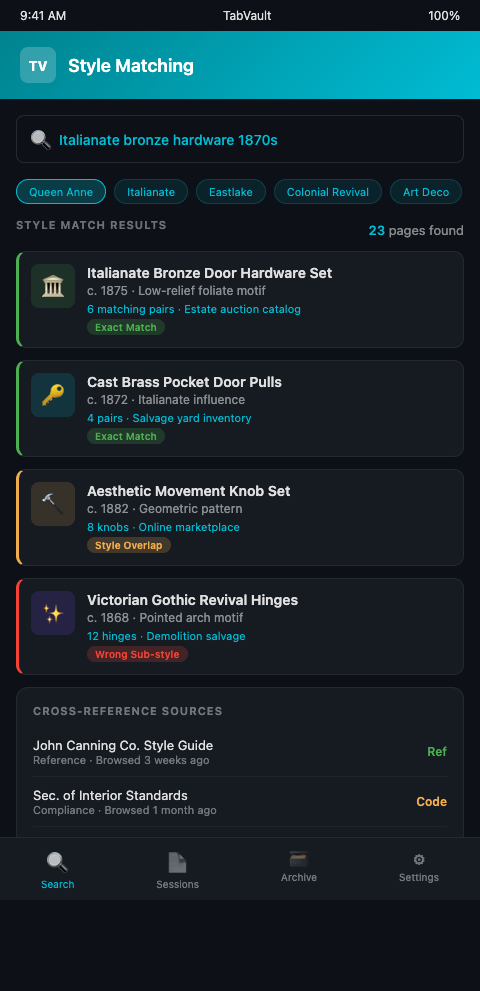
The architectural elements style matching capability extends beyond hardware to every material category. Mantels, tiles, light fixtures, stained glass, and millwork all carry style-specific characteristics that must match the target period. A search for "Art Deco" returns not just hardware listings but also lighting fixtures, tile patterns, and decorative metalwork from the same era — a unified style-specific results set that no individual supplier or marketplace can provide.
The period-specific salvage sourcing workflow pairs naturally with your period hardware tracking across catalogs. Hardware is often the most style-specific element in a restoration project, and the full-text index lets you find hardware that matches a specific era even when the seller's description uses different terminology than your search terms. A search for "Queen Anne" might surface a listing described as "Aesthetic Movement, 1880s, turned brass knobs" — a period and style overlap that a keyword-tag system would not connect.
The indexing also captures reference material. If you have browsed articles on Victorian architectural details, such as John Canning Co. on Victorian woodwork, those pages are in your archive too. A search for a specific wood species or finish type returns both reference material and available inventory in the same results list — research and sourcing unified.
Veterinary toxicology responders use the same cross-referencing approach when matching species-specific dosing information across multiple databases. The principle is identical: when the matching criteria are complex and the sources are fragmented, a unified full-text index collapses the search problem into a single query.
The temporal dimension adds further value. Architectural styles do not appear on the salvage market evenly throughout the year. Estate sales from neighborhoods built during specific eras produce clusters of period-appropriate materials. A dealer who has indexed six months of browsing can search for a style term and see not just current availability but the historical pattern of when and where that style's materials tend to surface. This longitudinal view — impossible to reconstruct from bookmarks or memory — turns the indexed archive into a sourcing forecast.
Advanced Tactics for Style Matching
Build a style glossary in your index. Browse authoritative reference pages for each major architectural style and let them get indexed. When you later search for a style term, these reference pages appear alongside inventory listings, giving you visual and textual confirmation of whether a salvaged item truly matches the target style.
Search by construction technique, not just era. Matching styles reclaimed materials sometimes requires identifying construction methods — hand-forged versus machine-made, mortise-and-tenon versus butt-jointed, hand-planed versus mill-finished. If you have browsed articles or catalog descriptions that mention these techniques, your index captures them and surfaces them alongside relevant inventory.
Cross-reference with provenance research. When a client requires documented provenance for a restoration project, your indexed browsing history can show the chain of pages you reviewed — the demolition notice, the building history, the listing — creating a research trail that supports authenticity claims.
Use negative searches to eliminate mismatches. If a client specifies "not Eastlake," browse your results for items that match the target era but check the descriptions for Eastlake-specific terms. Your full-text index makes this elimination process fast because you can scan descriptions across all sources at once rather than revisiting each individually.
Track seasonal patterns in style-specific inventory. Estate sales peak in spring and fall. Demolition permits cluster around construction season. Your indexed archive, accumulated over a full year, reveals when specific styles tend to appear on the market — intelligence that helps you time your sourcing for upcoming projects.
Build client preference profiles. When restoration architects and designers contact you repeatedly, their requests reveal their style preferences and project pipeline. Your indexed archive captures the research you did for each request. A search for a client's name or project address shows every page you reviewed on their behalf, creating a preference profile that helps you proactively flag inventory matching their taste before they ask.
Index museum and historical society collection pages. Museum collections often publish online catalogs of period architectural elements. These pages, once indexed, serve as style reference guides. When you need to verify whether a salvaged item matches a specific period, your archive may contain a museum example of the same pattern or style — authoritative documentation that supports your identification and increases buyer confidence.
Match the Style, Close the Sale
Architectural style matching is the intersection of knowledge and speed. The dealer who recognizes a style, knows where matching inventory exists, and can locate it within minutes commands a premium in the restoration market. That capability is built on accumulated research — every catalog page, every reference article, every listing you have reviewed over months of sourcing. Restoration clients and designers need precision, and the dealer who can match a style request to available inventory fastest wins the project. TabVault makes your accumulated browsing into a style-specific search engine that spans every source you have touched. Join the waitlist and give your architectural elements style matching the search layer it deserves.
When a restoration architect requests period-appropriate materials for an 1895 Queen Anne, your response time defines whether you win the contract. Search your indexed archive for "Queen Anne" and see every listing, reference article, and catalog page matching that style -- sorted across months of accumulated browsing. A dealer with six months of indexed sessions can match a style specification to available inventory in minutes. A dealer without that archive starts the research from scratch every time. In the restoration market, speed and precision win projects.