Cross-Referencing Multi-Species Dosing References With Tab Search
The Wrong Dose for the Wrong Species
A mixed-practice emergency clinic receives a call at 2 a.m.: a household cat and dog both ingested anticoagulant rodenticide from the same bait station. The veterinarian on duty opens the Merck Veterinary Manual for canine brodifacoum dosing, then a second tab for the feline protocol, then a third for the ASPCA Animal Poison Control Center's species-specific guidance. Within minutes, she has nine tabs open and is manually comparing numbers across all of them.
Species-specific dosing errors are not abstract risks. A 2016 study in the Journal of Veterinary Emergency and Critical Care found that dosing errors accounted for a significant share of adverse drug events in veterinary hospitals, with weight-based miscalculations being the most common category (Koenig & Giuffrida, 2016). The challenge intensifies in multi-species practice, where a clinician may treat a dog, a cat, a ferret, and a parrot in the same shift, each with fundamentally different pharmacokinetics.
The Merck Veterinary Manual notes that activated charcoal dosing in dogs is typically 1-2 g/kg, but feline patients require careful consideration of their limited hepatic glucuronidation capacity, which alters metabolism of many common toxins (Merck Veterinary Manual). The ASPCA Animal Poison Control Center handles over 400,000 cases annually across all species (ASPCA), and their dosing recommendations often differ from what a general formulary lists. When a veterinarian needs to compare these sources, the research is scattered across tabs that cannot talk to each other.
The core failure is not a lack of information. It is the inability to search across multiple dosing references simultaneously.
One Query Across Every Species Reference
The fix starts with changing how you interact with dosing references during emergencies. Instead of treating each open tab as an isolated lookup, treat your entire browsing session as a collection point that feeds a permanent, searchable index. This is what it means to turn chaotic browser sessions into a searchable private database: every species-specific dosing chart, every formulary page, every ASPCA recommendation you view gets captured and indexed locally.
TabVault makes this concrete. When you open the Merck Veterinary Manual page for canine vitamin K1 dosing, then switch to the feline page, then check a PubMed case report on ferret anticoagulant toxicosis, all three pages are indexed automatically. Close every tab. Tomorrow, when another rodenticide case walks in, type "brodifacoum vitamin K1" into TabVault's search bar. Every indexed page containing those terms appears in a single results list, regardless of which site it came from or when you viewed it.
This approach transforms the species-specific dosing chart search from a repetitive multi-tab scramble into a single-query operation. You built your personal toxin reference library over weeks of normal clinical browsing, and now it pays dividends every time a multi-species case arrives.
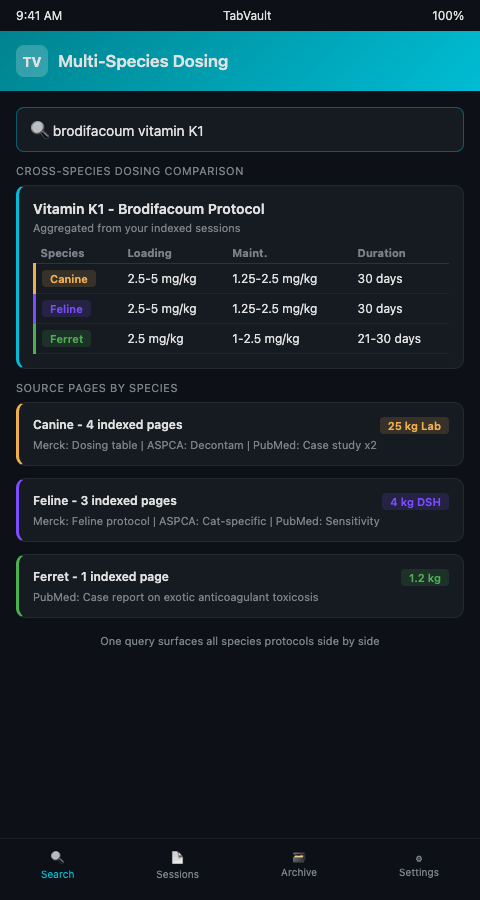
The canine feline dosing lookup problem is especially acute with toxins that have narrow therapeutic windows. Methocarbamol for tremorgenic mycotoxin ingestion, for example, has different dosing ceilings in dogs versus cats. A clinician who indexed both the canine and feline dosing pages during previous cases can now retrieve both in one search, compare the numbers on screen, and confirm the correct dose without opening a single new tab.
TabVault's tab search dosing database grows with every shift you work. After three months of indexing, a multi-species practice has a personal archive covering the most common toxins seen in their patient population, organized not by species but by full-text content. Search for "ethylene glycol feline" and get every feline-specific reference you have ever viewed. Search for "ethylene glycol canine" and get the parallel set. The comparison that used to require juggling six tabs now takes one search.
The value extends to exotic species where dosing data is sparse. A clinician researching avian zinc toxicosis may find only a handful of relevant pages across the internet. Once indexed, those pages are preserved and searchable even if the original sources go offline. The same logic applies here: when data is scattered and ephemeral, a local index turns fragile web pages into durable reference material.
For clinics that have already started automating species-specific protocol retrieval, the cross-referencing step is where the real clinical benefit emerges. Automated retrieval gets the right pages in front of you. Cross-referencing lets you compare them.
Tactics for Multi-Species Dosing Archives
Build species-specific search patterns. After a few weeks of indexing, develop a set of standard queries for your most common scenarios. "Chocolate theobromine canine mg/kg" versus "chocolate theobromine feline" versus "chocolate theobromine ferret" gives you three species-stratified result sets from the same archive. Save these query patterns somewhere accessible so any clinician on shift can use them.
Index formulary updates as they publish. Plumb's Veterinary Drug Handbook and similar formularies update dosing recommendations periodically. When you review updated pages, they get indexed alongside the older versions. This gives you a built-in version history: you can see that the recommended dose changed between your April index and your October index, and trace which source prompted the update.
Flag weight-based versus fixed-dose protocols. Some toxin treatments use weight-based dosing (activated charcoal at 1-2 g/kg) while others use fixed protocols (atropine challenge doses). When searching your archive, knowing which type of dosing a result references helps you interpret the numbers faster. Adding a brief note to your session before closing — "weight-based" or "fixed dose" — makes future searches more precise.
Cross-reference with the Veterinary Information Network. Genealogy researchers track thresholds across multiple platforms using the same cross-source search principle. The VIN community discussions often contain dosing insights from board-certified toxicologists that do not appear in published formularies. Index those discussion threads alongside your formal references. A search for a specific toxin then surfaces both the textbook answer and the clinical experience of specialists who have treated real cases. The Veterinary Information Network remains one of the largest peer-reviewed veterinary communities, and its discussion archives are a rich dosing resource.
Use your archive during case rounds. When presenting a multi-species poisoning case to colleagues or residents, pull up your indexed search results to show exactly which dosing references informed your treatment decisions. The archive provides a transparent evidence trail that strengthens case discussions and supports the kind of evidence-based practice that toxicology demands.
Prepare for off-label dosing scenarios. Multi-species practice frequently involves off-label drug use, particularly for exotic species where approved formulations do not exist. When a clinician treats a ferret for anticoagulant rodenticide exposure, the dosing protocol may be extrapolated from canine data with adjustments for body size and metabolic differences. Your indexed archive captures every reference consulted during that extrapolation process. If the off-label protocol succeeds, the archived research trail becomes a reference for the next ferret rodenticide case. If complications arise, the same trail documents the evidence base that informed the decision, providing both a clinical learning resource and a defensible rationale for the dosing choice.
Build the Dosing Database Your Practice Needs
Every multi-species dosing reference cross-reference you perform during a shift adds another layer to your searchable archive. Over time, TabVault turns months of clinical browsing into a veterinary dosing comparison tool that is tailored to the exact toxins and species your practice encounters. Stop toggling between nine tabs when a two-species poisoning case arrives. Join the waitlist and start building a tab search dosing database that gives you every species reference in a single query.
When a household cat and dog both present after eating the same rodenticide bait, TabVault lets you search once and see both species' protocols side by side. The feline vitamin K1 dosing page you indexed during a case last fall appears alongside the canine protocol from two weeks ago and the Merck Veterinary Manual entry on anticoagulant rodenticide class differences you read during a CE webinar. No more toggling between nine open tabs trying to compare numbers across species. Your archive organizes itself by content, not by website, so a single query for the toxin name delivers every species-specific reference your practice has ever consulted in one results list.