Automating Species-Specific Protocol Retrieval With Full-Text Search
The Species Problem in Emergency Toxicology
A 4-kilogram domestic shorthair cat arrives at an emergency veterinary clinic after ingesting two extra-strength acetaminophen tablets. The attending veterinarian needs the feline-specific treatment protocol immediately. But acetaminophen toxicosis treatment differs fundamentally between species: dogs metabolize the drug through glucuronidation, while cats lack sufficient glucuronosyltransferase activity, making them extraordinarily sensitive. The Merck Veterinary Manual documents that cats can develop methemoglobinemia and hepatotoxicity at doses as low as 10 mg/kg — roughly half a single regular-strength tablet for a small cat. For dogs, the toxic threshold is approximately 150 mg/kg.
This species divergence applies to virtually every toxicology protocol. Permethrin, a common flea and tick ingredient, is used therapeutically in dogs but causes fatal neurotoxicity in cats. The ASPCA Animal Poison Control Center maintains separate treatment protocols for canine, feline, avian, and exotic species for nearly every toxin in its database. Chocolate theobromine toxicity affects dogs severely but is rarely a clinical concern in cats. Xylitol causes acute hypoglycemia and liver failure in dogs but has not been documented to produce the same effect in ferrets.
The problem in practice is retrieval speed. During an emergency, a clinician searching for "acetaminophen treatment" online gets results that mix canine and feline protocols, human medical guidelines, and general consumer information. The Veterinary Information Network (VIN) discussion archives alone contain thousands of threads about acetaminophen across multiple species, without a reliable way to filter by species at the search level. Manual scanning of results to find the species-specific protocol costs minutes that a critically poisoned cat does not have.
Emergency practices that treat multiple species — canine, feline, equine, and exotic — face this retrieval challenge dozens of times per week. Each case requires the right protocol for the right species, and the cost of applying the wrong species' protocol ranges from ineffective treatment to iatrogenic harm.
Full-Text Search as Species-Specific Retrieval
The solution is not a better search engine for the open web. The solution is a pre-indexed archive of toxicology resources where species-specific content has already been captured, organized, and made searchable at the full-text level. This is the core of automating species-specific protocol retrieval: building a local database from your own clinical research sessions and querying it with species-specific terms.
TabVault creates this database automatically. Every time a clinician visits a species-specific treatment page — the ASPCA's feline acetaminophen protocol, the Merck Veterinary Manual's canine chocolate toxicosis entry, a VIN thread on equine oleander poisoning — the full text of that page is indexed locally. Over weeks and months of clinical practice, the archive accumulates a comprehensive library of species-specific dosing references and treatment protocols.
The retrieval automation comes from search specificity. Instead of searching the open web for "acetaminophen treatment," a clinician searches their TabVault archive for "feline acetaminophen N-acetylcysteine." The full-text species treatment search returns only pages that contain all three terms — isolating the feline-specific protocol from the hundreds of canine and human results that would clutter a general web search. The canine feline equine protocol lookup becomes a single query against a curated archive rather than a multi-step web search requiring manual filtering.
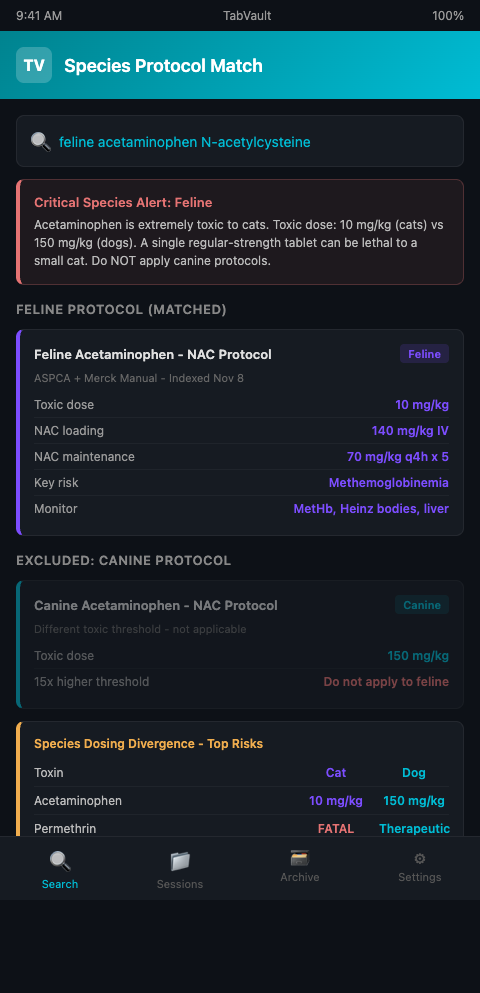
The automated antidote protocol matching capability improves over time. Each new case adds more indexed pages to the archive. After six months, the practice's full-text search covers not just the major reference sites but also the niche VIN discussions, the PubMed case reports, and the conference proceedings that clinicians consulted for unusual cases. A search for "ferret grape toxicosis" might return zero results from a two-week-old archive but surface three relevant pages from an archive with six months of accumulated research.
This is the practical meaning of turning chaotic browser sessions into a searchable private database for species-specific protocols. The chaos is not just the number of tabs — it is the undifferentiated mix of species, toxins, and treatment approaches within those tabs. Full-text indexing with species-specific search terms imposes the structure that the raw browsing experience lacks.
TabVault's value here is cumulative and practice-specific. A general toxicology database contains the same information for every practice. Your indexed archive reflects the species you actually treat, the toxins you actually encounter, and the protocols your clinicians actually prefer. A practice that treats primarily large animals will build an equine-heavy archive; a cat-only practice will accumulate feline-specific resources. The species-specific dosing automated search adapts to your caseload because it indexes your actual research, not a generic corpus.
Advanced Species-Specific Retrieval Tactics
Build species prefix search habits. Train every clinician on the team to begin every toxicology search with a species qualifier: "canine," "feline," "equine," "avian," "reptile." This simple convention dramatically improves retrieval precision in a multi-species archive. Over time, the indexed pages themselves contain these species terms in their source text, making the species filter inherent in the full-text search.
Index exotic species resources proactively. Exotic animal toxicology references are scarce and hard to find during emergencies. When a clinician researches treatment for a toxin exposure in a parrot, a rabbit, or a sugar glider, the indexed pages become disproportionately valuable because they may be the only species-specific reference available for the next similar case. Proactive indexing of full-text search resources for period-accurate species matching applies equally to rare-species toxicology references.
Cross-reference species protocols for drug interaction risks. Some antidotes interact differently depending on species. Atipamezole reverses dexmedetomidine in dogs but has different pharmacokinetics in cats. When your archive contains both canine and feline protocols for the same drug, searching across species can reveal interaction risks that single-species research might miss.
Use negative search terms to filter results. When treating a cat, search for "acetaminophen -canine -dog" to exclude canine-specific results from your archive. Negative terms are especially useful in multi-species practices where the archive contains extensive protocols for multiple species on the same toxin.
Flag species-critical dosing differences. Research on feline drug metabolism has shown that cats lack the major phenol UDP-glucuronosyltransferase enzymes responsible for acetaminophen clearance, resulting in primarily sulfation-dependent metabolism that saturates at far lower doses than in dogs (Court & Greenblatt, 2000). When the indexed archive reveals that a drug's toxic dose differs by more than fivefold between two species the practice commonly treats, flag that information for clinic-wide awareness. These critical thresholds — acetaminophen in cats versus dogs, permethrin in cats versus dogs, ivermectin in collies versus other breeds — are the most dangerous points of confusion in multi-species emergency practice.
Maintain a species-specific bookmark of verified archive pages. While the full-text archive contains everything you have indexed, certain pages carry outsized clinical importance for species-specific decisions. After verifying a protocol page against current guidelines, mark it as a confirmed reference within your workflow. When a future case demands the same species-specific protocol, the verified page surfaces alongside newer results, giving you both a trusted baseline and any updated references that have entered the archive since. This layered approach ensures that the automated retrieval process is grounded in pages that have been clinically validated, not just passively indexed during routine browsing.
Get the Right Protocol for the Right Species — Fast
Species-specific protocol retrieval is the difference between effective treatment and potentially fatal error. TabVault builds your practice a searchable archive of every toxicology page your team consults, indexed by full text and retrievable with species-specific queries in seconds. Join the waitlist to automate the protocol matching that your emergencies demand.
A 4-kilogram cat with acetaminophen toxicosis cannot wait while you manually filter canine results out of a generic web search. TabVault delivers species-specific protocols in seconds because your archive already contains the feline NAC dosing page, the canine NSAID decontamination threshold, and the equine oleander treatment protocol — each indexed during previous cases and each retrievable with a species-qualified search. After six months of multi-species emergency work, your archive reflects the exact species distribution of your practice, giving you faster access to protocols for the animals you actually treat rather than a one-size-fits-all formulary that buries the species you need under the species you do not.