How Full-Text Search Speeds Period-Accurate Salvage Matching
The Precision Problem in Period Material Matching
The Secretary of the Interior's Standards require that replacement features match the old in material, design, scale, color, and finish. For restoration projects seeking federal historic tax credits, this is not a suggestion. It is the regulatory standard that determines whether a rehabilitation qualifies as certified. Salvage dealers serving the restoration market must source materials that meet this standard, and meeting it requires matching by era with a precision that generic search tools cannot deliver.
The difficulty is that architectural periods overlap, sub-styles proliferate, and the terminology used to describe period materials varies wildly across sellers. A Craftsman-era fixture from 1910 may be listed as "Arts and Crafts," "Mission style," "early twentieth century," "bungalow hardware," or simply "antique brass." A dealer relying on traditional keyword searches across individual websites misses listings that use different terminology for the same period.
The National Trust for Historic Preservation defines restoration as accurately depicting a property as it appeared at a particular period by removing features from other periods and reconstructing missing features from the restoration period. For salvage dealers, this means a single project may require sourcing materials that fit within a narrow date window, sometimes as specific as a single decade, and rejecting otherwise identical materials from outside that window.
Period-specific material matching demands research depth that compounds with every project. A dealer handling a Queen Anne restoration needs to know the difference between Eastlake hardware (1870s-1880s) and Colonial Revival hardware (1890s-1910s), even when both appear in listings described generically as "Victorian." This identification requires consulting reference materials, pattern catalogs, manufacturer histories, and academic resources alongside the supplier listings where materials are actually available for purchase.
The Traditional Building magazine guide to substitute materials addresses the challenge directly: substitute materials must be compatible with historic materials in appearance, must have similar physical properties, and must meet basic performance expectations over an extended period. The most common reason for considering substitutes is the difficulty in finding a good match for the historic material. For salvage dealers, reducing that difficulty through comprehensive, searchable sourcing records means fewer substitutions and more period-accurate results.
Full-Text Search as a Period Matching Engine
TabVault transforms the matching reclaimed materials by era problem by turning chaotic browser sessions into a searchable private database, indexing the full text of every page a dealer visits. This means the dealer's archive captures not just URLs and titles but the actual descriptions, specifications, and contextual information on every listing page, every reference page, and every research session.
The practical effect is that a search for "mortise lock 1880" returns every page the dealer has visited where those terms appear together, regardless of which website hosted the listing or what the listing title said. A supplier who described a lock as "antique hardware, circa 1875-1885, solid brass mortise mechanism" appears in the results alongside a reference page from a hardware dating guide that discusses the same lock type. The dealer sees both the supply and the reference material in one search.
This full-text search capability changes how architectural style and period matching works in practice. Instead of searching each supplier website individually with different keyword combinations, the dealer runs one search across the entire indexed archive. Full-text search across a private database means that organized, period-accurate retrieval replaces the fragmented browsing that dealers currently endure, turning salvage matching from a memory exercise into a systematic query.
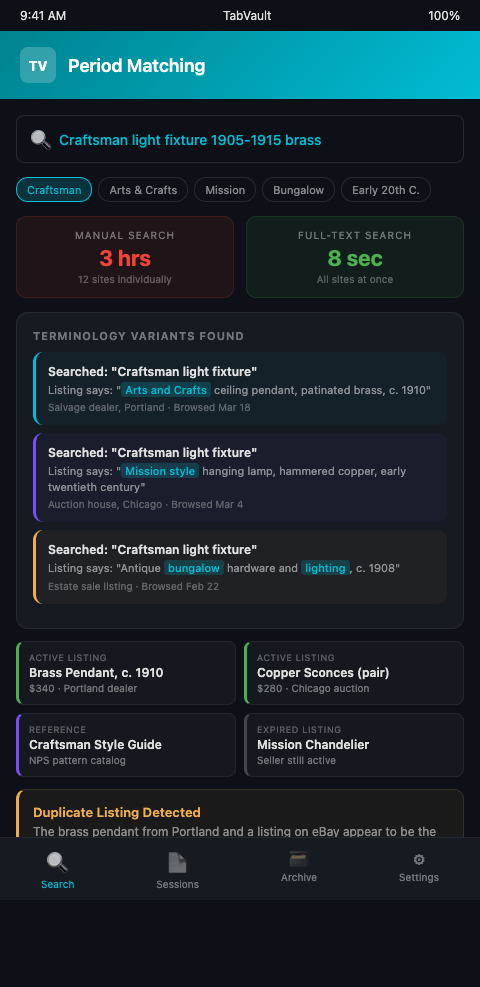
The automated salvage material search capability also addresses the terminology problem. Because full-text search matches against the complete page content, a search for "Eastlake" catches listings that mention the style in their description even if the listing title says "Victorian hardware." Similarly, a search for a specific manufacturer name returns listings across multiple suppliers who carry pieces from that manufacturer, even if each supplier uses different terminology in their listing titles.
The Victorian sourcing case study demonstrated this effect across a full interior project. The dealer sourced matching hardware sets by searching for pattern names rather than generic style terms, finding partial sets across multiple suppliers that combined into complete matched collections. Without full-text search across indexed sessions, the pattern-name connections between suppliers would have remained invisible.
Architectural period material identification also benefits from the archive's accumulation over time. A dealer who has been indexing sessions for six months has built a reference library spanning thousands of pages of supplier inventories, auction records, and research materials. A new request for 1920s Art Deco tile triggers a search that returns not just current listings but also historical listings the dealer browsed months ago. Even if those older listings are no longer active, the archived content tells the dealer which suppliers carried that type of material, providing a starting point for direct outreach.
The deduplication problem familiar to researchers in other fields applies to period-accurate salvage matching as well. Multiple suppliers may list the same piece, acquired from the same estate sale, at different prices. Full-text search reveals these duplicates by matching identical or near-identical descriptions across different supplier sessions, preventing the dealer from unknowingly bidding on the same piece twice.
Compounding Value Across Projects
The archive's value for period matching compounds with each project completed. A dealer who finishes a Craftsman-era restoration has indexed hundreds of sessions covering Arts and Crafts suppliers, period hardware manufacturers, and era-specific reference materials. When the next Craftsman project arrives, that accumulated knowledge is immediately available. The dealer starts the new project with a deeper understanding of the supply landscape than any competitor who treats each project as a fresh research effort.
Full-text search also handles the evolving terminology problem that complicates period-accurate salvage matching. Architectural historians and salvage dealers do not always use the same vocabulary. A historian may describe a feature as "Aesthetic Movement" while a salvage yard lists the same piece as "Anglo-Japanese." A pattern book from 1885 uses period-specific terminology that differs from modern restoration language. Because full-text search matches against the actual words on each page, it catches these terminology variations as long as the dealer has browsed pages using each variant. The archive becomes a de facto thesaurus of period terminology, built organically from diverse browsing sources.
Advanced Period Matching Tactics
Build era-specific search templates for the periods you handle most frequently. A dealer specializing in Victorian and Craftsman materials should maintain a list of period-specific search terms organized by element type. For hardware: "Eastlake," "aesthetic movement," "Renaissance Revival," "Colonial Revival," "Arts and Crafts," "Mission." For woodwork: "egg and dart," "acanthus," "dentil," "rope twist," "gingerbread." Running these templated searches periodically against the growing archive surfaces new matches as the archive expands.
Cross-reference supplier inventories against dated reference materials within the same archive. When a supplier lists a fixture as "circa 1900," search the archive for manufacturer catalogs or hardware guides that can verify or narrow that date. The archive preserves both types of source material, making cross-referencing a search-and-compare exercise rather than a multi-site research project.
Use the archive to build era-specific supplier profiles. Over time, certain suppliers consistently carry materials from specific periods. A search filtered by supplier name and period term reveals which suppliers are the most reliable sources for each era. This supplier intelligence compounds with every archived session, creating a matchmaking layer between client requests and supplier specialties.
For projects requiring multiple matched elements, sequence the sourcing to start with the rarest pieces. Find the hardest-to-match element first, then use the archive to identify suppliers who carry complementary pieces from the same period. This prevents the common mistake of sourcing common elements early and then discovering that the rare element requires a different period or style than what was already purchased.
Develop a period matching confidence scale for your team. The Antique Hardware Supply guide to identifying reproductions notes that older screws show handmade irregularities while modern reproductions are uniformly machine-made, providing one of many physical tests for period authenticity. Not every match requires museum-grade precision. A residential homeowner restoring a bungalow may accept a broader date range than a preservation architect working on a National Register property. Documenting the required confidence level at the start of each project prevents over-researching low-stakes matches and under-researching high-stakes ones. The archive supports both levels of rigor, but the amount of cross-referencing and verification effort should scale with the project's requirements.
Genealogy researchers face the same deduplication challenge when matching records across multiple databases, and the principle of using full-text search to surface duplicates transfers directly to salvage sourcing.
Track matching success rates across projects to identify which periods and material categories present the most difficulty. If Craftsman-era hardware consistently takes twice as long to match as Victorian hardware, that data informs staffing decisions, timeline estimates, and pricing for future projects. The archive provides this tracking data automatically through the volume and duration of search sessions associated with each material category.
Speed Up Your Period Matching
Full-text search across indexed browsing sessions turns period-accurate salvage matching from a memory-dependent art into a systematic, repeatable process. TabVault captures every listing, every reference page, and every research session, making your entire browsing history searchable by content. Join the waitlist to match materials by era in seconds rather than hours.
A restoration architect asks for six matching Craftsman-era fixtures from 1905 to 1915. You search your indexed archive and find three matching supplier listings in under ten seconds -- plus two more you had completely forgotten. That response speed, built from months of accumulated and indexed browsing sessions, turns period sourcing from an art dependent on memory into a systematic process dependent on data. Each browsing session adds depth to your period-specific knowledge base, and every completed project leaves behind a research archive that accelerates the next one.