How One Dealer Sourced a Victorian Interior Through Tab Search
The Scope of a Full Victorian Interior
Restoring a Victorian interior to period accuracy demands sourcing dozens of distinct elements, each with specific material, dimensional, and stylistic requirements. As Saikley Architects notes, Victorian homes feature elaborate woodwork including crown moldings, wainscoting, and intricate trim, with original materials like old-growth timber possessing quality and durability rarely matched by contemporary alternatives. Finding those original materials on a deadline separates professional salvage dealers from casual antique browsers.
The Cincinnati project required seventeen distinct element categories. The architect provided reference photographs from an 1889 pattern book and specified that reproductions were acceptable only for elements where no period originals could be found within the budget. The dealer's preliminary research identified potential sources across twelve states, including salvage yards, estate auction houses, online marketplaces, and demolition contractors handling contemporary Queen Anne teardowns.
The challenge was not finding Victorian architectural elements. Victorian material is among the most commonly salvaged in the industry. The challenge was finding the right Victorian elements: pieces that matched the specific sub-style, date range, and dimensional requirements of an 1887 Queen Anne rather than an 1870 Italianate or an 1895 Colonial Revival. According to InspectApedia's hardware dating guide, door hardware alone can be dated by examining fabrication methods, noting whether components show hand-worked irregularities or machine-produced uniformity, with Victorian-era hardware displaying specific casting patterns and surface finishes that distinguish it from both earlier and later periods.
That level of specificity across seventeen element categories, researched across dozens of online sources over eight weeks, generates an enormous volume of browsing sessions. The dealer estimated she opened and evaluated over two thousand individual web pages during the project.
The Texas Historical Commission's federal tax credit guidelines require that replacement features match the original in material, design, scale, color, and finish. For Queen Anne interiors, this standard encompasses everything from the thread count of decorative screen panels to the finish chemistry on brass hardware. A general search for "Victorian door hardware" produces thousands of results. A period-accurate search for "Eastlake pattern cast brass doorknob with matching escutcheon, circa 1885-1890" produces a handful of results scattered across specialized suppliers that no single search engine indexes comprehensively.
How Tab Search Turned Research Into Results
The dealer's approach relied on TabVault to capture every browsing session and make it searchable by content. The first week focused entirely on research: browsing salvage yard inventories, auction house catalogs, demolition contractor listings, and collector forums across the country. Each session was automatically indexed with full page content.
By the end of week one, the dealer had browsed over four hundred pages. Without indexed search, revisiting any of those pages would have required remembering which site listed the encaustic tiles versus the pocket door hardware. With TabVault turning chaotic browser sessions into a searchable private database, a search for "encaustic tile" returned every page where those words appeared, regardless of which site hosted the listing or which day the dealer visited it.
The style matching process accelerated once the archive reached critical mass. The dealer could search for "Eastlake" to find all sessions involving Eastlake-influenced Victorian hardware, then refine by material ("brass" or "bronze") and dimension. Cross-referencing between sessions revealed that a salvage yard in Michigan had pocket door hardware from the same manufacturer as a set of doorknobs listed by a dealer in Pennsylvania. Purchasing both from the same manufacturer's production run ensured visual consistency across the finished interior.
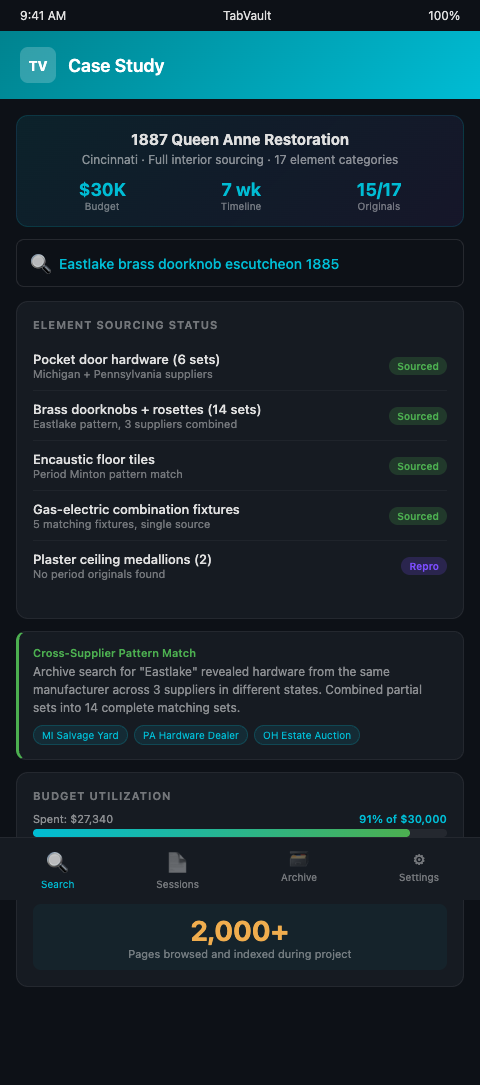
Sourcing Victorian hardware fixtures proved the most challenging category. The architect required matching doorknobs, rosettes, hinges, and escutcheons across fourteen doors. The NPS Preservation Brief 16 notes that substitute materials must match the historic materials in appearance, physical properties, and performance over time. Finding fourteen matching sets of original hardware from the same approximate period required searching across eight different suppliers and cross-referencing catalog patterns between them.
The indexed archive made this cross-referencing practical. A search for the specific pattern name returned sessions from three different suppliers, each carrying partial sets. The dealer assembled a complete set of fourteen by combining inventory from those three sources, verifying pattern consistency by comparing the archived page content from each supplier's listing.
The period interior reclamation story had a concrete outcome. The dealer sourced fifteen of seventeen element categories with period originals, within budget, in seven weeks. The two remaining categories, specific plaster ceiling medallion patterns, required reproduction. The restoration architect later noted that the sourcing speed exceeded any previous project of similar scope. The indexed archive, which the dealer described as her case study equivalent for the salvage world, contained the complete research trail for every sourcing decision.
Budget Tracking and Serendipitous Discoveries
The budget management dimension of this salvage dealer case study is worth detailing. Across the seven-week sourcing period, the dealer tracked prices on comparable elements as she browsed. The archive captured not just the listings she purchased from but also the listings she rejected, with the prices and conditions that led to rejection. When the architect asked for a cost justification on the hardware budget, the dealer pulled the archived sessions showing the price range she had evaluated across eight suppliers. The documentation supported both the final purchase price and the rationale for choosing specific suppliers over cheaper alternatives.
The Victorian interior salvage sourcing process also benefited from the archive's ability to surface related listings. While searching for encaustic floor tiles, the dealer encountered a supplier who also carried period-appropriate radiator covers. The architect had not specified radiator covers in the original scope, but the archived session prompted a conversation that added them to the project. This kind of serendipitous discovery, where a browsing session for one element surfaces an opportunity for another, happens frequently during period sourcing projects but is lost when browsing sessions are not retained.
Advanced Tactics for Period Sourcing Projects
Start by building a reference library within the archive before sourcing begins. Spend the first two or three days browsing pattern books, period catalogs, and academic resources on the specific Victorian sub-style. These reference sessions become the benchmark against which every potential purchase is evaluated. A search for "Queen Anne cornice" should return both the reference material and the supplier listings, side by side.
Prioritize the hardest-to-find elements first. Hardware sets, specialty tiles, and custom millwork have the longest lead times and the fewest available sources. Common elements like baseboards and standard trim can be sourced later from more readily available inventory.
Use the archive to track price variance across suppliers. The same style of Victorian transom window may be listed at three hundred dollars in one state and eight hundred in another. Over the course of a project, the archive accumulates a market intelligence layer that supports negotiation and budget optimization.
For future projects involving similar periods, the archive from a completed project becomes a head start. The dealer's Cincinnati archive, containing over two thousand indexed pages of Victorian salvage research, becomes the foundation for the next Queen Anne project. Suppliers, pricing patterns, and material availability data carry forward without any additional research. This compounding effect is why daily sourcing habits built around indexed search pay dividends far beyond any single project.
Document the architect's specifications alongside the sourcing sessions. When the architect specifies "Eastlake pattern, cast brass, circa 1885," capture the specification document in the same archive as the supplier listings. Future searches for "Eastlake brass" will return both the specification and the listings, eliminating the back-and-forth between specification documents stored in one system and sourcing research conducted in the browser.
Track rejection reasons as carefully as purchase decisions. When the dealer evaluated a set of pocket doors but rejected them because the wood species did not match the architect's specification, that rejection, and the browsing session documenting it, becomes useful data. If the specification changes later, or if a different project requires that exact species, the rejected listing is already in the archive, ready for re-evaluation without fresh research.
Maintain a running list of hard-to-find elements across all active projects. When a supplier listing surfaces an item that matches a standing need from a different project, the archive surfaces the connection through overlapping search terms. A search for "cast iron radiator Victorian" may return results relevant to two separate projects simultaneously. This cross-project visibility turns each browsing session into a potential contribution to multiple active sourcing efforts.
Start Your Next Period Sourcing Project
Victorian interior salvage sourcing does not need to be a frantic scramble through bookmarks and browser history. TabVault captures every page you visit, making your entire research trail searchable by content. Join the waitlist to see how indexed search transforms period sourcing from a memory test into a systematic process.
Over eight weeks, one dealer browsed two thousand pages and sourced fifteen of seventeen element categories for a full Victorian interior -- on time and under budget. The indexed archive made cross-referencing between suppliers practical, budget documentation automatic, and pattern matching across eight hardware catalogs possible. Your next period sourcing project does not have to be a scramble through bookmarks. It can be a systematic search across every page you have ever browsed, retrieving matching encaustic tiles, pocket door hardware, and gas-electric fixtures in seconds.