A Clinic's Story: Uncovering a Neighborhood Poisoning Cluster
Five Dogs, Three Blocks, Ten Days
In September 2023, a veterinary emergency clinic outside Atlanta treated a four-year-old Labrador retriever for acute onset of tremors, hypersalivation, and seizures. The attending veterinarian suspected metaldehyde toxicosis — slug bait poisoning — based on clinical signs and the owner's report that the dog had been in the backyard unsupervised. She researched treatment protocols, administered diazepam and activated charcoal, and the dog recovered over 48 hours. A routine case, or so it seemed.
Three days later, a different clinician at the same practice treated a mixed-breed dog from a neighborhood two streets away. Same clinical signs: tremors, hypersalivation, seizures. Again, the clinician researched metaldehyde protocols independently. Two more dogs followed over the next week, all from the same general area, all presenting with the same toxidrome. The National Pesticide Information Center at Oregon State University documents metaldehyde as a common molluscicide found in slug and snail baits, with clinical signs in dogs appearing within one to three hours of ingestion. But metaldehyde poisoning cases at a single clinic typically occur in isolation — one or two per year, not five in ten days.
The fifth case was the one that changed everything. Dr. Okafor, who happened to have treated both the first and fifth dogs, recognized the pattern. But the recognition was accidental. She remembered the first case only because it had been unusually severe. The second, third, and fourth cases had been handled by colleagues on different shifts with no knowledge of each other's cases. According to the CDC's guidelines on disease cluster investigation, the first step in identifying any cluster is recognizing that individual cases share a common link — a step that depends entirely on information being visible across observers.
How Indexed Research Connected the Cases
The breakthrough came not from the medical records system but from the clinic's indexed browser research. Dr. Okafor, suspecting a geographic toxin cluster, searched the practice's TabVault archive for "metaldehyde" and "slug bait" across the previous two weeks. The results showed four distinct research sessions — four different clinicians, four different shifts — each involving the same toxin, the same ASPCA treatment guidelines, the same Merck Veterinary Manual entry on molluscicide poisoning.
The ASPCA Animal Poison Control Center has noted that geographic clustering of pet poisoning cases often indicates a shared environmental source rather than coincidence, underscoring the importance of connecting individual case presentations. The cluster was hiding in plain sight inside the browser research. Each clinician had treated an individual case. None had seen the full picture. But the indexed archive preserved every page each clinician had visited, timestamped and searchable. Neighborhood poisoning cluster detection became possible because the research trail existed as a permanent, queryable record rather than ephemeral browser tabs that closed at the end of each shift.
This is the concrete payoff of turning chaotic browser sessions into a searchable private database. The medical records system could have surfaced the pattern too, if someone had run the right query against discharge diagnoses. But toxicology research often happens before a definitive diagnosis is recorded. The browser research — the pages consulted while forming a clinical impression — often captures the suspicion of metaldehyde poisoning earlier and more specifically than the formal medical record.
TabVault's full-text search made the correlation immediate. Searching for "metaldehyde" returned not just the ASPCA protocol page (which all four clinicians had visited) but also a VIN discussion thread one clinician had found about metaldehyde bait pellets being distributed by a landscaping company, and a PubMed case series another clinician had read about seasonal toxin patterns in suburban neighborhoods. The indexed research was richer and more detailed than any case summary in the medical record.
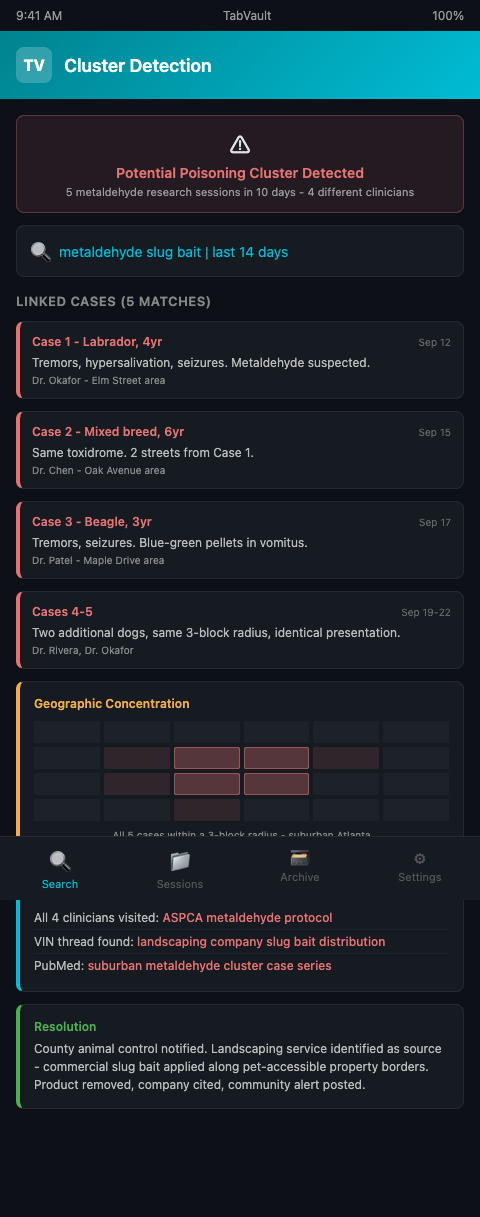
Dr. Okafor contacted the owners of all five dogs and confirmed they lived within a three-block radius. Two owners reported finding blue-green pellets in their yards. The clinic notified the county animal control office, which investigated and found that a landscaping service had applied a commercial slug bait product along property borders in the neighborhood — spreading it in areas accessible to pets. The product was removed, the landscaping company was cited, and the clinic posted a community alert.
Without the indexed research archive, the cluster might never have been identified. Each case would have been treated, resolved, and forgotten. The dogs would have recovered, but the source of the poisoning would have remained active. Community poisoning pattern analysis depends on connecting cases across clinicians and across time — exactly the kind of connection that repeat presentation tracking is designed to support.
Applying Cluster Detection to Your Practice
Search by toxin, not by patient. Medical records are organized by patient. Indexed research is organized by content. When you suspect a cluster, search your TabVault archive by toxin name, clinical sign, or antidote — the terms that connect cases regardless of which animal was affected. This approach mirrors the veterinary epidemiology browser research methodology that public health investigators use when looking for disease clusters.
Set weekly review triggers. Designate one clinician per week to review the most frequently researched toxins in the archive. If the same toxin appears in three or more independent research sessions within a seven-day window, flag it for further investigation. This simple protocol catches clusters that no individual clinician would notice. It is the same principle that makes case breakthroughs possible through tab-connected research in investigative fields.
Map cases geographically. When a cluster is suspected, pull the patient addresses from your medical records and plot them. A ten-year analysis of companion animal exposures reported to a national poison control center found that geographic and seasonal patterns in poisoning data can inform targeted surveillance and prevention efforts (Swirczek et al., 2020). Geographic toxin cluster investigation often reveals that cases concentrate around a specific park, drainage area, or commercial property. The indexed research tells you what the team was treating; the geographic data tells you where to look for the source.
Document the investigation trail. From the first search query to the final community notification, the indexed archive preserves the entire cluster poisoning case correlation process. This documentation is valuable for regulatory reports, legal proceedings, and internal quality reviews. Every page viewed, every search conducted, and every timestamp recorded creates a defensible record of how the cluster was identified and investigated.
Report to poison control networks. The ASPCA Animal Poison Control Center and state veterinary medical boards maintain surveillance systems that depend on individual reports. When your indexed research reveals a cluster, reporting it contributes to broader geographic and seasonal surveillance databases. Your three-block cluster in suburban Atlanta might correlate with clusters reported by other clinics in the region, revealing a product recall need or regulatory gap. Include the dates, toxin identification, and geographic radius from your indexed archive in the report — the more specific the data, the more actionable it becomes for regional surveillance teams and regulatory agencies investigating environmental hazards.
The Pattern Is There — If You Can See It
Neighborhood poisoning clusters are more common than most clinics realize. The cases come in one at a time, treated by different clinicians on different days, and the pattern stays invisible unless someone connects them. TabVault turns every clinician's browser research into a shared, searchable record where those connections surface automatically. Join the waitlist to give your practice the cluster detection capability that could protect your community.
Five dogs from three blocks in ten days — the pattern was hiding in browser tabs that four different clinicians opened across four different shifts. TabVault made those sessions searchable as a unified archive, and a single query for "metaldehyde" revealed the cluster that individual case records missed. Your practice's research trail does not have to be invisible. Every toxin lookup, every ASPCA consultation reference, every PubMed case report your team indexes becomes part of a permanent, queryable record that can connect cases across clinicians, shifts, and weeks — turning routine poisoning treatments into community-level epidemiological intelligence.