14 Months, One Cold Case Timeline, and the Tab That Connected It All
14 Months, One Cold Case Timeline, and the Tab That Connected It All
The Wall of Dead Ends
The National Institute of Justice estimates that roughly 40 percent of homicides in the United States remain unsolved, with an estimated 242,000 unresolved cases accumulated between 1980 and 2016 (NIJ). For investigative podcast producers who take on cold cases, those statistics translate into months of research through fragmented public records, archived news stories, and scattered court documents — most of which lead nowhere. The breakthroughs, when they come, rarely arrive from a single new piece of evidence. They come from connecting evidence across tabs that were opened weeks or months apart.
A Grand Valley State University study on the impact of true crime podcasts on unsolved homicides documented how podcast-driven investigations have generated new leads and witnesses in cases that law enforcement had shelved for decades (GVSU). The podcast "Your Own Backyard" investigating the Kristin Smart case prompted the San Luis Obispo County District Attorney to state that the podcast "helped identify additional witnesses and evidence that was critical in the prosecution of this case." But behind every breakthrough episode is a research archive that most producers describe in the same terms: overwhelming, disorganized, and held together by memory and browser tabs.
This is the story of how one cold case timeline came together — not through a dramatic revelation, but through a search query that connected two research sessions separated by nine months.
How a Single Search Rewired the Investigation
The producer — call her Sarah — started researching a 1998 homicide in a mid-sized Southern city in January 2025. The victim, a small business owner, was found dead in his shop. Police initially investigated two persons of interest but never made an arrest. The case went cold in 2001.
Sarah's first six months followed the standard cold case research pattern: pulling court records, requesting archived police reports through FOIA, searching newspaper databases for contemporary coverage, and browsing county property records for financial connections between the victim and his known associates. She used TabVault to index every page she visited. By July 2025, her archive contained over 800 indexed pages spanning county assessor records, civil court dockets, local newspaper archives, and state corporate filings. Each page was timestamped, full-text indexed, and searchable — a growing corpus of evidence that expanded with every research session.
The breakthrough came in October. Sarah was researching the victim's business partner — a person of interest who had been cleared in the original investigation — and searched her TabVault archive for the partner's name. The search returned 23 results. Most were expected: court records, business filings, news mentions. But one result stood out. It was a county property transfer record she had indexed in January, during her first week of research, while pulling deed records for the neighborhood around the victim's shop. The property transfer showed the business partner selling a parcel to a family member of the second person of interest — six weeks before the murder.
Sarah had looked at that deed record nine months earlier. She had not recognized the buyer's surname because she had not yet researched the second person of interest's extended family. The connection only became visible in retrospect, when the archive contained enough context to make the relationship meaningful. This is what turning chaotic browser sessions into a searchable private database produces: the ability to find connections between research moments that were months apart and had no obvious relationship at the time.
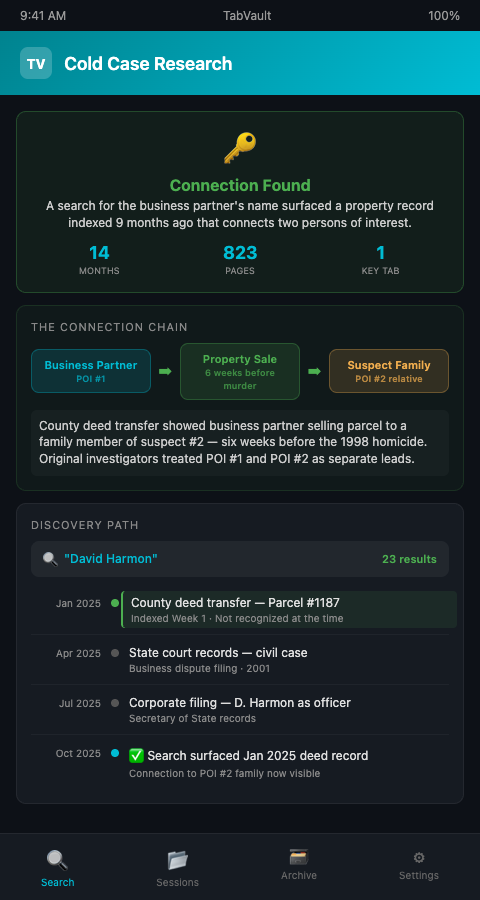
That single cold case research tab discovery restructured the entire timeline. The financial relationship between the business partner and the second suspect's family predated the murder by weeks, not months. It suggested coordination that the original investigators — who had treated the two persons of interest as separate leads — had never explored. Sarah built the next three episodes around that timeline, using the property transfer as the connective thread.
The TabVault archive did not create the evidence. It made the evidence findable. The indexed page had been sitting in Sarah's local database for nine months, waiting for the right query to surface it. Without a searchable archive, the connection would have required Sarah to remember a specific deed record from a browsing session 40 weeks prior — the kind of recall that no producer can reliably maintain across a 14-month investigation.
The IRE's training programs emphasize that database analysis and document cross-referencing are foundational skills for modern investigative work, and that detecting patterns in public records requires the ability to search across the full corpus of collected material. Podcast producers function as this kind of external analyst, but they need research infrastructure that matches the duration and complexity of the cases they take on. A 14-month investigation generates more research data than any person can hold in working memory. The searchable archive becomes the producer's external memory — reliable, comprehensive, and available at query speed.
The cold case timeline podcast format is particularly well suited to this archival approach because the narrative structure tracks the producer's research journey. When the archive records every step of that journey — every page visited, every search run, every connection discovered — the narrative backbone of the season writes itself from the search results. Sarah did not need to reconstruct her research path from memory for the episode outline. She searched her archive chronologically and the story emerged from the timestamps.
The source pattern detection capabilities that a full-text archive provides are what separate cold case podcast research that stalls from research that breaks through. When every page is indexed and searchable, the investigation's accumulated knowledge compounds over time rather than degrading.
Applying This to Your Own Cold Case Research
Index everything from Day 1. Sarah's breakthrough came from a page she indexed during her first week. She did not know it would matter. That is the point. In cold case research, you cannot predict which record will become significant months later. Index aggressively and let the archive hold what your memory cannot.
Search for people, not only events. The connection Sarah found was a person appearing in an unexpected property record, not a document she was specifically seeking. Run name searches against your full archive regularly, especially as new persons of interest emerge. Each new name is a search query that might surface a hidden connection in previously indexed material.
Build the timeline from search results. TabVault timestamps every indexed page. When a search returns results spanning months, arrange them chronologically. The person cross-referencing approach works best when temporal context is preserved — knowing when a document was filed, not only what it contains, reveals sequences that static lists obscure.
Cross-reference against other case studies. The same archival research approach that breaks cold case timelines applies across investigative disciplines. Architectural salvage dealers have used tab search to source a complete Victorian interior by connecting inventory records separated by months, and the structural principle is identical: a searchable archive rewards patience.
Revisit cleared suspects through the archive. Sarah's business partner had been cleared in 2001. The property transfer connection did not prove guilt — it revealed a financial relationship that warranted further investigation. Cold case podcast producers should periodically search their archives for every cleared person of interest. A corporate filing indexed in month eight showing a cleared suspect as co-officer of an LLC that also appears in a property transfer indexed in month three transforms an innocuous record into evidence of a financial relationship worth investigating.
Let the archive accumulate before drawing conclusions. The temptation in cold case research is to build theories early and search for confirmation. The archive rewards the opposite approach: accumulate broadly for months, then query intensively. Sarah's breakthrough came precisely because she had not tried to organize her research into a theory during the first nine months. She had simply indexed everything, and the archive held material whose significance she could not have predicted at the time of collection.
Use the archive to brief law enforcement contacts. When cold case podcast research uncovers a new lead worth sharing with investigators, the TabVault archive provides the evidentiary context that makes the lead credible. Instead of telling a detective "I found a property connection," the producer can present the specific records — indexed pages with dates, URLs, and full text — that establish the connection. This level of documentation transforms a tip into actionable intelligence and reflects the NIJ's recommendation that cold case teams incorporate external research resources to bring fresh analytical perspectives to stalled investigations.
The Tab You Already Have
The page that breaks your cold case timeline open may already be in your archive, indexed months ago during a research session you barely remember. The question is whether you can find it. TabVault gives cold case podcast researchers a private, full-text search index that makes connecting evidence across tabs a systematic practice rather than a matter of luck. True crime cold case investigation tools are only as good as the research archive behind them, and the archive is only as good as the indexing habit that builds it. If you are months into an investigation and still relying on bookmarks and memory, join the waitlist and start building the archive that catches what you have already found.
Sarah's 1998 homicide cold case turned on a county property transfer she indexed during her first week of research -- a record whose significance only emerged nine months later when she searched for a newly discovered family connection. That single search result restructured a 14-month investigation timeline. The page had been sitting in her local archive, waiting for the right query. Without full-text indexing, the connection would have required remembering a specific deed record from 40 weeks prior. Your cold case archive may already contain the breakthrough you need. Join the waitlist and start searching what you have already found.