Automating Person Cross-Referencing Across County and State Records
The Name Fragmentation Problem
Texas maintains court records across 254 counties, each with its own search interface, naming conventions, and data formats (Texas State Law Library). A person named "Robert James Mitchell" might appear as "Robert J. Mitchell" in a county civil docket, "R. James Mitchell" in a state corporate filing, "Bob Mitchell" in a local news article, and "Mitchell, Robert J." in a property deed index. For investigative podcast producers researching that person across jurisdictions, each name variation requires a separate search on a separate platform — and the risk of missing a relevant record grows with every variation.
The Pennsylvania Unified Judicial System portal, the Minnesota Court Records Online system, and the California Department of Justice public records database each present data differently (PA Courts). County assessor offices maintain property records under the name of the tax billing party, which may differ from the legal owner if the property is held in a trust or LLC. A person who appears in assessor records under their personal name may appear in corporate filings under their LLC, and in court records under yet another variation. These are not edge cases — this is the default condition of public records research.
Investigative Reporters and Editors includes public records navigation as a core component of its Watchdog Workshop training, recognizing that cross-referencing records across jurisdictions is a fundamental investigative skill that most journalists learn through painful experience rather than systematic instruction (IRE). The skill gap is not about knowing that cross-referencing matters — every investigative producer knows that. The gap is about having the infrastructure to make it efficient.
Building a Cross-Reference Layer From Browsing Research
Manual county records cross-reference search follows a predictable pattern: the producer opens a county assessor site, searches for a name, notes the results, opens the next county's site, searches again, and tries to reconcile the results in a spreadsheet. This process is slow, error-prone, and loses context. The spreadsheet captures the data points the producer chose to record, but not the full text of the source pages.
TabVault changes this by indexing the full text of every public records page the producer visits. When a producer pulls property records from three different counties for the same person of interest, TabVault indexes all three pages — including the full text, the source URLs, and the visit timestamps. A subsequent search for any name variation returns every indexed page where that string appears, regardless of which county or record type it came from. This is what turning chaotic browser sessions into a searchable private database makes practical for state records person matching.
The automation is not in the searching of external databases — TabVault does not scrape or query government sites on the producer's behalf. The automation is in the cross-referencing layer. Once the producer has visited the relevant pages during normal research, the indexed archive becomes a unified search layer across all of them. Searching for "Mitchell" returns results from the county assessor, the court docket, the corporate filing, and the news archive — all in one result set, with timestamps showing when each page was visited.
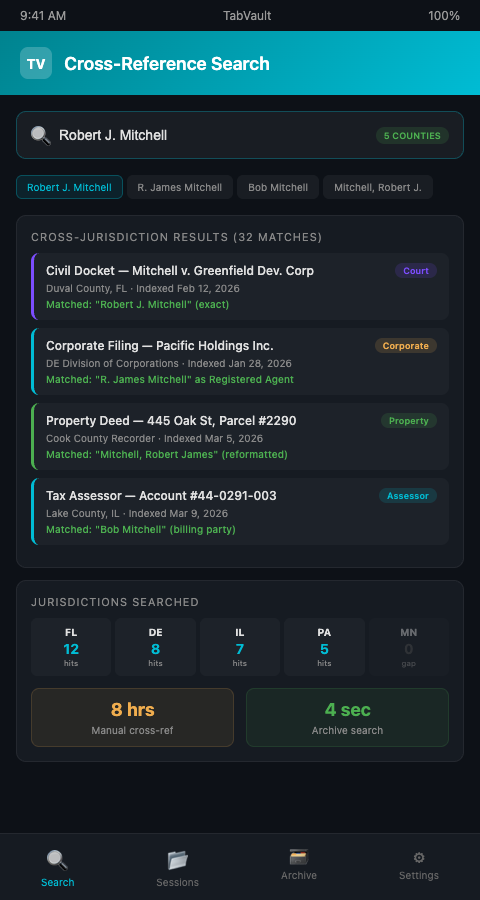
This cross-referencing capability compounds over time. After six months of investigation, a producer's TabVault archive might contain indexed pages from 30 different government databases across multiple counties and states. A new person of interest enters the investigation. The producer searches the archive for that name and instantly sees whether the person appears in any previously indexed record — even records pulled months earlier for a different purpose. This is the same structural advantage that person tracking across public records provides, but scaled across jurisdictions.
The speed advantage compounds with each new county or state added to the archive. A traditional manual cross-reference of one person against records in five counties might take a full workday — finding each county's search interface, entering the name, evaluating the results, recording matches. With a TabVault archive built from six months of browsing research across those same five counties, the same cross-reference takes one search query and returns results in seconds. The producer's prior browsing sessions have already done the retrieval; the archive has already done the indexing. The only remaining step is the query.
Handling Data Quality, Entity Mapping, and Workflow Integration
The county records cross-reference search also reveals data quality issues. When the same person appears under different name formats in different counties — "Robert J. Mitchell" in one, "Mitchell, Robert James" in another — the full-text search catches both entries because it matches on the string "Mitchell" regardless of formatting. This is a structural advantage over spreadsheet-based cross-referencing, which requires exact-match lookups or manual fuzzy-matching that most producers lack the tools to automate.
The approach also handles entity-to-person mapping. When a property is held by an LLC, the TabVault archive might contain the LLC's corporate filing (showing the registered agent), the property deed (showing the LLC as owner), and a news article (naming the individual behind the LLC). A search for the individual's name surfaces the news article; a search for the LLC name surfaces the deed and the corporate filing. The producer connects the person to the property through the archive rather than through memory.
For teams working across multiple investigations, the same automated deduplication approach used in genealogy research applies: when two producers index pages for the same person from different sources, the merged archive shows both entries, making duplicate research visible and consolidatable.
The practical workflow for automated public records cross-referencing through TabVault looks like this: the producer opens the county assessor site, searches for a name, reviews the results page — TabVault indexes it. The producer clicks through to the detail page — TabVault indexes it. The producer switches to the state corporate registry, searches for the same name — TabVault indexes the results and detail pages. Over a two-hour session pulling records from three counties and one state corporate registry, the producer might visit 60 pages. All 60 are indexed, full-text searchable, and timestamped. The cross-referencing that would have required a spreadsheet now requires only a search query.
Scaling Cross-Referencing for Complex Investigations
Build a variant name list for every person of interest. BRB Publications' research on public record searching techniques emphasizes that providing personal identification information beyond the minimum — maiden names, aliases, and previous names — significantly reduces false matches when cross-referencing records across jurisdictions (BRB Publications). Before searching the archive, compile every known name variation: full legal name, common nicknames, maiden names, name changes, business aliases. Run each variant as a separate TabVault search and compare the result sets. Pages that appear in multiple searches confirm the person's presence; pages that appear in only one search may contain a name variant you had not considered.
Search by address as a person proxy. When name variations are ambiguous — "John Smith" is effectively unsearchable — use associated addresses instead. A home address, a business address, or a registered agent address is often unique enough to isolate the right person. TabVault's full-text index captures addresses embedded in property records, corporate filings, and court documents, making address-based person matching feasible.
Use the archive for corporate filing cross-referencing alongside person matching. People and entities interleave in public records. A person search should always be complemented by an entity search for any associated businesses, trusts, or organizations. The TabVault archive treats both searches identically — full-text queries against the same indexed corpus.
Flag jurisdictional gaps. After running cross-reference searches, note which counties and states are represented in the results and which are missing. If your person of interest has known ties to a county where you have not yet pulled records, that gap represents an unindexed research opportunity. Automated public records cross-referencing is only as complete as the pages you have visited and indexed.
Export cross-reference results for fact-checking. When a person cross-reference surfaces connections that will appear in an episode, export the relevant search results — source URLs, indexed text, timestamps — as a documentation package. This creates the evidence chain that fact-checkers and legal reviewers need to verify your claims.
Cross-reference against campaign finance disclosures. Campaign contributions are filed under the donor's name and address, which provides another data point for person matching. When a person of interest appears in property records and corporate filings, searching for their name in indexed campaign finance pages confirms the identity and adds a financial dimension to the profile. Many state campaign finance databases are browsable, making them natural additions to the TabVault archive during routine county state records investigation sessions.
Maintain a "person of interest" dashboard. For each active investigation, keep a running list of every person of interest alongside the number of TabVault search results for each name. Update the counts weekly. A person whose search result count jumps from 3 to 12 over two weeks has appeared in newly indexed material — a signal worth investigating. Conversely, a key person of interest with a stagnant result count may indicate that the investigation has exhausted available public records for that individual, suggesting the need for alternative research strategies.
Stop Cross-Referencing by Hand
Manually reconciling person records across county and state databases is the investigative equivalent of doing arithmetic on paper when a calculator is available. TabVault gives investigative podcast producers an automated cross-reference layer built from their own browsing research — every page visited, every name indexed, every connection searchable. Automating person cross-referencing records across jurisdictions turns a day-long manual task into a single search query. If you are spending hours matching names across jurisdictions, join the waitlist and let the archive do the matching.
A person of interest who appears as "Robert J. Mitchell" in a county civil docket, "R. James Mitchell" in a state corporate filing, and "Mitchell, Robert J." in a property deed index requires separate searches across separate portals -- unless all three pages live in the same full-text archive. After six months of indexing across 30 government databases, one producer's TabVault archive turned a day-long manual cross-reference into a single search query that returned matches from five counties and two state registries in under eight seconds. Join the waitlist and automate the cross-referencing that spreadsheets were never designed to handle.