Advanced Property and Corporate Filing Cross-Referencing
The Layered Ownership Problem
The SEC's EDGAR database contains over 500,000 entity records and provides full-text search access to more than two decades of electronic filings (SEC). State-level corporate registries — Delaware's Division of Corporations, New York's Department of State, Florida's Sunbiz — each maintain separate databases with different search interfaces and different data formats (Delaware Division of Corporations). County assessor offices hold property tax records that list an LLC or trust as the owner rather than a natural person. And county recorder offices maintain deed records that show the chain of title — which may involve multiple entities across multiple jurisdictions.
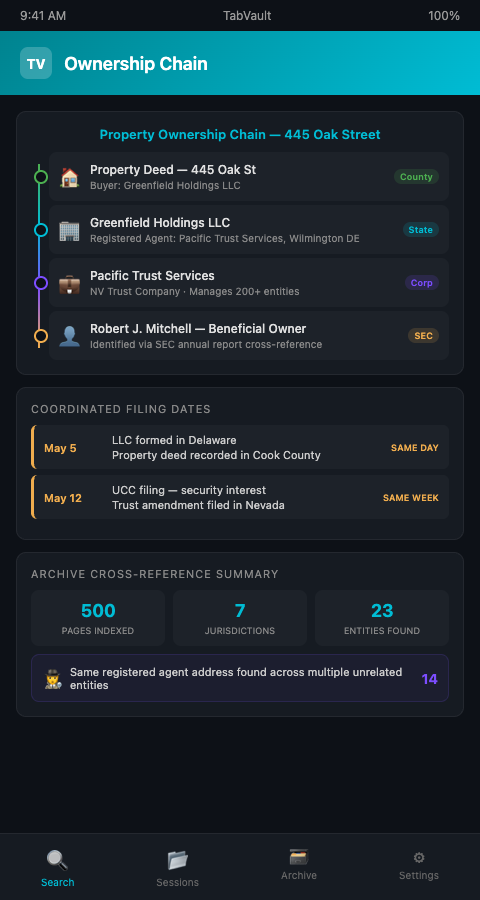
For investigative podcast producers, the problem is not access. These records are public. The problem is cross-referencing. A property deed shows "Greenfield Holdings LLC" as the buyer. The LLC is registered in Delaware with a registered agent address in Wilmington. The LLC's organizer is listed as "Pacific Trust Services" — a Nevada trust company that manages entities for hundreds of clients. The actual beneficial owner appears nowhere in any single record. Connecting the ownership chain requires pulling records from at least three jurisdictions — the county recorder, the Delaware Division of Corporations, and the Nevada Secretary of State — and manually matching names, addresses, and filing dates across them.
Rutgers Law School's investigative research guide identifies corporate filings, SEC records, court dockets, and property records as the four primary sources for business entity investigations, noting that cross-referencing these sources is the foundation for establishing ownership chains and financial relationships (Rutgers Law Library). The methodology is well established. The infrastructure for executing it efficiently is not.
The University of Michigan's Kresge Research Guide on corporate filings notes that Mergent Online provides complete corporate history including lists of subsidiaries, property holdings, financial data, annual reports, and insider ownership — but this information exists across multiple database interfaces that do not cross-reference automatically (University of Michigan). For investigative podcast producers, the cross-referencing labor falls on the producer, page by page, tab by tab.
Building a Cross-Reference Archive for Property and Corporate Records
The manual approach to corporate filing cross-referencing research follows a predictable cycle: search one database, record the result in a spreadsheet, search the next database, add another row, and try to connect the rows through shared names, addresses, or dates. This works for a single property or a single entity. It breaks down when an investigation involves dozens of properties, multiple corporate layers, and filing dates spanning years.
TabVault replaces the spreadsheet with a searchable full-text archive. When a producer pulls a property deed from the county recorder, TabVault indexes the full text of the page — the property address, the buyer and seller names, the recording date, the document number. When the producer then searches the Delaware Division of Corporations for the buyer's LLC, TabVault indexes that page too — the entity name, the registered agent, the formation date, the organizer. Both pages are now in the same searchable index, and a query for any shared term — the LLC name, the registered agent's name, the property address — returns both results.
This is what turning chaotic browser sessions into a searchable private database means for property records investigation search. Instead of building a spreadsheet row by row, the producer browses public records normally and lets TabVault build the cross-reference layer automatically. The archive grows with every research session, and the cross-referencing capability scales with it.
The corporate filings public records search process that most producers follow manually — open a tab, search a database, note the results, repeat — naturally generates the browsing behavior that TabVault indexes. No workflow change is required. The producer searches public records the same way they always have; TabVault adds the cross-referencing layer silently.
The compound value appears when the archive is deep enough to reveal connections the producer did not anticipate. After six months of indexing property and corporate records for a corruption investigation, the archive might contain 500 pages from county assessors, recorders, and state corporate registries across multiple jurisdictions. A search for a registered agent name returns the entities the producer was actively investigating and every entity associated with that agent across the entire archive. If the same registered agent appears in both the target investigation and in records indexed during an earlier, unrelated episode, that connection surfaces through search. These cross-investigation connections are among the most valuable findings in property records investigation search, because they reveal networks that no single investigation would uncover on its own.
The property ownership cross-reference challenge is fundamentally a data integration problem. Property records, corporate filings, and court documents each use different identifiers, different naming conventions, and different data structures. A unified full-text search index collapses these differences by treating every page as text — searchable on any string, regardless of the original database's structure. This is a brute-force approach to cross-referencing, but it works precisely because it makes no assumptions about data format.
This approach directly supports person cross-referencing by adding the entity layer. A person might not appear directly in property records if they hold assets through an LLC, but the LLC's officers or registered agents connect back to the person through corporate filings. TabVault's full-text search crosses both layers — personal names and entity names — in a single query.
For investigations involving social media records alongside public filings, TabVault indexes both source types into the same archive, meaning a search for a person or entity name returns results from Instagram profiles and county deed records alike.
Advanced Cross-Referencing Techniques
Map the entity chain before searching. For each property, sketch the expected ownership chain: property deed (county recorder) → LLC owner (state corporate registry) → registered agent or organizer → beneficial owner. Then pull records for each node in the chain. TabVault indexes each page, and the chain becomes searchable as a connected sequence rather than isolated records.
Search for registered agent addresses, not only names. Registered agent companies use a small number of physical addresses across thousands of entities. Searching for the registered agent's street address in your TabVault archive may reveal dozens of entities serviced by the same agent — a faster way to map corporate networks than searching entity by entity.
Cross-reference filing dates to detect coordinated activity. When an LLC is formed in Delaware on the same day that a property deed is recorded in another state, the timing suggests coordination. TabVault's timestamp and full-text index make it possible to search for filing dates and match them across jurisdictions. This temporal cross-referencing is a core technique for advanced public records cross-referencing in corporate investigations.
Pull UCC filings as a secondary cross-reference. Uniform Commercial Code filings at the state level list secured transactions — liens, financing statements, collateral assignments. These filings contain the names of both the debtor and the secured party, along with descriptions of the collateral. UCC filings indexed in TabVault provide another cross-reference layer that connects people and entities to specific assets.
Use the SEC's EDGAR full-text search for publicly traded entities. If any entity in the ownership chain is associated with a publicly traded company, EDGAR's full-text search across more than 20 years of filings can surface connections that state-level records miss. Index the EDGAR results in TabVault alongside county and state records to build a comprehensive cross-jurisdictional archive. The FinCEN beneficial ownership reporting requirements under the Corporate Transparency Act created a new reporting framework designed to make it harder for bad actors to hide behind shell companies -- and while the rule's scope has narrowed, the underlying principle reinforces why cross-referencing corporate filings across jurisdictions remains essential for investigative work.
Check county assessor records against county recorder records. Assessor data reflects tax billing responsibility while recorder data reflects legal ownership. These may differ when a property is held in a trust or recently transferred. Indexing both in TabVault and searching for the property address surfaces both records side by side, revealing discrepancies that may indicate unreported transfers or ownership disputes. This layered verification approach is the foundation of thorough property ownership cross-reference methodology.
Document the ownership chain as you build it. As cross-referencing reveals each layer — property deed to LLC to registered agent to beneficial owner — record the chain in a structured note alongside the TabVault archive. The archive holds the full-text evidence; the ownership chain note provides the analytical summary. Together, they create a presentation-ready evidence package that can be used in episode scripts, shared with collaborators, or provided to legal counsel during pre-publication review. The same structural principle appears in adjacent fields — architectural salvage dealers use building permit and estate sale cross-referencing to connect property records to inventory opportunities through the same multi-source chain-building approach.
Follow the Paper Trail Through One Search Bar
Property ownership cross-reference and corporate filing cross-referencing research depend on connecting records scattered across dozens of databases and jurisdictions. TabVault gives investigative podcast producers a single searchable archive built from every public records page they visit — property deeds, corporate filings, SEC disclosures, and court records, all indexed and queryable from one search bar. Advanced public records cross-referencing requires an archive deep enough to hold records from multiple jurisdictions and smart enough to return them all in a single query. If you are tracing ownership chains through layered entities, join the waitlist and let the archive connect what the databases keep separate.
Tracing a property from a county deed through a Delaware LLC to a Nevada trust to the beneficial owner requires records from at least three jurisdictions -- each with different search interfaces, naming conventions, and data formats. After six months of indexing property and corporate records, one producer's TabVault archive contained 500 pages from county assessors, recorders, and state corporate registries. A search for a registered agent name returned not only the entities under active investigation but every entity associated with that agent across the entire archive, revealing a network of 14 related LLCs that no single-jurisdiction search would have uncovered. Join the waitlist and follow the paper trail through one search bar.