Cross-Referencing Building Permits With Estate Sale Listings
Two Data Streams, One Salvage Opportunity
A dealer in Portland learned about a 1904 Craftsman bungalow through an estate sale listing on EstateSales.net. The listing mentioned "original built-ins and hardware." What it did not mention was that the city had already issued a demolition permit for the property — the heirs planned to raze the house after clearing personal effects. The dealer who cross-referenced the estate sale address with the city's permit database arrived at the sale with a salvage proposal ready. He left with negotiated rights to every interior door, window casing, and light fixture in the house.
Most dealers monitor either estate sales or building permits, rarely both in tandem. The Warren Group's analysis of building permit data shows that permit records can predict market activity and property transitions — the same transitions that generate estate sales. When a property owner dies, the estate typically enters probate. Probate timelines stretch six to twelve months, during which personal property is liquidated through estate sales and the real property may be listed, renovated, or demolished. Building permit salvage research that accounts for this sequence catches opportunities at their earliest stage.
The challenge is logistical. Estate sale listings live on platforms like EstateSales.net, AuctionZip, and local Facebook groups. Building permits live on municipal portals that vary by jurisdiction. Yale Insights research has shown that swings in building permit activity can predict broader property transitions, meaning permit data is a leading indicator of the very estate sale and demolition events that generate salvage opportunities. Cross-referencing these sources manually means copying addresses from sale listings, pasting them into permit search portals, and trying to remember which addresses you have already checked. At scale, this process fragments across dozens of tabs and inevitably produces gaps.
The fragmentation is worse than it appears. Estate sale listings are ephemeral — they go up a week or two before the sale and disappear afterward. Building permits persist on government portals but may cycle off the default search results after thirty or sixty days. A dealer who checks estate sales on Monday and permits on Thursday may never overlap on the same address, simply because the timing of each check misses the window when both records were active. The only way to catch every overlap is to store both data streams permanently and search across them at any time.
The architectural salvage lead verification problem also extends beyond simple address matching. An estate sale at 442 Oak Street might not correspond to a demolition permit for 442 Oak — but it might correspond to a renovation permit at 440 Oak, the adjoining property. Or the estate sale description might mention "the family home on Oak near Third," while the permit uses the full legal address. Catching these near-misses requires full-text search, not exact address lookup — and that is precisely what most manual cross-referencing methods cannot do.
Building a Cross-Reference Layer From Your Browsing
The ATTOM Data analysis of nationwide building permit records demonstrates that compiling, standardizing, and cross-referencing millions of public and private real estate records produces a comprehensive picture of property transitions. Salvage dealers need the same cross-referencing capability, but applied to a narrower and more time-sensitive data set: which properties are simultaneously entering the estate sale pipeline and the demolition pipeline?
The fix is structural, not incremental. Instead of maintaining two separate research workflows, let both data streams flow into the same indexed archive. Every estate sale listing page you view and every permit detail page you check gets captured, full-text indexed, and made searchable in one place. This is the principle behind turning chaotic browser sessions into a searchable private database — and it is how TabVault turns the building permit estate sale cross-reference from a manual chore into an automatic byproduct of your normal browsing.
Here is what that looks like in practice. On Monday morning, you browse the week's new estate sale listings in your metro area. Each listing page — with its address, description, dates, and photos — gets indexed. On Tuesday, you check the city's permit portal for new demolition and renovation permits. Those pages get indexed too. On Wednesday, you search your archive for an address that appeared in Monday's estate sale listings. If a permit was filed for that address, both the sale listing and the permit detail page appear in your results.
The cross-referencing salvage leads workflow becomes even more powerful over weeks and months. An estate sale you viewed in January might correspond to a demolition permit filed in March. Without an indexed archive, that connection is invisible — the estate sale tab was closed months ago, and the permit page is brand new. With an archive, a search for the street name or neighborhood surfaces both records regardless of when you viewed them.
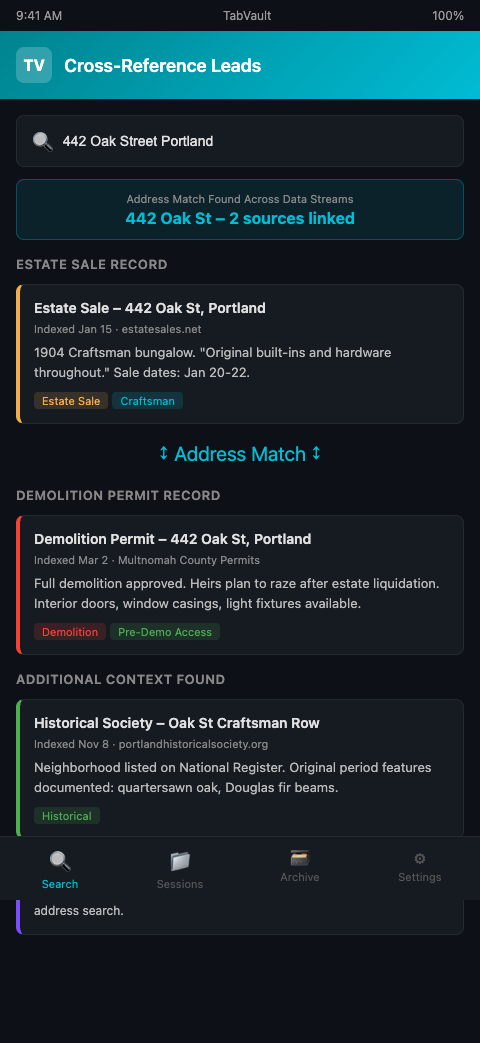
TabVault's full-text indexing makes this cross-reference possible because it captures more than just URLs. It captures the text content of each page — sale descriptions mentioning "original Victorian hardware," permit notes specifying "full demolition," property addresses, dates, and contact information. A search for "Queen Anne" might surface an estate sale listing describing the home's style alongside a renovation permit for a Queen Anne property three blocks away. These are the kinds of connections that emerge when disparate records are unified under one search layer — the same principle that investigative producers apply when searching court records across multiple state jurisdictions to build cases from fragmented public data.
The demolition notice monitoring you do for individual cities feeds directly into this cross-reference. Every permit page you index during your demolition monitoring becomes available for matching against estate sale listings, and vice versa.
The verification benefit compounds when you add other data sources. County tax records showing delinquent payments on a property may correlate with an upcoming estate sale. A Zillow or Redfin listing showing a property marketed as "handyman special" or "investor opportunity" may signal that the interior is being gutted. All of these pages, once browsed and indexed, become part of the same cross-referenceable archive. The building permit salvage research you began with becomes the anchor of a multi-source lead qualification system that improves with every page you view.
Advanced Tactics for Lead Verification
Verify timing before you act. An estate sale listing and a demolition permit for the same address could be separated by months. Check the permit filing date against the estate sale date to understand the sequence. If the sale precedes the permit, the heirs may not have decided to demolish yet — and a well-timed salvage offer could beat the wrecking ball.
Search for contractor names across your archive. Demolition permits often list the contractor. If you see the same contractor appearing across multiple permits, you have a potential sourcing relationship. Search your indexed archive for that contractor's name to see every project they are associated with across all the cities you monitor.
Cross-reference with property tax records. Hennepin County's building material reuse guidance confirms that permit data cross-checked with property records reveals ownership changes, tax delinquencies, and vacancy indicators — all signals that architectural salvage may become available. Add tax record pages to your browsing rotation so they enter your searchable index alongside permits and sale listings.
Track neighborhood patterns. When multiple estate sales and demolition permits cluster in the same neighborhood, redevelopment is likely underway. Your indexed archive lets you search by neighborhood or zip code to spot these clusters before they become obvious to the broader market. This estate sale permit matching at the neighborhood level is a competitive intelligence advantage that individual address lookups miss.
Build relationships with estate sale companies. When you identify a sale company that frequently handles properties with architectural value, note their name in your browsing. Over time, your index builds a record of which companies handle which types of properties, giving you a roster of sourcing partners ranked by relevance to your inventory needs.
Watch for renovation permits as closely as demolition permits. A renovation permit may signal that original architectural elements are being removed and replaced — the homeowner wants new windows but the original 1920s casements are heading to the dumpster. Your indexed archive treats renovation and demolition permits equally, making both available for cross-reference with estate sale and listing data. The renovation-to-salvage pipeline is often overlooked by dealers who focus exclusively on demolitions, but it produces a steady stream of individual elements — doors, hardware, lighting, tile — that are smaller in scale but higher in per-unit value.
Document your verification success rate. The HBWeekly analysis of historical building permit data demonstrates that tracking permit trends over time reveals cyclical patterns in construction and demolition activity — the same patterns that drive estate sale frequency in residential neighborhoods. After several months of cross-referencing permits and sales, review which matches led to actual salvage acquisitions. If your archive shows that 15% of cross-referenced addresses produced actionable leads, you have a baseline to measure against as you refine your sourcing routine. This feedback loop turns the cross-referencing salvage leads process from a hopeful experiment into a measurable business practice.
Your Leads Are Already in Your Browser
Every week, properties are transitioning through probate, estate liquidation, and demolition permitting — and the overlap between these processes is where the most time-sensitive salvage opportunities surface. The overlap between building permits and estate sales is where the best salvage opportunities live, but only if you can see both data streams at once. TabVault gives you that visibility by indexing every page you browse into a single searchable archive. Stop toggling between tabs and start cross-referencing automatically. Join the waitlist and let your browsing build the lead verification system your business needs.
When both estate sale listings and building permits flow into the same indexed archive, cross-referencing happens automatically. An address you browsed on EstateSales.net in January surfaces alongside a demolition permit filed for the same property in March -- a connection invisible to any dealer who keeps these data streams in separate browser sessions. Over six months, these cross-references accumulate into a lead qualification system that catches opportunities at the exact moment two timelines converge.