Searching Court Records Across Multiple State Jurisdictions
The Multi-Jurisdiction Maze
A producer working on a financial fraud series last year described searching court dockets in Delaware, New York, Florida, Nevada, and Texas over the course of three weeks. By week four, she could not remember which defendant names she had already run through the Delaware Chancery Court system or whether the Texas results had included civil filings. She re-ran searches she had already completed, burning two full days.
This is a structural problem, not a personal one. The National Center for State Courts maintains a directory of state court websites, and the variation is staggering. Some states offer free, comprehensive online access to docket entries. Others restrict searches to members of the bar or charge per-query fees. Still others provide online access only for certain court levels, leaving trial court records accessible only in person. The Reporters Committee for Freedom of the Press documents in its Open Government Guide how court record access rules differ not only state by state but county by county within the same state.
For federal cases, PACER provides electronic access to more than one billion documents across all federal courts, but at ten cents per page with a three-dollar cap per document. State systems have no such uniformity. A cross-state court record search for a single subject might involve five completely different interfaces, five different account systems, and five different ways of displaying docket information.
When your investigation spans multiple state jurisdictions, the browser becomes the connective tissue. You open tabs for each state's court portal, each county clerk's online index, each docket search result. Within a single research session, you might have thirty tabs open across four jurisdictions. Close those tabs, and the evidence trail disappears.
From Tab Chaos to Searchable Court Record Archive
The core failure is not the number of tabs. The failure is that closing a browser window destroys the record of what you searched, what you found, and what came back empty.
TabVault addresses this by turning chaotic browser sessions into a searchable private database. Every court portal page you visit during a multi-jurisdiction case research session gets indexed -- the URL, the page content, the search parameters, the docket entries displayed. When you need to verify three weeks later whether you already searched the Nevada civil docket for a particular LLC name, you search your own indexed archive instead of logging back into the portal and guessing at your previous queries.
The practical workflow for docket entry search across states looks like this. You dedicate a research session to one jurisdiction at a time. You open the state court portal, run your searches, and review every docket entry that appears. TabVault indexes each page as you work. When you finish with that state, you move to the next. At the end of the week, you have a permanent, searchable record of every court system you queried, every name you searched, and every result -- including the empty ones.
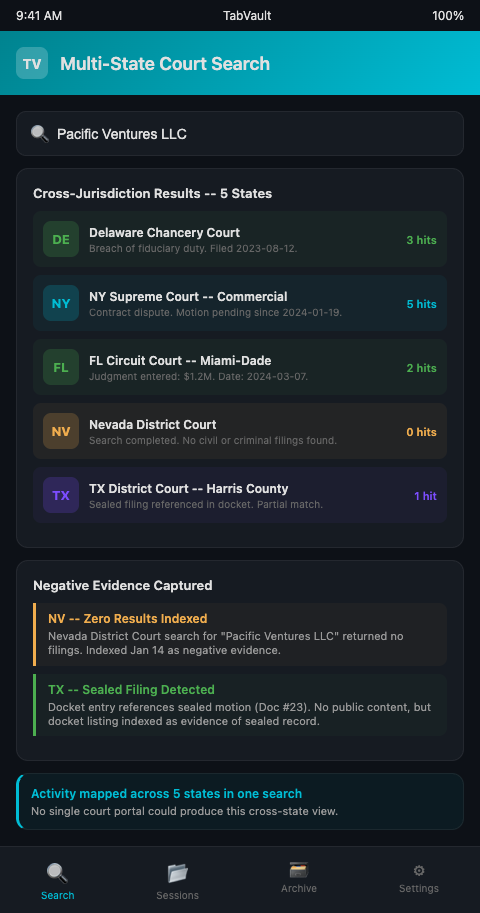
Empty results matter enormously in investigative work. Knowing that a defendant has no civil filings in Delaware is as important as finding a judgment against them in Florida. Your indexed sessions capture that negative evidence automatically. The portal page showing zero results is indexed alongside the one showing forty docket entries.
Producers who also work with public records beyond court systems find that indexed court sessions become part of a larger research archive. A docket search from January can be cross-referenced against a property records search from March, all through the same search interface.
Structuring Multi-Jurisdiction Sessions
The most effective approach separates your court record research by jurisdiction and case type rather than mixing everything into marathon sessions.
One state per session block. Dedicate a focused session to each state's court system. Search all relevant court levels -- appellate, circuit, district, municipal -- within that single jurisdiction before moving on. This prevents the common mistake of searching appellate courts in three states, then switching to trial courts in a fourth, and losing track of which court levels you covered where.
Standardize your search terms across states. Before you begin, create a master list of every name variant, LLC name, and alias you need to search. Run the same list against every state system. Your indexed sessions will confirm whether you actually searched each variant in each state, eliminating the guesswork that leads to repeated searches.
Document the access limitations. Some state court records are only available for cases filed after a certain date. Others restrict online access to criminal cases only. Note these limitations during your session so your indexed archive reflects both what you searched and what was searchable. Producers tracking person-of-interest names across public databases face similar challenges with inconsistent coverage across systems.
Tag sessions by investigation and jurisdiction. If your indexing workflow supports session labels, tag each block with the investigation name and state abbreviation. A session tagged "Meridian-Fraud-DE" is instantly findable six months later when the story moves to trial.
Advanced Tactics for State Court Records Investigation
The most powerful capability of an indexed multi-state archive is running a single name search that returns docket entries from Delaware, New York, Florida, Nevada, and Texas simultaneously -- a cross-jurisdiction query that no individual court portal can execute.
Cross-state defendant activity mapping. Once you have indexed sessions from multiple states, search your TabVault archive for a defendant's name across all jurisdictions simultaneously. The results show you every state where that name appeared in a docket -- and by omission, every state where it did not. This kind of cross-state pattern recognition is impossible when your research exists only as browser history entries.
Timeline reconstruction from docket dates. Court dockets contain dates -- filing dates, hearing dates, judgment dates. When your indexed sessions span multiple states, you can construct a chronological timeline of a subject's legal activity across jurisdictions. This technique parallels how researchers monitor demolition notices across multiple city portals, building a timeline from scattered municipal sources.
Fee tracking and budget management. PACER charges accumulate quickly during intensive federal research, and many state systems charge per search or per document. The Free Law Project's analysis of PACER fees documents that PACER has generated over a billion dollars in cumulative revenue, with 75 percent of that revenue coming from just 1 percent of users. By indexing confirmation and receipt pages, you create a record of what you spent and where. This matters for podcast budgets and for transparency with funders or partners.
Leverage negative results for narrative completeness. When your indexed sessions show that a defendant has active litigation in four states but zero filings in the fifth state where they claim primary residence, that absence pattern becomes a data point worth investigating. Did they structure their business activities to avoid litigation in their home jurisdiction? Your indexed archive makes these absence patterns visible across jurisdictions in a way that searching individual state portals one at a time cannot.
Watch for sealed and redacted records. A docket entry that references a sealed filing is itself valuable evidence -- it tells you something exists that someone wanted hidden. Index those pages carefully. The docket entry listing may be the only publicly accessible trace of the sealed document.
If your investigative podcast requires court records from multiple state jurisdictions and you are losing track of which systems you already searched, your browser is actively working against you. TabVault turns every court portal session into a permanent, searchable record. No more duplicate searches, no more lost docket entries, no more guessing which states you already covered. Join the waitlist to bring order to your multi-jurisdiction research.