Tracking Person-of-Interest Names Across Public Databases
The Name Fragmentation Problem
Bellingcat's Online Investigations Toolkit catalogs hundreds of tools for tracking people and entities across open sources, and the sheer number reflects the difficulty of the task. A single person of interest can appear differently in every public database they touch. Court records use legal names. Corporate filings list officers by formal name but register entities under business names. Property records may list a spouse or a trust. Voter registration files use the name on file at registration, which may predate a marriage or legal name change.
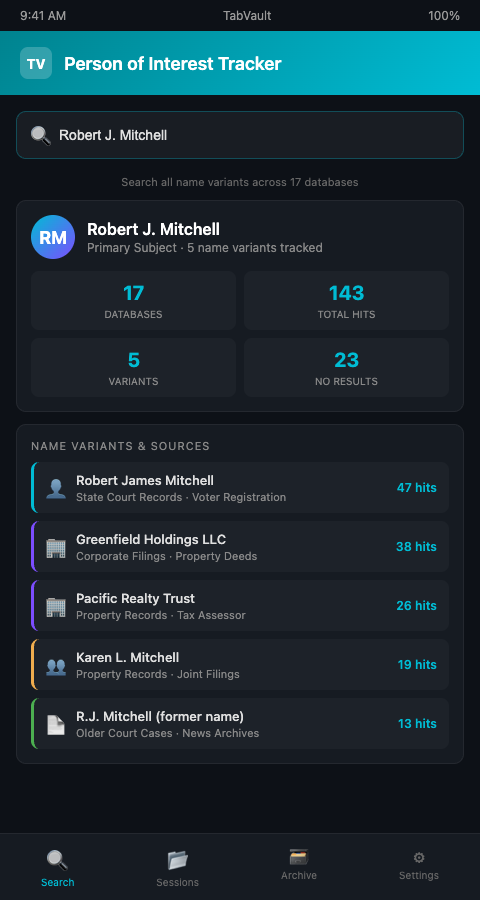
A producer working on a series about a real estate developer described searching seventeen different public databases for one individual. The developer's legal name appeared in state court records. An LLC name appeared in corporate filings. A different LLC appeared on property deeds. A spouse's name appeared on a second set of property records. A former surname appeared in older court cases. By the end of two weeks, the producer had opened well over a hundred tabs across those seventeen systems. When she closed her browser for the weekend, the map connecting those names across those systems existed only in her notebook -- a notebook she later realized had incomplete entries.
The National Freedom of Information Coalition documents that every state has its own open records laws, its own database systems, and its own search interfaces. A name search across public records in Florida works differently than one in Illinois. Some systems allow wildcard searches; others require exact matches. Some return both civil and criminal results; others separate them. The name variant that produces hits in one state's system may return nothing in another -- not because the person has no records there, but because the search algorithm handles names differently.
Building a Person-Centered Research Archive
The fundamental shift is from database-centered research to person-centered research. Instead of thinking about each public database as a separate silo, you build a searchable archive organized around the person you are investigating.
TabVault makes this possible by turning chaotic browser sessions into a searchable private database. Every time you search a public database for any variant of your person of interest's name, the search results page, the individual record pages, and even the empty result pages get indexed. Later, when you search your own archive for the person's legal name, you get hits from court records, corporate filings, property records, and news articles -- all from different research sessions, all in one set of results.
The practical workflow for tracking a person of interest across public databases starts with a name variant list. Before you begin searching, compile every known variant: legal name, maiden name, known aliases, LLC names, trust names, spouse names. Then search each variant through each relevant database, letting TabVault index every page you visit.
When you finish, searching your archive for any single variant pulls up every database where that variant appeared. Searching for the legal name might return court records and voter registration hits. Searching for the LLC name returns corporate filings and property records. The person-centered view emerges from the overlap -- the same indexed archive, queried with different names, reveals how one person operates across multiple systems.
Producers who already search court records across multiple state jurisdictions can extend the same approach to every public database type. The jurisdiction-by-jurisdiction method applies equally to corporate registries, property records, and professional licensing databases.
Techniques for Witness Tracking Across Public Databases
Witnesses and secondary figures in an investigation require the same systematic approach as primary subjects, often with less initial information to work from.
Start with what you know. A witness might first appear as a name in a court filing. Search that name across your indexed sessions to see if it appeared in any previous research. If the name surfaces in a news article from a different session, you have an immediate connection between two research threads.
Expand through association. Public databases often reveal relationships. A property record might show co-ownership. A corporate filing might list co-officers. A court case might name co-defendants. Each associated name becomes a new search variant. Index the pages where you discover these associations so you can trace back from any name to the document that first connected them.
Track which databases returned nothing. For witness tracking across public databases, negative results are as important as positive ones. If a witness has no property records in the county where they claim to live, that absence is itself a data point. Your indexed empty result pages prove you checked.
Monitor for new activity. Some public databases update regularly -- court dockets add new filings, corporate registries record new amendments. Schedule periodic re-searches for key names and index the new results alongside the old. The comparison between what your archive showed three months ago and what it shows today reveals changes in your person of interest's activity. Researchers who track centimorgan thresholds across multiple platforms use the same longitudinal comparison approach.
Advanced Tactics for Person Cross-Referencing Investigation
Network mapping from indexed sessions. Search your archive for each known associate of your primary subject. The pages where associate names appear alongside your subject's name -- co-defendants in court records, co-officers in corporate filings, co-owners on property deeds -- map the network around your subject. This network map is built entirely from your own research history, not from a third-party tool.
Address-based cross-referencing. When a specific address appears in your indexed sessions, search for that address across all your research. The same address might appear in corporate filings, property records, and court documents under different names -- revealing connections between entities that share a physical location but not an obvious name connection.
Temporal patterns. Search your archive for a subject's name and sort results by the dates visible on the indexed pages. The pattern of when and where a person appears in public records tells a story of its own -- incorporation in one state followed by a lawsuit in another followed by a property sale in a third may reveal a sequence of events that drives your narrative. The Bureau of Justice Statistics tracks case processing timelines across state courts, and comparing your subject's court activity against those benchmarks can reveal whether their cases moved unusually fast or slow -- itself a potential investigative finding.
Cross-reference with social media findings. Producers who combine social media research with court record analysis can search their indexed social media sessions alongside their public records sessions. A public database name monitoring search that turns up a new corporate filing can be cross-referenced against social media posts from the same period to build a fuller picture.
Verify name variants against official records. Before committing to a name variant list, check authoritative sources for the correct legal name. The SEC's EDGAR database provides full-text search access to over two decades of electronic filings, and a subject who has served as an officer or director of any publicly traded company will appear under their legal name in those filings. State-level corporate registries similarly require legal names for officers and registered agents. Starting your public database name monitoring with the legally verified name and expanding outward to aliases, maiden names, and LLC names ensures that your person-centered archive is anchored to an authoritative identifier.
If your investigation requires tracking a person of interest across multiple public databases and you are losing the thread that connects name variants to records to systems, your research has outgrown your browser's memory. TabVault keeps every search, every result, and every empty page in a single searchable archive. Join the waitlist to build person-centered research archives that no notebook can match.