Combining Social Media Deep Dives With Court Record Analysis
Two Source Types, Two Different Truths
Police1 documents how law enforcement uses open-source intelligence from social media to uncover suspect movements, relationships, and behaviors through techniques like geotag analysis, relationship mapping, and cross-platform username tracking. Investigative podcast producers use many of the same techniques, but with a different output goal: narrative rather than prosecution.
The investigative value of combining social media with public records lies in the friction between what people present publicly and what official records document. A real estate developer posts photos of new construction projects on Instagram while court records show unpaid contractor liens. A nonprofit director shares testimonials about program impact on Twitter while tax filings reveal declining revenue and board resignations. A public official's Facebook posts reference community events while FOIA documents show they were not present.
These contradictions are not visible when social media research and court record research live in separate browser sessions, separate notebooks, and separate mental contexts. A producer might spend Tuesday doing a thorough investigation of a subject's social media and Thursday searching court dockets for the same person. By Friday, the specific Instagram post from Tuesday that contradicts Thursday's court filing exists only in memory -- if the connection was noticed at all.
Bellingcat has pioneered methods for cross-referencing digital evidence across platforms, and their Auto Archiver tool has preserved over 150,000 web pages and social media posts specifically to prevent the loss of digital evidence. The underlying principle applies to podcast investigation: if the evidence is not preserved and searchable, the cross-reference never happens.
Unifying Social Media and Court Records in One Searchable Archive
The operational shift is straightforward: index both source types in the same system so a single search query returns results from social media pages and court record pages simultaneously.
When you conduct an extensive search across social media -- scrolling through a subject's Facebook timeline, reviewing their Instagram posts, checking their LinkedIn history, searching their Twitter mentions -- TabVault indexes every page you visit. The post content, the dates, the images described in captions, the comments, the usernames. When you later conduct a court record search for the same subject, those docket entries, filing texts, and judgment details join the same archive.
Now a single name search pulls from both worlds. The Instagram post from March 2023 showing a subject at a luxury resort appears alongside the court filing from April 2023 where that same subject claimed financial hardship. The connection that required human memory to bridge now surfaces through a keyword search. TabVault turns chaotic browser sessions into a searchable private database where social media evidence and public records coexist.
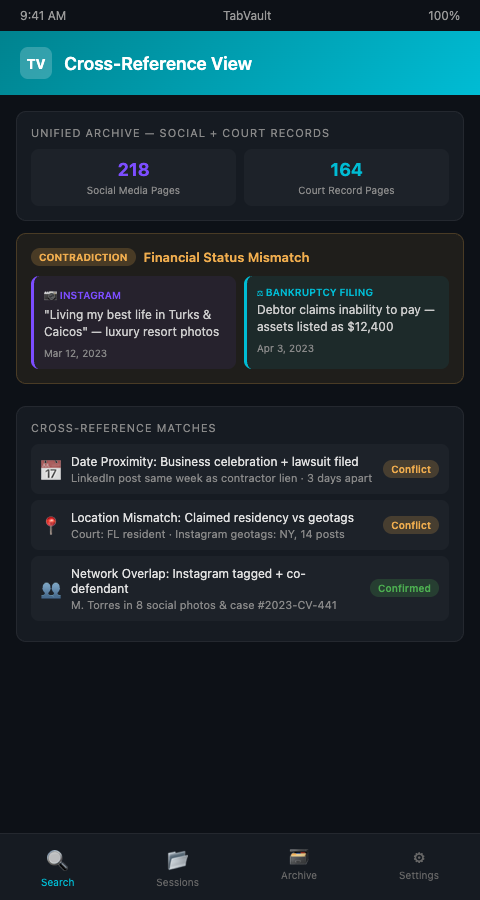
This court record social media cross-reference capability is particularly valuable for producers already tracking person-of-interest names across public databases. The same name variant list you use for public records searches works for social media -- legal name on court filings, username on Instagram, display name on LinkedIn, handle on Twitter. Indexed sessions from all platforms feed the same archive.
Practical Cross-Referencing Techniques
Date matching. Social media posts carry timestamps. Court filings carry dates. Search your indexed archive for a subject's name, then compare dates across source types. Posts made within days of a court filing are almost always relevant. A social media post celebrating a business milestone the same week a lawsuit was filed against that business is narrative gold.
Location cross-referencing. Social media posts with geotags or location mentions can be compared against court filings that reference addresses. If a subject claims residency in one state for court purposes but posts geotagged content from another state, your indexed sessions from both sources make that contradiction findable.
Network mapping from both sources. Court records reveal formal relationships -- co-defendants, co-plaintiffs, corporate co-officers. Social media reveals informal relationships -- friends, followers, tagged associates. Search your archive for names that appear in both source types. A person tagged in a subject's Instagram photos who also appears as a co-defendant in a court filing connects the social and legal worlds in a way neither source alone reveals.
Statement comparison. Public statements on social media can be compared against sworn statements in court filings. Search your indexed sessions for specific claims a subject made on social media, then search for the same topic in court records. Researchers who correlate MSDS safety data with decontamination protocols use the same technique of cross-referencing documented standards against case-specific records.
Advanced Investigative Social Media Analysis Tactics
Platform-specific indexing awareness. Social media platforms display content differently. Facebook shows extensive timeline history if privacy settings allow. Instagram organizes by visual grid with captions. Twitter threads can run dozens of posts. LinkedIn shows professional history in a structured format. When indexing each platform during a social media investigation, be aware that the indexed content reflects the platform's display format. Search your archive for content terms rather than platform-specific formatting.
Archive before it disappears. Social media posts can be deleted, accounts can be deactivated, and privacy settings can change. The FOIA.gov reports portal preserves government data permanently, but social media has no such guarantee. Index social media pages during your research sessions aggressively. A post indexed today may not exist tomorrow. The indexed version in your archive becomes the only record.
Cross-reference social media connections with court docket witnesses. Search your indexed social media sessions for names that appear on court docket witness lists. A witness who is also a social media connection of the defendant may have a bias that your audience needs to know about. The connection is only visible when both source types live in the same searchable archive.
Track social media activity around court dates. Search your archive for social media posts dated around key court dates -- filing dates, hearing dates, judgment dates. Subjects and witnesses sometimes post about legal proceedings, reveal emotional states, or make statements that become relevant to the investigation. Producers who have already indexed court records from multiple jurisdictions can layer social media timeline data onto their existing court chronology.
Preserve social media evidence with timestamps. Social media platforms display content in their own formats and frequently change their interfaces, but the underlying data -- post text, dates, tagged locations, visible comments -- gets captured in your TabVault index at the moment you browse the page. This matters because social media posts can be deleted within hours of a court filing becoming public. A subject who posts celebratory photos on Saturday may delete them by Monday when a lawsuit is filed. If you indexed the profile page over the weekend, the deleted post's content remains searchable in your archive. The NIST guidelines on digital evidence preservation recommend establishing standardized systems for managing evidentiary items throughout their lifecycle, and treating indexed social media pages as preserved evidence follows that same principle.
Build contradiction timelines for narrative impact. The most compelling segments in investigative podcasts often present a subject's public statements alongside contradicting official records in chronological sequence. Search your indexed archive for a subject's name, separate the results by source type -- social media on one side, court records on the other -- and align them by date. The resulting timeline reveals every moment where the public persona diverged from the legal record. These contradiction timelines become the structural backbone of episodes that hold audience attention because the evidence speaks for itself.
If your investigative podcast relies on both social media research and court record analysis but you are conducting them in separate silos, you are missing the contradictions and confirmations that make investigations compelling. TabVault puts both source types in the same searchable archive so the cross-references surface automatically. Join the waitlist to stop relying on memory to connect what people say online with what official records show.
An Instagram post showing a subject at a luxury resort in March 2023 and a bankruptcy filing from April 2023 claiming financial hardship live in two separate research silos -- until both enter the same indexed archive. TabVault bridges detailed analysis of social media and court record research by capturing every page from both source types into one searchable corpus. A producer investigating a nonprofit director found that three social media posts directly contradicted sworn statements in tax filings, and the contradictions surfaced from a single name search across six months of indexed sessions. Join the waitlist and start catching the discrepancies that separate silos hide.